- Is it advisable, or even possible, to go through life without firm opinions? (LH p.15)
- Should you always mistrust your senses, if they've occasionally misled you? (LH p. 16)
- Do you think it plausible that Pyrrho's skepticism might have been influenced by the philosophy he may have encountered as a young man in India? (LH p.18)
- Is it a promising strategy for happiness to "free yourself for desires and not care how things turn out"? (LH p.19)
- Pyrrhonic skepticism is clearly extreme, but what do you think of moderate skepticism? (LH p.20)
- What do you think of Anne Hutchinson's theology (LH 32) and her confident certainty? (LH 34)
- Why didn't America have figures to rival Shakespeare, Galileo, Bacon et al in the 1600s? (LH 36)
- Why didn't the Age of Reason take, in America? (LH 39)
- What do you think of Cotton Mather's "evidence"? (LH 40)
- Why did so many Americans believe in witches? (LH 41)
- What do you think of Andersen's assessment of the enduring influence of American protestantism? (LH 42)
- "The stress on logic has been the most distinctive feature of Western philosophy... Aristotle first set out the basic principles" (HWT 54) -- Do you think it's important to be "logical," or rational, in constructing your worldview? Do you try to avoid holding logically inconsistent or incompatible beliefs?
- Is our culture too "dualistic," allowing only for "true or false, winner and loser"? 59
- "We are intuitive, emotional and heavily influenced by others and our environment" (68)... so, can we be rational?
- "The human mind works without supernatural assistance" (70) -- Does secular reason, built on logic and curiosity, suffice for human conduct and aspiration?
- Would a "theory of everything" reveal, as Stephen Hawking said, "the mind of God"? (71) Or might it reveal the irrelevance of a god to explicate the workings of the physical universe as we know it?
- "Science... is not a teacher of morals," William Jennings Bryan complained at the Scopes "Monkey Trial" (78)... But should we all take scientific conclusions into account, in articulating our moral views?
Melvyn Bragg and his guests discuss Scepticism, the idea that it may be impossible to know anything with complete certainty. Scepticism was first outlined by ancient Greek philosophers: Socrates is reported to have said that the only thing he knew for certain was that he knew nothing. Later, Scepticism was taught at the Academy founded by Plato, and learnt by students who included the Roman statesman Cicero. The central ideas of Scepticism were taken up by later philosophers and came to the fore during the Renaissance, when thinkers including Rene Descartes and Michel de Montaigne took up its challenge. A central plank of the philosophical system of David Hume, Scepticism had a powerful influence on the religious and scientific debates of the Enlightenment. With: Peter Millican Professor of Philosophy at Hertford College, Oxford Melissa Lane Professor of Politics at Princeton University Jill Kraye Professor of the History of Renaissance Philosophy and Librarian at the Warburg Institute, University of London.
Captain Metaphysics and the Extreme Skeptic
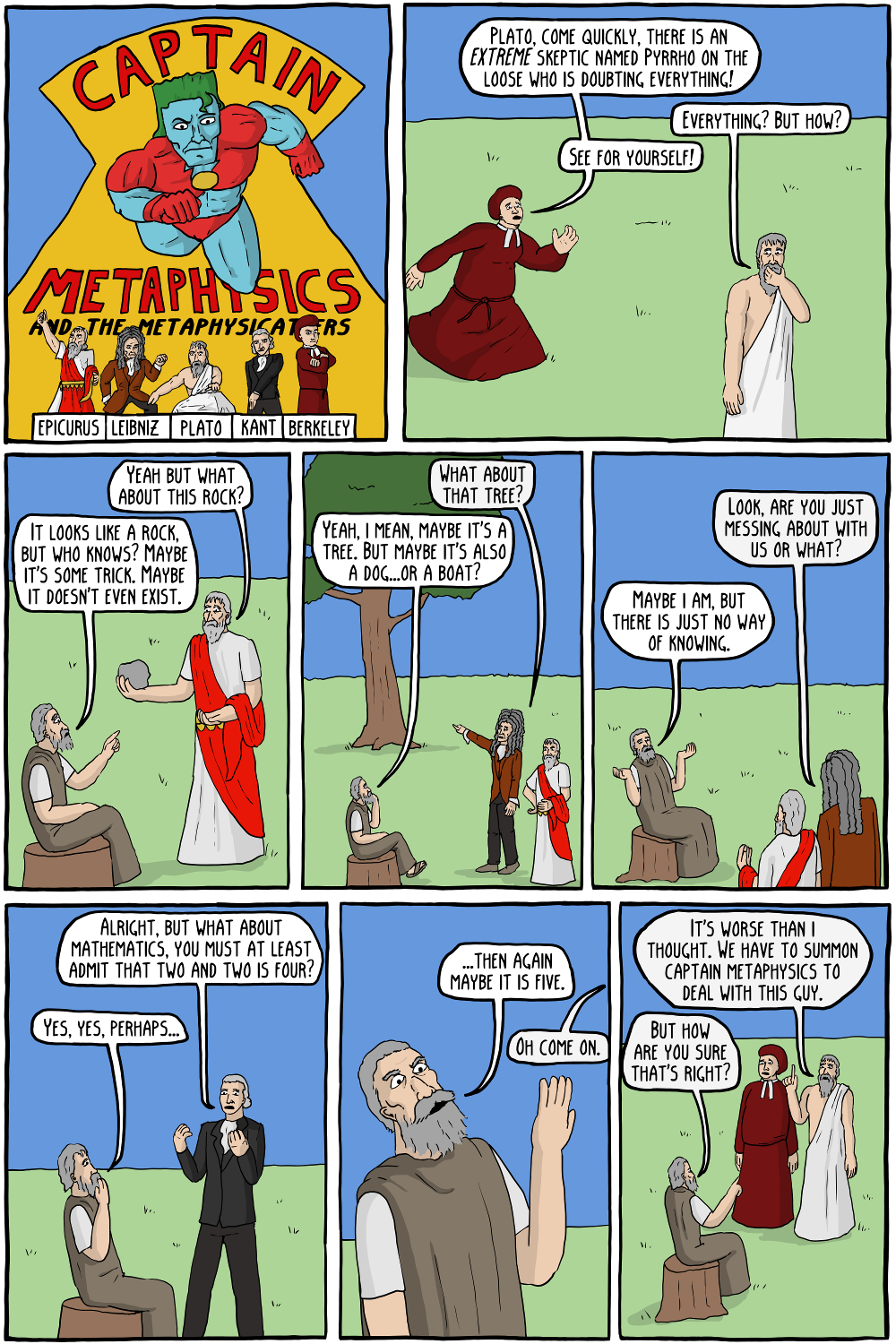
Permanent Link to this Comic: http://existentialcomics.com/comic/143
A Brief History of Philosophical Skepticism

“Those who can make you believe absurdities, can make you commit atrocities.” Voltaire
“I mean, you could claim that anything's real if the only basis for believing in it is that nobody's proved it doesn't exist!”
―
"The truly civilized man is always skeptical and tolerant, in this field as in all others. His culture is based on "I am not too sure.”
―
Summer '18-MALA 6040, Evolution in America - we had a field trip to Dayton TN, for the annual Scopes Trial re-enactment (as discussed in FL 18)...
Ancient Skepticism, from Philosophy Without Any Gaps...
Pyrrho & Ancient Skepticism discussed in Bertrand Russell's History of Western Philosophy...

"What use is knowledge if, for its sake, we lose the calm and repose which we should enjoy without it and if it makes our condition worse than that of Pyrrho's pig?" Montaigne on Pyrrho's Pig, in Consolations of Philosophy... 120
Ancient Skepticism (SEP)
Bertrand Russell: Popular Cynicism did not teach abstinence from the good things of this world, but only a certain indifference to them. In the case of a borrower, this might take the form of minimizing the obligation to the lender. One can see how the word "cynic" acquired its every-day meaning. What was best in the Cynic doctrine passed over into Stoicism, which was an altogether more complete and rounded philosophy. Scepticism, as a doctrine of the schools, was first proclaimed by Pyrrho, who was in Alexander's army, and campaigned with it as far as India. It seems that this gave him a sufficient taste of travel, and. that he spent the rest of his life in his native city, Elis, where he died in 275 B.C. There was not much that was new in his doctrine, beyond a certain systematizing and formalizing of older doubts. Scepticism with regard to the senses had troubled Greek philosophers from a very early stage; the only exceptions were those who, like Parmenides and Plato, denied the cognitive value of perception, and made their denial into an opportunity for an intellectual dogmatism. The Sophists, notably Protagoras and Gorgias, had been led by the ambiguities and. apparent contradictions of sense-perception to a subjectivism not unlike Hume's. Pyrrho seems (for he very wisely wrote no books) to have added moral and logical scepticism to scepticism as to the senses. He is said to have maintained that there could never be any rational ground for preferring one course of action to another. In practice, this meant that one conformed to the customs of whatever country one inhabited. A modern disciple would go to church on Sundays and. perform the correct genuflexions, but without any of the religious beliefs that are supposed to inspire these actions. Ancient Sceptics went through the whole pagan ritual, and were even sometimes priests; their Scepticism assured them that this behaviour could not be proved wrong, and their common sense (which survived their philosophy) assured them that it was convenient. Scepticism naturally made an appeal to many unphilosophic minds. People observed the diversity of schools and the acerbity of their disputes, and decided that all alike were pretending to knowledge which ____________________ * The Hellenistic Age ( Cambridge, 1923), p. 86. -233- was in fact unattainable. Scepticism was a lazy man's consolation, since it showed the ignorant to be as wise as the reputed men of learning. To men who, by temperament, required a gospel, it might seem unsatisfying, but like every doctrine of the Hellenistic period it recommended itself as an antidote to worry. Why trouble about the future? It is wholly uncertain. You may as well enjoy the present; "What's to come is still unsure." For these reasons, Scepticism enjoyed a considerable popular success. It should be observed that Scepticism as a philosophy is not merely doubt, but what may be called dogmatic doubt. The man of science says "I think it is so-and-so, but I am not sure." The man of intellectual curiosity says "I don't know how it is, but I hope to find out." The philosophical Sceptic says "nobody knows, and nobody ever can know." It is this element of dogmatism that makes the system vulnerable. Sceptics, of course, deny that they assert the impossibility of knowledge dogmatically, but their denials are not very convincing. Pyrrho's disciple Timon, however, advanced some intellectual arguments which, from the standpoint of Greek logic, were very hard to answer. The only logic admitted by the Greeks was deductive, and all deduction had to start, like Euclid, from general principles regarded as self-evident. Timon denied the possibility of finding such principles. Everything, therefore, will have to be proved by means of something else, and all argument will be either circular or an endless chain hanging from nothing. In either case nothing can be proved. This argument, as we can see, cut at the root of the Aristotelian philosophy which dominated the Middle Ages. Some forms of Scepticism which, in our own day, are advocated by men who are by no means wholly sceptical, had not occurred to the Sceptics of antiquity. They did not doubt phenomena, or question propositions which, in their opinion, only expressed what we know directly concerning phenomena. Most of Timon's work is lost, but two surviving fragments will illustrate this point. One says "The phenomenon is always valid." The other says: "That honey is sweet I refuse to assert; that it appears sweet, I fully grant." * A modern Sceptic would point out that the phenomenon merely occurs, and is not either valid or invalid; what is valid or invalid must be a state- ____________________ * Quoted by Edwyn Bevan, Stoics and Sceptics, p. 126. -234- ment, and no statement can be so closely linked to the phenomenon as to be incapable of falsehood. For the same reason, he would say that the statement "honey appears sweet" is only highly probable, not absolutely certain. In some respects, the doctrine of Timon was very similar... History of Western Philosophy
The contemporary proliferation of bullshit also has deeper sources, in various forms of skepticism which deny that we can have any reliable access to an objective reality and which therefore reject the possibility of knowing how things truly are. These anti-realist doctrines undermine confidence in the value of disinterested efforts to determine what is true and what is false, and even in the intelligibility of the notion of objective inquiry... Facts about ourselves are not peculiarly solid and resistant to skeptical dissolution. Our natures are, indeed, elusively insubstantial-notoriously less stable and less inherent than the natures of other things. And insofar as this is the case, sincerity itself is bullshit.
Read Skeptic magazine, which in a recent issue doubts the possibility of eternal youth and features the parodic perspective of Mr. Deity. Skeptic's editor Michael Shermer says “Smart people believe weird things because they are skilled at defending beliefs they arrived at for non-smart reasons.” And, “I’m a skeptic not because I do not want to believe, but because I want to know.”
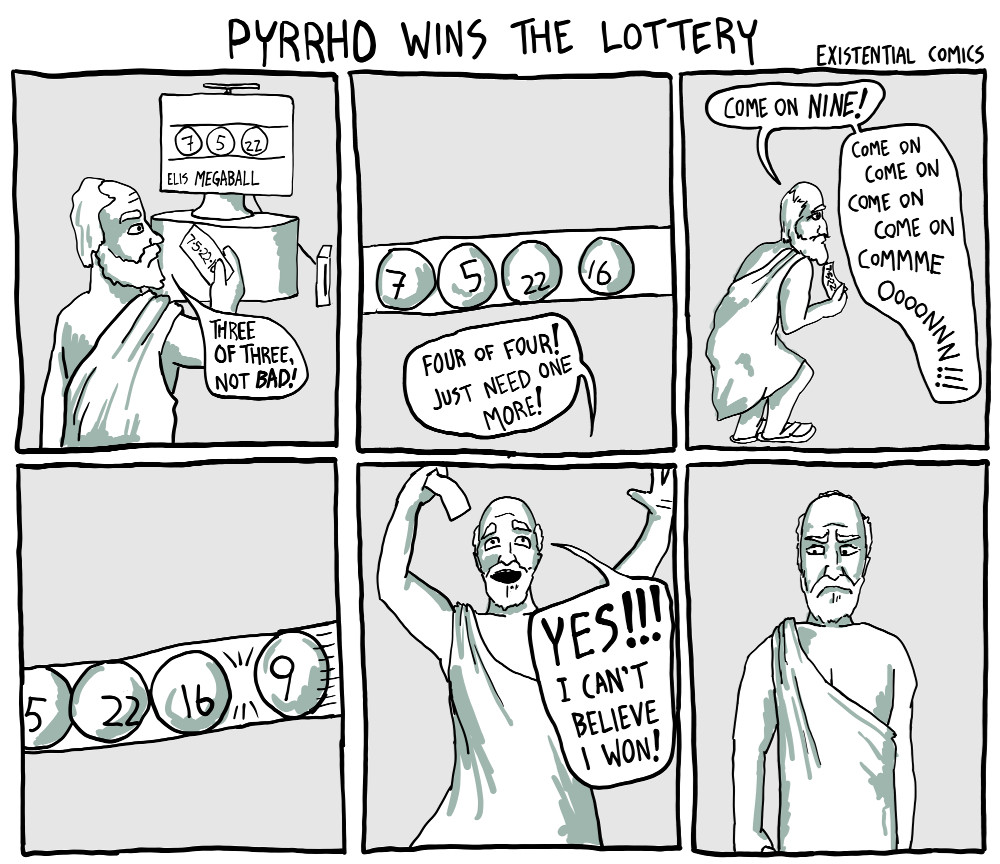
Pyrrho must not have been that crazy, to have lived to nearly ninety. "He did not act carelessly in the details of everyday life," said a defender, he just suspended judgment as to their ultimate import in the larger truths of things. Or maybe he just wanted to protect his batting average, so to speak. If you never swing, you'll never miss. But you'll still strike out if you take too many.
So let's not throw in the sponge on humanity just yet. What a strange expression, "throwing in the sponge"-it comes from the Roman Skeptic Sextus Empiricus, who told a story about a painter who stopped trying so hard to paint the perfect representation of a horse's mouth and discovered that sometimes it's best to just let fly. Fling your sponge, let it land where it may. Okay, if you're just painting. If you're living a life, though, maybe just a bit less skepticism is prudent.
Is it possible to go through life questioning and doubting everything, committing always to nothing, and holding no firm opinions? Is it desirable or useful to try doing so? And do you know anyone who doesn't look both ways before crossing the street?
*Pyrrho reminds me of the Ruler of the Universe

Excerpts from The Hitchhiker’s Guide to the Galaxy Radio Scripts
Skeptic Magazine... Skeptic magazine examines extraordinary claims, promotes science and reason, and serves as an educational tool for those seeking a sound scientific viewpoint.
eSkeptic-
“I have made a ceaseless effort not to ridicule, not to bewail, not to scorn human actions, but to understand them.” Spinoza, quoted by Michael Shermer
2010-01-01 | Skepticism, yes, egomania and arrogance, no. As Descartes, hero of scientists and skeptics everywhere, said, skepticism, like charity, begins at home more »
LISTEN:: Scepticism (PB)... Skeptics (rec.10/1/18)


