
"We can judge the heart of a man by his treatment of animals."
- Immanuel Kant
Saturday, October 10, 2020


Friday, October 9, 2020
Sympathy from Aristotle
Aristotle (@AristotlesStgra) tweeted at 10:30 AM on Fri, Oct 09, 2020:
Sympathizing with all those teaching my ethics alongside deontology and consequentialism as if the latter two were even remotely plausible or practicable.
(https://twitter.com/AristotlesStgra/status/1314589064440492035?s=02)
Sympathizing with all those teaching my ethics alongside deontology and consequentialism as if the latter two were even remotely plausible or practicable.
(https://twitter.com/AristotlesStgra/status/1314589064440492035?s=02)
A ‘Great Gatsby’ Quote Takes On New Resonance
So maybe this is what you were referring to in class the other day, Betsy?--
People critical of the president’s and other Republicans’ behavior have been sharing a line from the Fitzgerald novel about the wealthy characters whose “carelessness” harms everyone around them. https://www.nytimes.com/2020/10/07/books/great-gatsby-quote-trump.html?smid=em-share
Thursday, October 8, 2020
John Rawls
'He was a throwback: a philosopher who not only did philosophy, but who actually had a philosophy' @Jesse_Norman on John Rawls @prospect_uk https://t.co/GTURFScMLi
(https://twitter.com/philosophybites/status/1314263245956493312?s=02)
(https://twitter.com/philosophybites/status/1314263245956493312?s=02)
Machiavellian "manliness"?
Toxic masculinity is 'about weakness, and the fearful inability to admit to human vulnerability — and it takes an appalling pride in endangering those around you.' https://t.co/iQGXghQ2eg @kate_manne
(https://twitter.com/drjoncrowe/status/1313912042936578048?s=02)
(https://twitter.com/drjoncrowe/status/1313912042936578048?s=02)
Peer pressure
The pathetic peer group pressure among Trumpists to go maskless is exactly like the pathetic peer group pressure among kids when we were 12 to smoke cigarettes: upsets the responsible grownups, you think you look cool, kills you via lung disease.
(https://twitter.com/KBAndersen/status/1314214631083315200?s=02)
(https://twitter.com/KBAndersen/status/1314214631083315200?s=02)
Lost
New Philosopher magazine (@TheNewPhil) tweeted at 9:45 PM on Wed, Oct 07, 2020:
"Woe to him who saw no more sense in his life, no aim, no purpose, and therefore no point in carrying on. He was soon lost." Viktor Frankl https://t.co/1tpWZ8Wjyh
(https://twitter.com/TheNewPhil/status/1314034264279674881?s=02)
"Woe to him who saw no more sense in his life, no aim, no purpose, and therefore no point in carrying on. He was soon lost." Viktor Frankl https://t.co/1tpWZ8Wjyh
(https://twitter.com/TheNewPhil/status/1314034264279674881?s=02)
The Fly
LISTEN. Frank Bruni's account reassures me we didn't miss much when my wife flipped off last night's veep debate early on. We did miss the Fly that took up extended unacknowledged residence on the Vice President's pate.
How could he be expected to register or exile an itty-bitty pest when he routinely puts up with a great big one? That fly was some crazy combo of metaphor, visitation and karmic joke...
Pence kept talking over the moderator, Susan Page of USA Today, ignoring her alerts that his two minutes were up so that he could commandeer more time than Harris got. Page was left to sputter endlessly, “Thank you, Vice President Pence. Thank you, Vice President Pence. Thank you, Vice President Pence.” But more than a thanking he needed a spanking...
He would not fess up to humankind’s role in climate change but said, preposterously, “President Drumpf has made it clear that we’re going to continue to listen to the science.” Continue? Science? Is this before or after the bleach injections?
“This is a president who respects and cherishes all of the American people,” Pence said, making me wonder if I’d spaced out and missed an antecedent and he was talking about someone other than Drumpf.
Pence also said: “Senator Harris, you are entitled to your own opinion but you are not entitled to your own facts.” This confused me, because Drumpf gets to have his own facts and Pence just beams at him.

Today in CoPhi we lead off with Mill on Bentham, on happiness, pleasure, quality and quantity, and (crucially) liberty.
Would I rather be a sad human or a happy pig, Socrates dissatisfied or a fool satisfied? We get that question in both the Little History and How the World Thinks today... (continues)
Wednesday, October 7, 2020
Don't panic
Seems relevant. Maybe this is what the Daoist philosophy means by getting closer to Heaven and getting "beyond care" etc.? 235
“One of the most useful things about our minds is that they can in some moods allow us to step outside of ourselves – and consider our death from a wholly dispassionate perspective, as if it were someone else who would have to go through the event and as if we could understand it in the same way that a stranger four centuries from now might, in other words, as if it might not in the end be such a big deal at all, just an inevitable return to an atomic mulch from which our life was only ever a brief and unlikely spasm… On a cosmic scale nothing we will ever do, or fail to do, has the slightest significance. Everything connected directly to us is of no importance at all, when imagined on an appropriate scale. We are negligible instances, inhabiting a random, unremarkable backwater of the universe, basking for an instant or two in the light of a dying star. This perspective may feel cruel but it is also centrally redemptive, for it frees us from the squeals of our own frightened egos. It has only ever been an illusion, and a painful one at that, to imagine that our lives have anything significant to them whatever. We would feel so much lighter and freer if we could only acknowledge that we are and have always been as nothing...” (SoL/BoL, continues)
Tuesday, October 6, 2020
Midterm blogpost essay
Transcribe an imagined conversation (or the beginning of one) between Nigel Warburton, Kurt Andersen, Julian Baggini, and yourself, using actual quotes from their books as well as fictional statements based on your best extrapolation of what you imagine they would say in response to one another and to you (indicate actual quotes with parenthetical page numbers).
Begin the conversation by posing this question: "Do you think philosophy can help people learn to respect truth, facts, reality, and one another, and to reject falsehood, superstition, selfishness, polarization, partisanship, and mutual hostility based on differences of race, religion, ethnicity, nationality, belief, etc.? If so, how? If not, why not?
Also ask: How would you answer William James's "really vital question for us all: What is this world going to be? What is life eventually to make of itself?"
If you consult sources additional to A Little History of Philosophy, Fantasyland, and How the World Thinks, embed hyperlinks to them in your post. Have fun with the blogging platform and include non-textual content and relevant videos etc.
Your goal should be to construct a plausible conversation in which each speaker gives the best possible defense of their own views, and in which they (and you) listen and respond respectfully to one another.
When posting a video, introduce it with at least a descriptive sentence or two telling us why it's relevant.
Word-count minimum: 500 words (not including the questions), plus links, graphics, video, etc.
Alternatively, you may propose a different topic (pending my approval) so long as your essay includes multiple citations from Warburton, Andersen, and Baggini, as well as your critical evaluation of their views as you understand them and a reasoned defense of your own.
Due Oct 14 for section #12, Oct 15 for #s 10 & 11.
If you are not yet an author on our site, send me an email (phil.oliver@mtsu.edu) requesting an author invitation. I'll send you one as soon as new author slots become available.
Sections 10 & 11: class dismissed
Well it happened again!
Sorry for the abrupt end to our Zoom sessions today, sections 10 & 11. I don't know why we had connectivity issues, but let's call it a day.
jpo
Schopenhauer Minus Context (@SchopMinContext)
knocking, hammering, and tumbling things about has made the whole of my life a daily torment
(https://twitter.com/SchopMinContext/status/1281335947788005376?s=02)
(https://twitter.com/SchopMinContext/status/1281335947788005376?s=02)
Hegel & history
Special Edition: Philosophy Now Issue 140 on Hegel & History. #Hegel250 https://t.co/MWGodviyct https://t.co/wa9gWSyD2z
(https://twitter.com/HegelianNews/status/1312679738587185153?s=02)
(https://twitter.com/HegelianNews/status/1312679738587185153?s=02)
Kant tweets
Live your life as though your every act were to become a universal law.
(https://twitter.com/KantQuotes/status/1310107776669102080?s=02)
(https://twitter.com/KantQuotes/status/1310107776669102080?s=02)
Monday, October 5, 2020
Rise
LISTEN. That's my 5 a.m. mantra, but it's also the message of a powerful poem by Marshall Islands poet and climate activist Kathy Jetnil-Kijiner.
She, fellow poet Aka Niviana, some ice scientists, and Bill McKibben traveled to Greenland to research and plead for its melting ice shelf and our warming planet. McKibben shares the message at the end of our first day's reading in Falter: Has the Human Game Begun to Play Itself Out?
(continues)
She, fellow poet Aka Niviana, some ice scientists, and Bill McKibben traveled to Greenland to research and plead for its melting ice shelf and our warming planet. McKibben shares the message at the end of our first day's reading in Falter: Has the Human Game Begun to Play Itself Out?
(continues)
Bob Gibson
Bob Gibson was my favorite player, and most important early teacher: I read his autobiography "From Ghetto to Glory" at about age 10, then "Autobiography of Malcolm X." Sports isn't pure fantasy. https://t.co/OplfpkMSkw
(https://twitter.com/OSOPHER/status/1312792354865270785?s=02)
(https://twitter.com/OSOPHER/status/1312792354865270785?s=02)
Solidarity vs. Conformity
Let a thousand wild flowers bloom
(https://twitter.com/philosophybites/status/1313060718682550273?s=02)
(https://twitter.com/philosophybites/status/1313060718682550273?s=02)
A propos our reading in HWT on Harmony
"Space Force! VOTE!"
Wondering if his doctors have seen this tweet...
(https://twitter.com/philosophybites/status/1313094078112976896?s=02)
(https://twitter.com/philosophybites/status/1313094078112976896?s=02)
I'd vote for Commander Emma Green.
Sunday, October 4, 2020
Science + karma
Jim Carrey Plays Joe Biden in ‘S.N.L.’ Season Premiere Chris Rock hosted the first live episode since “S.N.L.” was driven from its studio by the coronavirus, and the show didn’t hold back on jokes about President Trump’s diagnosis. https://www.nytimes.com/2020/10/04/arts/television/snl-jim-carrey-biden-premiere-chris-rock.html?smid=em-share
Saturday, October 3, 2020
Questions, Oct 5-8
W 7/Th 8
- Was Mill right about Bentham's account of happiness? Would you rather be a sad human or a happy pig? 139
- Was Mill right about the best way to organize society? 141
- Was Mill right about the importance of open discussion and free speech? 143
- What do you think of Huxley's reply to Wilberforce? 144
- Is Dennett right about Darwin's idea of natural selection? 146
- Darwin said the subject of God is too profound for the human intellect. 151 Agree?
- More on the Scopes Trial: re-visit the Fantasyland discussion from last week. Should the judge have allowed "my first landlord" and the other scientific experts to testify?
- If you heard a voice purporting to be God, telling you to murder your child, what would you do? 152
- Do you agree with Kierkegaard that faith is an irrational "leap"? 154
- Kierkegaard was a Christian who hated the Danish church and reviled "christendom"... Was he a good Christian? 155
- Is the "subjective point of view all-important"? 157
- Was Marx right about history as "class struggle"? 159
- What do you think of "Marx's vision"? 161
FL
- Do you watch TV (and YouTube, Netflix, etc.) and play video games as much as (or more than) the average American? 151 Do you think you watch too much? Do you read for pleasure?
- Were Walt Disney and Steve Jobs great Americans? Have their fantasy worlds made life better? 153-4
- What do you think of Hugh Hefner's Playboy philosophy? 157 [See Carlin Romano, America the Philosophical 272f.]
- What do you think of Billy Graham? 166-7 Do we need a national ad hoc pastor-in-chief?
- Should "under God" be in the pledge of allegiance? Should small children be made to recite a pledge? Should any of us pledge blind allegiance to anything? 167
- Do people who don't like churches and religions need something like Esalen? 178
- Are you New Age? Do you believe you "create your own reality"? 180
- Did psychotropics make America more of a fantasyland, in a bad or a good way (or both)? 186
- Do you talk to your plants? 187
HWT
- Is it more important to form good habits or to follow strong principles, in order to build your character and become a good person? Or both?
- If you pursue excellence (arete) in life will you be more likely to be happy? More or less likely to value happiness? What do these terms mean to you?
- Would you rather be Socrates dissatisfied or a fool satisfied? 249
- COMMENT: "Nurture makes actual what nature makes possible." 252
- Are "manners" important? 255
- Is Aristotle right about the "mark of virtue"? 257 About "the mean"? 259 Does the Confucian Doctrine of the Mean apply to philosophy itself, and some philosophers' tendency to over-emphasize "one aspect"? 261
- Should virtue expect a reward? 263
- What do you think is the best version of The Golden Rule? 264-5
- Do truly good people need a Golden Rule? 266
More DQs
- Name two or three of your favorite pleasures. Are any of them higher or better than the others? In what way? Are any of yours higher or better than those of a friend whose list includes none of yours? Why or why not?
- Is state paternalism ever warranted?
- Why don't we ever talk about state maternalism?
- What are the appropriate legal limits on speech and expression in a free society, if any?
- How would you reply to Wilberforce's debate question?
- What do you think was the best idea ever?
- Do you want a map of your own genome? Why or why not?
- Do you agree with Darwin that the subject of God is "too profound for human intellect"? Does it mean we should all be agnostic?
- What would you have done, in Abraham's position? Would you have doubted the "message" or challenged the messenger?
- Does it damage the parent-child relationship if Mom or Dad make it clear to the child that they'll always defer to the perceived instructions of a "heavenly father," even including murderous instructions? Does anything "trump the duty to be a good [parent]"?
- Would you ever do something you considered morally wrong, in the name of faith?
- Does taking a "leap of faith" make you irrational?
- How do you balance your subjective point of view with objectivity, and with the subjectivity of others? What role should inter-subjectivity play, in forming that balance?
- If you ever own a business will you pay your workers as little as possible and extract as much "surplus value" from them as you can?
- Is anything in history "inevitable"?
- Does religion make people more reconciled to oppression and exploitation, and less likely to revolt?
==
- Do you think the human mind and its categories are like rose-colored spectacles, permanently preventing us from knowing the "noumenal" world but enabling us to see the "phenomena" more clearly? 111-12
- Was Kant's "great insight" really a breakthrough? 114
- Is sympathy irrelevant to morality? 115
- Have you ever helped someone because you felt sorry for them? Was that a moral action on your part?
- Should you ever lie? Is Kant's reasoning on this question reasonable, or rational? Is it emotionally intelligent? 117-18
- What do you think of Jeremy Bentham's auto-icon?
- Do you agree with the Greatest Happiness Principle? 122 Why or why not?
- Is a Felicific Calculus possible or desirable? 123
- Would you plug in to the Experience Machine? 125 Do you think virtual reality technology will one day make that a real option?
- If wisdom and understanding come only at a "later stage" of history, is philosophy worth doing now? 126
- Should Hegel have rejected Kant's view about noumena and phenomena? 128
- Is Geist real? Is there a "single mind" shared by all humanity? 129
- Was Hegel being arrogant to claim that Spirit first came to "know itself" in his own books?
- Was Schopenhauer right about Will? 133
- Is asceticism "the ideal way to cope with existence"? 136
FL
- Has the film industry narrowed the perceived distance between fantasy and reality? Is it like a drug? 136-7
- Is advertising manipulative and misleading? Has it engendered false desires and a confusion about what will make us happy? 138
- Do you think you would have been fooled by War of the Worlds?
- Are Americans too preoccupied with celebrity, and celebrities? 140
- Is the American suburb a mistake, a "happy fictionalization"? 143 Is suburban nostalgia racist? 144
- What do you think of LA and South Florida as fantasylands? 147-8 Do you want to live there?
HWT
- Did you know there's a Confucius Institute at MTSU? 222 Should there be a Western Philosophy Institute in China?
- Are there other "bonds" of harmony besides those noted by Mencius? 223
- What's the difference between harmony and conformity, compliance, sameness, or uniformity?
- Would we have a more eastern attitude about harmony and cosmic order in the west if Heraclitus (and Hegel) had "won out" over Plato? 225
- Do the Chinese actually have greater "family values" than westerners? 227
- Would you ever denounce your parents for political reasons?
- Do you feel a moral obligation to visit (and perhaps eventually care for) elderly relatives? 228
- Is Kant's view about Enlightenment and "maturity" an implicit critique of hierarchical and monarchical societies? 230
- Do you know any parents who try "to maintain their authority over their children after those children have grown up"? 231
- Is it disrespectful not to criticize others' views when you disagree with them? 234
- What do you think of people who are "beyond care" and have "given up"? 235
- Is/are "yin/yang" two things, or one? 237 Or are they things at all? 238
- Any comment on "picking yin"? 239 (Keep it clean please.)
- Are Daoists libertarians? 242
- Is the Confucian principle of quan anti-Kantian? 243 How about the African concept of ubuntu? 246
- Was Han China's version of Machiavelli? 244-5
Schopenhauer and his sidekick "Atman"
"His closest relationships are now with a succession of poodles, who he feels have a gentleness and humility humans lack... He acquires a new white poodle and names her Atman, after the world-soul of the Brahmins..." Consolations of Philosophy
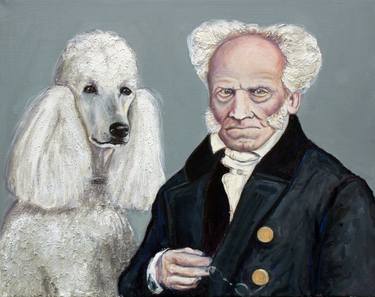
Reminds me of...

But he's still fun to read. He's often clever and amusing, and he's frequently right.

Schopenhauer on Hegel:
- “The assumption that animals are without rights and the illusion that our treatment of them has no moral significance is a positively outrageous example of Western crudity and barbarity. Universal compassion is the only guarantee of morality.”
- “Compassion for animals is intimately associated with goodness of character, and it may be confidently asserted that he who is cruel to animals cannot be a good man.”
- “Every miserable fool who has nothing at all of which he can be proud, adopts as a last resource pride in the nation to which he belongs; he is ready and happy to defend all its faults and follies tooth and nail, thus reimbursing himself for his own inferiority.”
- "Man can do what he wills but he cannot will what he wills.”
- “We forfeit three-fourths of ourselves in order to be like other people.”
- “A sense of humor is the only divine quality of man.”
- “What disturbs and depresses young people is the hunt for happiness on the firm assumption that it must be met with in life. From this arises constantly deluded hope and so also dissatisfaction. Deceptive images of a vague happiness hover before us in our dreams, and we search in vain for their original. Much would have been gained if, through timely advice and instruction, young people could have had eradicated from their minds the erroneous notion that the world has a great deal to offer them.”
- “If children were brought into the world by an act of pure reason alone, would the human race continue to exist? Would not a man rather have so much sympathy with the coming generation as to spare it the burden of existence, or at any rate not take it upon himself to impose that burden upon it in cold blood?”
The great rational optimist and cynical pessimist, ultimately (like us all) in the same boat. "Shipwreck is a permanent possibility," said William James...
Schopenhauer on Hegel:
“But the height of audacity in serving up pure nonsense, in stringing together senseless and extravagant mazes of words, such as had previously been known only in madhouses, was finally reached in Hegel, and became the instrument of the most barefaced general mystification that has ever taken place, with a result which will appear fabulous to posterity, and will remain as a monument to German stupidity.”
Arthur Schopenhauer, Die Welt als Wille und Vorstellung, trans. Haldane-Kemp (The World as Will and Idea, vol. 2), London: Kegan Paul, p. 22.
==
William James on Hegel:
Some "Hegelisms" James came up with, when reading Hegel while ingesting nitrous oxide:
What's mistake but a kind of take?
What's nausea but a kind of -ausea?
Sober, drunk, -unk, astonishment.
Everything can become the subject of criticism—how
criticise without something to criticise?
Agreement—disagreement!!
Emotion—motion!!!
Die away from, from, die away (without the from).
Reconciliation of opposites; sober, drunk, all the same!
Good and evil reconciled in a laugh!
It escapes, it escapes!
But——
What escapes, WHAT escapes?
Emphasis, EMphasis; there must be some emphasis in order
for there to be a phasis.
No verbiage can give it, because the verbiage is other.
Incoherent, coherent—same.
And it fades! And it's infinite! AND it's infinite!
If it was n't going, why should you hold on to it?
Don't you see the difference, don't you see the identity?
Constantly opposites united!
The same me telling you to write and not to write!
Extreme—extreme, extreme! Within the extensity that
'extreme' contains is contained the 'extreme' of intensity.
Something, and other than that thing!
Intoxication, and otherness than intoxication.
Every attempt at betterment,—every attempt at otherment,—is a——.
It fades forever and forever as we move.
{297}What's nausea but a kind of -ausea?
Sober, drunk, -unk, astonishment.
Everything can become the subject of criticism—how
criticise without something to criticise?
Agreement—disagreement!!
Emotion—motion!!!
Die away from, from, die away (without the from).
Reconciliation of opposites; sober, drunk, all the same!
Good and evil reconciled in a laugh!
It escapes, it escapes!
But——
What escapes, WHAT escapes?
Emphasis, EMphasis; there must be some emphasis in order
for there to be a phasis.
No verbiage can give it, because the verbiage is other.
Incoherent, coherent—same.
And it fades! And it's infinite! AND it's infinite!
If it was n't going, why should you hold on to it?
Don't you see the difference, don't you see the identity?
Constantly opposites united!
The same me telling you to write and not to write!
Extreme—extreme, extreme! Within the extensity that
'extreme' contains is contained the 'extreme' of intensity.
Something, and other than that thing!
Intoxication, and otherness than intoxication.
Every attempt at betterment,—every attempt at otherment,—is a——.
It fades forever and forever as we move.
There is a reconciliation!
Reconciliation—econciliation!
By God, how that hurts! By God, how it does n't hurt!
Reconciliation of two extremes.
By George, nothing but othing!
That sounds like nonsense, but it is pure onsense!
Thought deeper than speech——!
Medical school; divinity school, school! SCHOOL! Oh my
God, oh God, oh God!
Reconciliation—econciliation!
By God, how that hurts! By God, how it does n't hurt!
Reconciliation of two extremes.
By George, nothing but othing!
That sounds like nonsense, but it is pure onsense!
Thought deeper than speech——!
Medical school; divinity school, school! SCHOOL! Oh my
God, oh God, oh God!
The most coherent and articulate sentence which came was this:—
There are no differences but differences of degree between different degrees of difference and no difference.
This phrase has the true Hegelian ring, being in fact a regular sich als sich auf sich selbst beziehende Negativität. And true Hegelians will überhaupt be able to read between the lines and feel, at any rate, what possible ecstasies of cognitive emotion might have bathed these tattered fragments of thought when they were alive. But for the assurance of a certain amount of respect from them, I should hardly have ventured to print what must be such caviare to the general.
William James, On Some Hegelisms
==
==
Arts & Letters Daily search results for “schopenhauer” (5)
2013-07-11 | John Gray against humanism. Influenced by Schopenhauer, Conrad, and an abiding cynicism, the philosopher has lost hope for mankind more »
2014-03-13 | Schopenhauer called noise 'the most impertinent of all forms of interruption,' and he was right. Thus our obsession with silence: the new luxury good more »
2013-10-23 | Schopenhauer dismissed dignity as 'the shibboleth of all perplexed and empty-headed moralists.' But the notion has been revived as a liberal ideal more »
2010-01-01 | 'Hitler kept Schopenhauer''s works in his knapsack through WWI, so he claimed. Too bad that he couldn''t actually spell the philosopher''s name' more »
2018-01-27 | Philosophers haven’t had much to say about middle age, but Schopenhauer is an exception. His view of the futility of desire -- getting what you want can make you unhappy -- illuminates the darkness of midlife more »
HEGEL
2011-01-01 | Darwin has displaced Hegel as a political thinker, suggests Francis Fukuyama. Is this the end of the end of history? more »
2016-08-02 | A philosophy of education. Influenced by Hegel and Darwin, John Dewey launched a revolution that overthrew the methods of the day. Hannah Arendt was not pleased more »
2017-07-26 | The tradition of Kant, Hegel, and Habermas has given way to slick performers. Is German philosophy exchanging profundity for popularity? more »
2014-12-04 | For an apostle of alienation, Herbert Marcuse sure was a media star. To think his unsettling blend of Hegel, Marx, and Freud ended up in Playboy more »
2011-01-01 | Hegel goes west. In the 1870s, an odd idea took hold on the American frontier: History had a direction, and it pointed toward St. Louis more »
2018-05-12 | For Plato, uprightness made us human; for Kant, people were inherently bent; Hegel worried about stiffness. Why does posture attract such philosophical attention? more »
2017-05-12 | Since Hegel, philosophers have declared the end of art, meaning that no further progress is possible. In that sense, it’s a good thing: Art is now free to be anything more »
KANT
2018-05-12 | For Plato, uprightness made us human; for Kant, people were inherently bent; Hegel worried about stiffness. Why does posture attract such philosophical attention? more »
2014-07-08 | What would Kant do? His maxims, applied to ethical quandaries, seem contradictory, incoherent, a mess. But there's another way more »
2012-11-29 | Harvard wants to enroll the next Homer, Kant, Dickinson. But how likely is it that future philosophers, critics, and artists will be admitted? more »
2015-02-23 | At least since Kant said the 'true strength of virtue is a tranquil mind,' anxiety has been something to avoid. Was he wrong? more »
2015-04-09 | Feeling distracted, as if advertisers, Facebook, and Apple had colonized your mental space? Is silence ever harder to find? Blame Kant more »
2015-08-21 | Kant is associated with optimism, ambition, progress. But he suffered from depression and “general morbid feelings.” His last word: “Enough” more »
2018-08-15 | Kant believed that beautiful art “must always show a certain dignity in itself.” Alfred Brendel disagrees. He believes in musical jokes more »
2018-09-14 | In 1791, a depressed Austrian woman wrote to Kant seeking advice. She later killed herself. Oh, the folly of asking philosophers for practical advice more »
2015-04-18 | John Searle has a bone to pick with Bacon, Descartes, Locke, and Kant. He blames them for the basic mistake of modern epistemology more »
2017-01-14 | Because the study of logic ended with Aristotle, Kant believed, the field had run its course. But what was logic for in the first place? more »
2016-04-22 | Philosophy has been overrun by Kant and by moralistic rules. We need a version that appeals to people — we need a return to Hume more »
2018-09-06 | Hobbes, Hume, and Kant alike sympathetic to the thought that “there must be something more,” and sensitive to the limits of speculating about God more »
2015-05-13 | From the Greek philosophers to Kant and beyond, theories of the cosmos have been proposed and discarded. Has the expansive debate finally slowed? more »
2016-05-20 | Kant declared fashion "foolish." To Kierkegaard, outer garments kept us from ascertaining inner truth. But clothes are a form of thought, freighted with meaning more »
2017-07-26 | The tradition of Kant, Hegel, and Habermas has given way to slick performers. Is German philosophy exchanging profundity for popularity? more »
2017-11-02 | Kant thought entire civilizations incapable of philosophy. Derrida said China had no philosophy, only thought. Why did Western philosophy turn its back on the world? more »
BENTHAM
2018-02-17 | The comprehensive John Stuart Mill. He was out to combine Bentham with poetry, the Enlightenment with Romanticism, and to span the entire philosophy of his time more »
Friday, October 2, 2020
Virtual Happy Hour today, 4:30 pm
An opportunity to hang out informally with profs and peers, every other Friday afternoon starting today. Email me for the Zoom link: phil.oliver@mtsu.edu.

Spirited beverages not provided, or required...
just the spirit of Philosophy (and Religious Studies)
Thursday, October 1, 2020
For the Sake of Democracy, Cancel the Trump-Biden Debates
The president is maneuvering to steal the election. Why help him?
Little more than 12 hours after the conclusion of the most chaotic, counterproductive and outright offensive American presidential debate in my lifetime, the Commission on Presidential Debates promised unspecified format changes in the two remaining faceoffs between Donald Drumpf and Joe Biden so that the events would be more orderly, which is to say watchable at all.
Hooray for the commission, but give me a break. If its members fully absorbed President Drumpf's 90-minute snit on Tuesday night in Cleveland, then they know that they can show him the way toward decency and give him a few forceful shoves in its direction, but they can never get him there. That's the lesson of his entire presidency. The debate just put a gargantuan exclamation point on it.
A destructive, dangerous exclamation point, too, which is why the commission isn't going far enough. It should cancel the coming Drumpf-Biden debates altogether.
Let Vice President Mike Pence and Senator Kamala Harris have their matchup next Wednesday night, then let Americans move on. They have all the information they need to decide whether they want another four years of Drumpf. Giving him more time in front of a national television audience isn't a route to clarity. It's an expressway to autocracy, because his performance on Tuesday night proved that he will use these showcases to subvert democracy... (continues)
Little more than 12 hours after the conclusion of the most chaotic, counterproductive and outright offensive American presidential debate in my lifetime, the Commission on Presidential Debates promised unspecified format changes in the two remaining faceoffs between Donald Drumpf and Joe Biden so that the events would be more orderly, which is to say watchable at all.
Hooray for the commission, but give me a break. If its members fully absorbed President Drumpf's 90-minute snit on Tuesday night in Cleveland, then they know that they can show him the way toward decency and give him a few forceful shoves in its direction, but they can never get him there. That's the lesson of his entire presidency. The debate just put a gargantuan exclamation point on it.
A destructive, dangerous exclamation point, too, which is why the commission isn't going far enough. It should cancel the coming Drumpf-Biden debates altogether.
Let Vice President Mike Pence and Senator Kamala Harris have their matchup next Wednesday night, then let Americans move on. They have all the information they need to decide whether they want another four years of Drumpf. Giving him more time in front of a national television audience isn't a route to clarity. It's an expressway to autocracy, because his performance on Tuesday night proved that he will use these showcases to subvert democracy... (continues)
Voltaire's Candide
HOW CANDIDE WAS BROUGHT UP IN A MAGNIFICENT CASTLE, AND HOW HE WAS EXPELLED THENCE.
In a castle of Westphalia, belonging to the Baron of Thunder-ten-Tronckh, lived a youth, whom nature had endowed with the most gentle manners. His countenance was a true picture of his soul. He combined a true judgment with simplicity of spirit, which was the reason, I apprehend, of his being called Candide. The old servants of the family suspected him to have been the son of the Baron's sister, by a good, honest gentleman of the neighborhood, whom that young lady would never marry because he had been able to prove only seventy-one quarterings, the rest of his genealogical tree having been lost through the injuries of time.
The Baron was one of the most powerful lords in Westphalia, for his castle had not only a gate, but windows. His great hall, even, was[Pg 2] hung with tapestry. All the dogs of his farm-yards formed a pack of hounds at need; his grooms were his huntsmen; and the curate of the village was his grand almoner. They called him "My Lord," and laughed at all his stories.
The Baron's lady weighed about three hundred and fifty pounds, and was therefore a person of great consideration, and she did the honours of the house with a dignity that commanded still greater respect. Her daughter Cunegonde was seventeen years of age, fresh-coloured, comely, plump, and desirable. The Baron's son seemed to be in every respect worthy of his father. The Preceptor Pangloss[1] was the oracle of the family, and little Candide heard his lessons with all the good faith of his age and character.
Pangloss was professor of metaphysico-theologico-cosmolo-nigology. He proved admirably that there is no effect without a cause, and that, in this best of all possible worlds, the Baron's castle was the most magnificent of castles, and his lady the best of all possible Baronesses.
"It is demonstrable," said he, "that things cannot be otherwise than as they are; for all being created for an end, all is necessarily for the best end. Observe, that the nose has been formed to bear spectacles—thus we have spectacles. Legs are visibly designed for stockings[Pg 3]—and we have stockings. Stones were made to be hewn, and to construct castles—therefore my lord has a magnificent castle; for the greatest baron in the province ought to be the best lodged. Pigs were made to be eaten—therefore we eat pork all the year round. Consequently they who assert that all is well have said a foolish thing, they should have said all is for the best."
Jimmy Carter
It’s the birthday of the man who said, “America did not invent human rights. In a very real way, human rights invented America.” That’s former president Jimmy Carter (books by this author), born in Plains, Georgia (1924). He took over the family peanut farm after his father died in 1953, and he expanded the farm into a fertilizer business, a farm supply business, and a peanut-shelling plant. He got interested in politics after he refused to join a citizens’ group that opposed the integration of schools. He became the governor of Georgia and then, in 1977, the 39th president of the United States. Carter said he wanted to end what he called “the imperial presidency.” He walked down Pennsylvania Avenue for his inauguration, often wore informal clothes at official appearances, and sold the presidential yacht. Jimmy Carter said: “A strong nation, like a strong person, can afford to be gentle, firm, thoughtful, and restrained. It can afford to extend a helping hand to others. It is a weak nation, like a weak person, that must behave with bluster and boasting and rashness and other signs of insecurity.”
==
The Free Speech Movement was launched in Berkeley, California, on this date in 1964. It was the first mass civil disobedience protest held on a college campus during the 1960s. The University of California at Berkeley had a policy against allowing political activity or fundraising on campus, with the exception of the established Democrat and Republican student clubs. Jack Weinberg was one of several graduate students who had been to the South to join the civil rights movement. They came back to UC Berkeley to spread the word about the movement, and they set up an information table on the steps of Sproul Hall to mobilize their fellow students. University officials asked Weinberg to stop, and he refused. They called the police, who put him in the back of a squad car when he declined to show them his identification. Students quickly surrounded the police car and staged a sit-in, keeping the car from driving off. Weinberg’s fellow student activist, Mario Savio, climbed on the police car and used it as an impromptu podium. Weinberg ended up being held in the squad car for 32 hours. A journalist interviewed him and tried to get him to admit that the students were the puppets of older agitators; Weinberg denied it, and famously said that the movement’s members didn’t trust anyone over 30.
Some of the original protestors now say that they think the movement went too far, but 50 years after the original protest, Weinberg defended it. “Democracy’s messy,” he said. “When people have the right to express themselves and organize for whatever they are, you’re always going to find some things that you find objectionable … But I think that American society is much better off today than it was in the ’50s when there was very little freedom of any kind. Unless you were dressed the right way and spoke the right way and thought the right way, you were marginalized.”
Cultivate your garden, clean up your mess
LISTEN. Just spilled hot coffee all over my hand and wrist (and kitchen), maybe I should consider a different method than pour and drip at 5 a.m. But I'm up and woke.
I was finally able to sit down and watch a televised baseball game with real interest, after class yesterday. Cards-Padres, post-"season," never mind (for now) the sea of empty seats. My focus was instead on those green fields, in San Diego and in my imagination. I've missed them badly since March, when David Price took the mound for LA in Arizona just before COVID canceled the Cactus League and snipped the season. It feels good to care about something so inconsequential as a game in the sun. That's what Roger Angell said too, that the caring is why we should let games that don't really matter, matter to us... (continues)
I was finally able to sit down and watch a televised baseball game with real interest, after class yesterday. Cards-Padres, post-"season," never mind (for now) the sea of empty seats. My focus was instead on those green fields, in San Diego and in my imagination. I've missed them badly since March, when David Price took the mound for LA in Arizona just before COVID canceled the Cactus League and snipped the season. It feels good to care about something so inconsequential as a game in the sun. That's what Roger Angell said too, that the caring is why we should let games that don't really matter, matter to us... (continues)
Leibniz and Spinoza
The Courtier and the Heretic: Leibniz, Spinoza & the Fate of God in the Modern World
by Matthew Stewart

According to Nietzsche, "Every great philosophy is... a personal confession of its creator and a kind of involuntary and unperceived memoir.". Stewart affirms this maxim in his colorful reinterpretation of the lives and works of 17th-century philosophers Spinoza and Leibniz. In November 1676, the foppish courtier Leibniz, "the ultimate insider... an orthodox Lutheran from conservative Germany," journeyed to The Hague to visit the self-sufficient, freethinking Spinoza, "a double exile... an apostate Jew from licentious Holland." A prodigious polymath, Leibniz understood Spinoza's insight that "science was in the process of rendering the God of revelation obsolete; that it had already undermined the special place of the human individual in nature." Spinoza embraced this new world. Seeing the orthodox God as a "prop for theocratic tyranny," he articulated the basic theory for the modern secular state. Leibniz, on the other hand, spent the rest of his life championing God and theocracy like a defense lawyer defending a client he knows is guilty. He elaborated a metaphysics that was, at bottom, a reaction to Spinoza and collapses into Spinozism... g'r
by Matthew Stewart
According to Nietzsche, "Every great philosophy is... a personal confession of its creator and a kind of involuntary and unperceived memoir.". Stewart affirms this maxim in his colorful reinterpretation of the lives and works of 17th-century philosophers Spinoza and Leibniz. In November 1676, the foppish courtier Leibniz, "the ultimate insider... an orthodox Lutheran from conservative Germany," journeyed to The Hague to visit the self-sufficient, freethinking Spinoza, "a double exile... an apostate Jew from licentious Holland." A prodigious polymath, Leibniz understood Spinoza's insight that "science was in the process of rendering the God of revelation obsolete; that it had already undermined the special place of the human individual in nature." Spinoza embraced this new world. Seeing the orthodox God as a "prop for theocratic tyranny," he articulated the basic theory for the modern secular state. Leibniz, on the other hand, spent the rest of his life championing God and theocracy like a defense lawyer defending a client he knows is guilty. He elaborated a metaphysics that was, at bottom, a reaction to Spinoza and collapses into Spinozism... g'r
Subscribe to:
Posts (Atom)