Book Overview
Neil DeGrasse Tyson is an American astrophysicist who has worked with both NASA and the Bush administration to bring space exploration to the forefront of the American conscious.
In Starry Messenger: Cosmic Perspectives on Civilization, Tyson explores more philosophical and sociological issues from the perspective of an astrophysicist. Using "cosmic perspectives", or examples found outside of our Earth and across the universe, he brings more objective facts to hot-button issues.
Tyson has also linked philosophy and astrophysics before, most notably in his Starlink podcast, where he practices "Co-Philosophy" with a variety of co-hosts.
Chapter 7 - Gender & Identity
In both Chapters 7 and 8, Neil DeGrasse Tyson introduces and deconstructs the "objective" distinctions that we've drawn in nature. In Chapter 7, as the title implies, he focuses on gender and personal identity.
Tyson argues that these distinctions comes from our "inability to cope with ambiguity". In our search to comprehend our vast universe and its complexity, we create categories to group similarities. One example Tyson discusses is the colors of the rainbow. There are countless shades and hues that blend into each other, but we typically only identify red, orange, yellow, green, blue, and purple as the main "rainbow colors".
But to what extend do these categorizations limit our view of the world?
Our Inability
I found that this ambiguity that Neil DeGrasse Tyson identifies shares many similarities to the theory of Linguistic Relativity. Although the theory has been viewed with skepticism in the field of linguistics, I believe that the basic idea that we don't think about what we don't talk about rings relatively true. If we talk as though certain careers are meant for men (mailman, fireman, handyman, etc.), it makes it harder for our brains to recognize this bias.
Androcentrism
EBSCO defines androcentrism as "the practice of prioritizing male perspectives, interests, and experiences over those of women."
Even if we don't realize it, androcentrism has deeply effected how we interact with the world. Not only with the titles that I listed earlier, but also with our reliance on masculine pronouns and forms of address when we don't know a speaker's gender. Even in small instances like wet floor signs, we understand the icons to be male due their lack of overt femininity. Men are punished for a lack of stereotypical masculinity, while women are praised as "girlbosses" for putting on suits and domineering the toxic workspaces that men have ruled for centuries. This quietly places the "ideal male" as the normal and anything even a degree more feminine as lesser.
When we construct categories for nature to fall into, we (either consciously or unconsciously) pick out which one is better. We choose pretty and ugly colors, we pick flowers but pluck weeds, and we create artificial hierarchies between the sexes.
Misandry
In the section 2 discussion of this topic, the idea of misandry was brought up, so I wanted to dedicate a portion of this blog post to it.
Merriam-Webster Dictionary defines misandry as "a hatred of men." However, their definition of misogyny goes a bit deeper, highlighting "aversion to, or prejudice against women." Why is that?
As Mark Greene describes in his blog post "Misogyny vs. Misandry: One Has Historically Defined the Structural, One Has Not", misogyny has been deeply entrenched in the laws and structures of most western countries. Women weren't allowed to vote until 1920 (and for women of color this right came much later), and they weren't allowed to take out loans without the permission of a man until 1974.
Through this adversity, women have persevered. Madam C.J. Walker became one of the wealthiest female entrepreneurs through her hair-care business, setting up factories and training schools and donating to the NAACP and other resources for the black community. Women whose fame came despite of, not from, the men around them have become inspirations to young women today. Frida Kahlo is remembered not for her relationship with her contemporary Diego Rivera, but for her emotionally charged self-portraits.
Seeing that women escaping from their subservient, male-centered prisons, the men who had profited (emotionally, financially, socially) from a lack of female competition got scared. We still see this today in manosphere talking points like "toxic feminism" and "woke ideology". Figureheads like Andrew Tate and Nick Fuentes spew the idea that the misogynistic laws of the past (and usually the racist laws too) created a more "natural" society that we have since deviated from.
By dissecting these talking points, we come back to the idea of categorization. They dilute the idea of a women down to "docile housewife who doesn't speak unless spoken to" and the idea of a man down to "strong head of the house who protects and provides". Neither of these ideals are achievable, or even as sustainable as a glorified Norman Rockwell painting will have you believe.
A majority of the misandrist phrases that Dr. Joe Kort highlights in his Psychology Today article come directly from this male caricature that conservative men love. When we dilute our understanding of gender performance to these unattainable standards, we set ourselves, and by extension our societies, up for failure.
The Science of Gender - What it is and isn't
As young children we're taught that girls wear dresses, skirts, and long ponytails, and boys wear shorts and short hair. Later, usually as we're entering puberty, we're taught that women have estrogen and men have testosterone. These are the things that make women female and men male. Or so the biology teacher says.
But the reality is much more complicated. Testosterone is an important part of the female endocrine system, and a lack of testosterone in menopause has been linked to side-effects such as fatigue and a loss of bone density. Ovaries naturally produce testosterone before menopause, but somehow we still consider it to be the "male hormone." And don't think that estrogen is the "female hormone", either. While it's common for conservative men to point out "less-masculine" men as the only men who have estrogen, that's not even close to the truth. In reality, men naturally produce estrogen to regulate their sex drive and fertility. Like in women, low estrogen can lead to osteoporosis. So have fun with your weak bones if you're so inclined to stick to your rigid thinking.
This strict mindset stems from our misunderstanding of what gender is. Unlike biological sex (and its complexities that we'll also discuss), gender is an entirely social concept that is unique to humans.
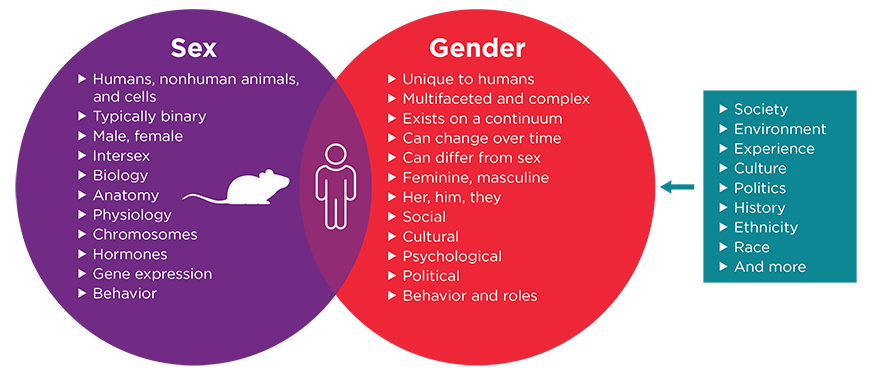 |
| Comparison of Sex vs. Gender from Taconic Biosciences |
Most of the differences we display between men and women are retroactively assigned. There's nothing in nature that says that women have to put on make-up and wear dresses, and likewise there's nothing that says that men have to have short hair and wear suits. By displaying these differences we make the categorization of man and women overt, and therefore it is easier to demonize anyone that falls outside of these binary genders.
But is "normal" really that common? It's common to think that most people have perfect XX or XY sex chromosomes and that intersex conditions are extremely rare; however, genetic mutations that differ from standard male and female occur in one in 100 births. And these misconceptions can be extremely harmful. Most intersex conditions that affect outward appearance will be "corrected" at birth and infants will be assigned a legal sex, without the child being old enough to even understand the concept of gender. The primary reason for these surgeries is not for the physical health of the patient, but for the child to appear "normal" as they age. But rather than doing invasive surgeries on infants, would it not be easier to change our mindsets on what is "normal"?
To conclude this section, it appears that limiting categorizations of nature can limit our understanding of the wide spectrum that is our universe. However, we must also realize that our reasoning for this categorization is not always an innocent attempt to simplify complex topics, but rather an attempt to distance ourselves from what we consider "abnormal".
Chapter 8 - Color & Race
 |
| Harvard Spectral Classification |
Rigid Categorization
Most people put skin colors into 3 categories: black, brown, and white. A more outdated list would have also included yellow and red, but we've rightfully moved away from those categories. But this list is still too restrictive to accurately depict the myriad of races across the world. No one is pitch black or stark white. And what about people who come from mixed-race families? Where should they put themselves? Does it matter?
Let's begin with why different skin pigmentations exist in the first place. The melanin in our skin, hair, and eyes provides different levels of pigmentation, with more melanin resulting in darker colors. This melanin protects our bodies from harmful UV rays, which we needed after becoming hairless, bipedal apes trying to survive in the African sun.
 |
| Map showing the predictive skin color of indigenous people based on latitude |
However, as different social groups split away from each other, we formed our own cliques. Tribes, towns, cities, countries, and continents. As we formed different cultures, we sought an easy way to identify ourselves and, more importantly, distinguish outsiders. In our search to identify ingroups and outgroups, we find the social construction of race.
Race in the Modern World: Who's in and Who's out
The US has separated its people by race since its first census in 1790. These very first censuses counted only three races: White, Indian, and Black. White people were citizens under the law, Native Americans were not citizens but belonged to the governments of their respective tribes, and Black people were not citizens but were counted only for the 3/5 compromise. From the beginning, we see how the US government specifically used race as a determining factor in how to treat the people within its borders.
The differentiation of races can change between censuses as well. Groups like Indians (people from India) and Mexicans have gone from being white to not white and back again for decades. Our inclusion of different races depends heavily on the political climate, but the existence of those groups remains constant from one decade to another. The stigmatization and changing understanding of racial groups can cause negative mental health consequences, such as lower self-esteem, increased depression, and lower self-worth. Immigrants, particularly Latinos and Asians, have an especially hard time assigning themselves to premade race labels and have a high rate of racial category change.
Even by expanding the number of races we identify on censuses, we cannot encompass the entire human experience. Asian Indian, Hmong, and Vietnamese people have widely different cultures and experiences, yet we label them all as "Asian" simply because they live within the boundaries that we have defined as Asia.
Pseudo-Science and Its Attempts to Justify Racism
Once we have successfully categorized people into different races, we automatically begin to look for differences between the races. Think about some common racial stereotypes in American media: The smart Asian kid, the "thug" black man, or the sassy Latina girl. A lot of these stereotypes come from racial pseudoscience that tried to explain innate differences between the races.
Pseudoscientific studies often come from scientists with preconceived biases trying to find justification for the mistreatment of other races. For example, Louis Agassiz used the idea of polygenism (the idea that different races evolved separately, rather than from a common ancestor) to justify that black people were "less evolved" than white people. While this idea fell out of fashion as scientists like Charles Darwin began researching evolution, the idea that black people were more "ape-like" stuck around in the form of racial caricatures and dehumanizing stereotypes. Scientists and medical professionals today still struggle with the idea that black people, especially black women, feel the same amount of pain as white people. The black maternal mortality rate was over 50 per 100,000 births, compared to 14.5 per 100,000 births for white mothers in 2023. Between 1932 and 1972, a group of black men in Tuskegee were unable to access treatment for syphilis as they were observed for a study in which the researchers did not receive informed consent. While the conclusion of this study led to a change in the standards for research, it's not a coincidence that black people were so often used as test subjects in these unethical studies. Through years of popular pseudoscience, society began to believe that black and white people were completely different – almost two separate species.
Tyson argues against this pseudoscience by flipping it on its head: what if white people were the inferior race? White people are more susceptible to sunburns and lice, and we eat "barbaric" food like haggis and veal. It's easy to point out flaws in every race since we're all human.
To conclude this section, it's important to point out why these distinctions hurt the scientific community. When we're focused on finding biological superiority between racial groups, we miss opportunities to discuss the social inequality in the world. There are talented people in all corners of the world, but resource inequality and a Eurocentric focus have hampered the ability of certain cultures, specifically those in Africa, South and Central Asia, and Latin America, to thrive.

Nice embed of the Google Books excerpt.
ReplyDelete"we don't think about what we don't talk about" - reminds me of something Lucy once said to Charlie Brown: "I don't think about things I don't think about." Seriously, this does align with WJ's notion that the body (which is, after all, pre-requisite to speech and discourse) coexists and oftentimes precedes our mental life, and does not strictly follow it.