Up@dawn 2.0 (blogger)

Delight Springs

Thursday, September 12, 2024

Where DJT gets his "intelligence" about Springfield cats & dogs

MAGA Will Fall for Anything

Apparently, this election is about … pets.

...a Malaysian MAGA influencer named Ian Miles Cheong posted about a disturbing incident in Ohio in which an American-born woman from Canton, Ohio, Allexis Telia Ferrell, is being prosecuted for killing and eating a cat. (She is pleading not guilty.)
Cheong falsely speculated that she was Haitian, and MAGA ran with it. Benny Johnson, a MAGA influencer with 2.7 million followers on X (Johnson has been identified as one of the right-wing personalities who — perhaps unwittingly — received substantial payments from Russia), posted that "THOUSANDS of Haitian Migrants TERRORIZE Ohio, EAT Family Pets, Cats, Dogs & Ducks." Another MAGA influencer, a person who goes by the online name Catturd, posted, "Unless you want your pets eaten, you better vote for Trump." Catturd has 2.9 million followers...

https://www.nytimes.com/2024/09/12/opinion/maga-debate-cats-dogs-haiti-trump.html?unlocked_article_code=1.KE4.1idr.PVnRvpjmII3_&smid=em-share

On library day...


"Who is Dewey?" Not John, not Tom...
Melvil
Melville Louis Kossuth "Melvil" Dewey (December 10, 1851 – December 26, 1931) was 
an influential American librarian and educator, inventor of the Dewey Decimal System


Wednesday, September 11, 2024

Questions SEP 12

 MEET at WALKER LIBRARY, Room 264A with librarian Rachel Kirk.

Remember to indicate your midterm report presentation topic preferences.


Augustine, Boethius, Anselm, Aquinas-LHP 6-8. FL 9-10, HWT 9-10

 LHP

1. How did Augustine "solve" the problem of evil in his younger days, and then after his conversion to Christianity? Why wasn't it such a problem for him originally?

2. What does Boethius not mention about himself in The Consolation of Philosophy?

3. Boethius' "recollection of ideas" can be traced back to what philosopher?

4. What uniquely self-validating idea did Anselm say we have?

5. Gaunilo criticized Anselm's reasoning using what example?

6. What was Aquinas' 2nd Way?

FL
1. How did Enlightenment values advance in America in the 19th century?

2. What fantasy about 1776 has been accepted as fact by Americans across the religious spectrum (and Ronald Reagan) ever since?

3. How was religion in America, unlike Europe, non-binary?

4. How did Thomas Jefferson characterize America's religious differences in the north and the south?

5. What happened in Cane Ridge, KY in 1801, and how did a Vanderbilt historian describe it?

6. Who was Charles Finney, and what did he understand about American Christianity?

7. What did de Tocqueville say was different about religion in America, compared to Europe?

8. Who was William Miller and what beliefs did he help revive?

9. Who was Joseph Smith and what is the most interesting thing about him?

HWT
1. What fundamental and non-western sense of time has underpinned much of human history?

2. What is "dreamtime" and how is it alien to the modern west?

3. The universalism of western universities implies that what is unimportant?

4. What does John Gray say about the idea of progress?

5. Karma originally concerned what, and lacked what connotations now commonly associated with it?

6. What western ideas have displaced karma, for many young Indians?


Discussion Questions
  • [Add your own DQs]
  • Would the existence of evil equivalent to good, without guarantees of tthe inevitable triiumph of the latter, solve the problem of suffering?
  • Why do you think Boethius didn't write "The Consolation of Christianity"? 
  • Do you think you have a clear idea of what it would mean for there to be an all-knowing, all-powerful, all-good supernatural being?
  • Do you think knowledge is really a form of remembering or recollection? Have we just forgotten what we knew?
  • Is there a difference between an uncaused cause (or unmoved mover) and a god?
  • Which is the more plausible explanation of the extent of gratuitous suffering in the world, that God exists but is not more powerful than Satan, or that neither God nor Satan exists? Why?
  • Are supernatural stories of faith, redemption, and salvation more comforting to you than the power of reason and evidence? Why or why not?
  • What do you think of the Manichean idea that an "evil God created the earth and emtombed our souls in the prisons of our bodies"? (Dream of Reason 392)
  • Do you agree with Augustine about "the main message of Christianity...that man needs a great deal of help"? (DR 395). If so, must "help" take the form of supernatural salvation? If not, what do you think the message is? What kind of help do we need?
  • What do you think of Boethius' proposed solution to the puzzle of free will, that from a divine point of view there's no difference between past, present, and future? 402
  • Did Russell "demolish" Anselm's ontological argument? (See below)
  • COMMENT: “The world is so exquisite with so much love and moral depth, that there is no reason to deceive ourselves with pretty stories for which there's little good evidence. Far better it seems to me, in our vulnerability, is to look death in the eye and to be grateful every day for the brief but magnificent opportunity that life provides.” Carl Sagan
  • COMMENT: “Science is not only compatible with spirituality; it is a profound source of spirituality. When we recognize our place in an immensity of light‐years and in the passage of ages, when we grasp the intricacy, beauty, and subtlety of life, then that soaring feeling, that sense of elation and humility combined, is surely spiritual. So are our emotions in the presence of great art or music or literature, or acts of exemplary selfless courage such as those of Mohandas Gandhi or Martin Luther King, Jr. The notion that science and spirituality are somehow mutually exclusive does a disservice to both.”  Carl Sagan
  • If you were falsely imprisoned, tortured, and scheduled for execution, would you be able to achieve "consolation"? How?
  • Can the definition of a word prove anything about the world?
  • Is theoretical simplicity always better, even if the universe is complex?
  • Does the possibility of other worlds somehow diminish humanity? 
  • How does the definition of God as omniscient, omnipotent, and perfectly good make it harder to account for evil and suffering in the world? Would it be better to believe in a lesser god, or no god at all?
  • Can you explain the concept of Original Sin? Do you think you understand it?
  • Is it better to embrace (or renounce) religious faith early in life, or to "sow your wild oats" and enjoy a wide experience of the world before committing to any particular tradition or belief? Were you encouraged by adults, in childhood, to make a public profession of faith? If so, did you understand what that meant or entailed?
  • Does the concept of a never-ending struggle between good and evil appeal to you? Does it make sense, in the light of whatever else you believe? Would there be anything "wrong" with a world in which good was already triumphant, happiness for all already secured, kindness and compassion unrivaled by hatred and cruelty?
  • Do you find the concept of Original Sin compelling, difficult, unfair, or dubious? In general, do we "inherit the sins of our fathers (and mothers)"? If yes, give examples and explain.
  • What kinds of present-day McCarthyism can you see? Is socialism the new communism? How are alternate political philosophies discouraged in America, and where would you place yourself on the spectrum?
  • Andersen notes that since WWII "mainline" Christian denominations were peaking (and, as evidence shows, are now declining). What do you think about this when you consider the visible political power of other evangelical denominations? Are you a part of a mainline traditon? If so, how would you explain this shift?
==
If our brains seem to be a step ahead of our minds, does that mean we do not possess free will?
 
Are all our actions inevitable? (Don't confuse that with ineffable.)
 
Is belief in free will better for some of us, while belief in determinism is better advised for others?
 

"Liberty consists in doing what one desires." — John Stuart Mill (But what if you always desire to do what nature has determined that you'll do? Is liberty the same as free will, if you couldn't have done otherwise... whether or not you desired to? What if you were a domino in one of those elaborately-prepared configurations, and you desired nothing more of life than to topple elegantly when your time came? Should we call you free?

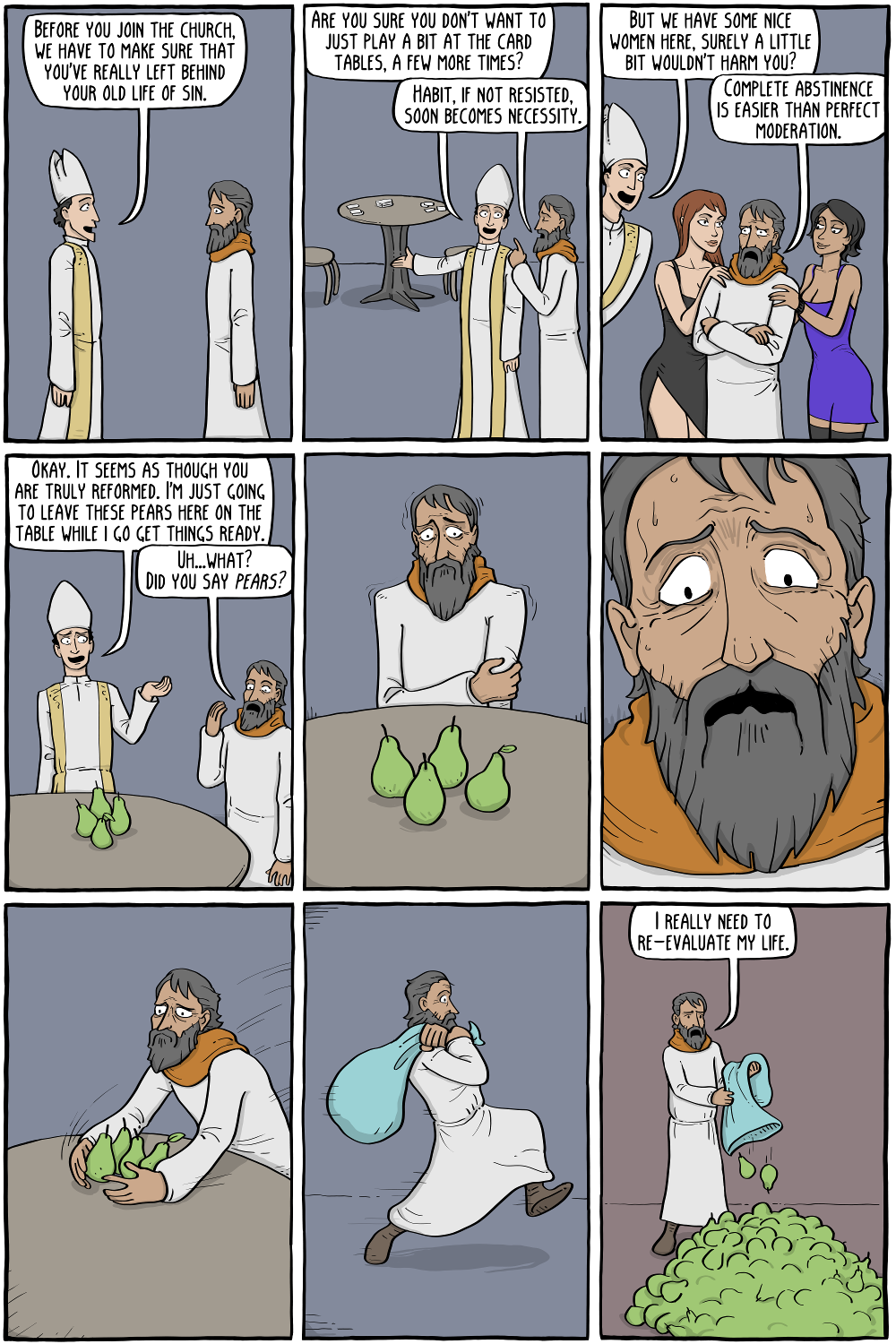
The first sin that Augustine remembers doing was as a child stealing pears, just to steal them. That is, it was the crime itself that made him want to do it, he didn't even want the pears, he just wanted to sin. It was his "original sin" in a sense, and he always felt most guilty about it.
==
==


I share these provocative cartoons not in hostility to religion, but because they reflect genuine puzzlements some of us have regarding the seeming incongruity of saying that God is ineffable AND being confident that one knows God's precise attitudes towards quite specific human concerns... and regarding the paradox of human free will in a universe allegedly governed by omniscience. I hope we'll all choose not to take offense, but to think about and discuss the experiences of ineffability, faith, agency, the unseen objects of belief, etc. 
 

The debate: going to the dogs (and cats)

Post by @thegradet
View on Threads
The moment he lost it... "They're eating dogs and cats in Springfield"


==
...Then Trump spoke and it was clear he was going off the rails. His first comment was to suggest Harris was lying, and then to insist that his proposed tariffs will solve everything, although he has the way tariffs work entirely backward: they are paid by the consumer, not by foreign countries. As he followed with a long list of his rally lies, Harris started to smile.

From then on, he continued to produce rally stories full of wild exaggerations and attack Harris with lies in what CNN fact-checker Daniel Dale called “a staggeringly dishonest debate performance from former president Trump.” "No major presidential candidate before Donald Trump has ever lied with this kind of frequency,” Dale said. “A remarkably large chunk of what he said tonight was just not true. This wasn't little exaggerations, political spin. A lot of his false claims were untethered to reality." As Harris spoke directly to the American people, growing stronger and stronger, Trump got wilder and angrier and told more and more crazy stories...

... he refused to say he would not sign a national abortion ban and admitted that after nine years of promising one, he had no health care plan (he has, he said, “concepts of a plan,” and if they pan out, he’ll let us know in the “not too distant future”).

He threatened World War III and repeated that the U.S. is “a failing nation.” He told a long story about threatening “Abdul,” the leader of the Taliban; in fact, the leader of the Taliban since 2016 is Mullah Hibatullah Akhundzada. In response to Harris’s statement that foreign leaders thought he was a disgrace, Trump answered that Hungarian prime minister Viktor Orbán, who destroyed his country’s democracy and replaced it with a dictatorship, says he’s a good leader. New York Times columnist David French wrote: “It's like she's debating MAGA Twitter come to life.”

...Immediately after the debate, the Harris campaign continued their demonstration of dominance. Harris-Walz campaign chair Jen O’Malley Dillon released a statement recapping Harris’s strength and Trump’s angry incoherence. She concluded: “Vice President Harris is ready for a second debate. Is Donald Trump?”

Then things got even worse for Trump.

Music phenomenon Taylor Swift endorsed Harris, telling her 283 million Instagram followers that she felt she had to because of Trump’s earlier reposting of an AI image of her seeming to endorse him. That, she said, “brought me to the conclusion that I need to be very transparent about my actual plans for this election as a voter. The simplest way to combat misinformation is with the truth. I will be casting my vote for Kamala Harris and Tim Walz in the 2024 Presidential Election.”

After explaining why she was supporting Harris and Walz and urging her fans to do their own research, Swift signed off: “Taylor Swift, Childless Cat Lady.” HCR
==
Rachel Maddow reads Taylor Swift's statement to Tim Walz...
==
Donald Trump Had a Really, Really Bad Debate

I’ve watched every Presidential debate for the past two decades, and I can’t think of anything that ranks higher in pure stupidity than Trump ranting and raving to a national audience about immigrants supposedly eating people’s cats and dogs. His line about how the Vice-President “wants to do transgender operations on illegal aliens that are in prison” was pretty memorable, too. What the hell was he talking about? No one knows, which was, of course, exactly Harris’s point. Trump was so unprepared for the debate that even he himself did not seem to know what he was saying at times. Asked to describe his proposal for jettisoning Obamacare and replacing it with something better, Trump tried to blame Democrats for the fact he didn’t have an alternative yet. Rather, he said, “I have concepts of a plan.” Yeah, right... Susan Glasser

Macho “Stoics” on the internet

I was asked in class yesterday about how some internet popularizers of Stoicism seem to equate that philosophy with "masculine values"… This seems relevant:

"Working through a book with some students yesterday and had a realization.💡

Many of us would agree that our culture is broadly nihilistic — lot of despair, feelings of pointlessness, atomization, and isolation. "Does anything matter?!"

A lot of the toxic stuff online targeting young men is flourishing IN THIS CONTEXT. Guys are offered "systems," and "discipline," and "tradition" as a balm for this aimlessness and anxiety about meaning."

Hannah Arendt on lying in politics

"No matter how large the tissue of falsehood that an experienced liar has to offer, it will never be large enough … to cover the immensity of factuality."

https://www.themarginalian.org/2016/06/15/lying-in-politics-hannah-arendt/

Tuesday, September 10, 2024

Cousin Mary’s advice

"Instructions for living a life. 

Pay attention. 

Be astonished. 

Tell about it." 

Mary Oliver, born on this day in 1935


https://www.threads.net/@mariapopova/post/CxAsoBsuaqg/?xmt=AQGzNeJkxo1w4zJDQy8Yolw02OD7YTT18hu9uY9Uv9zAVQ

Monday, September 9, 2024

Questions SEP 10

Epicureans and Stoics-LHP 4-5. Weiner 6, 12. Rec: FL 7-8. HWT 6-8. Select midterm report presentation topic & date: indicate on Sep 10 your 1st and 2d choices for date and topic in the comments space below "Midterm Report Presentations

LHP
1. According to Epicurus, fear of death is based on what, and the best way to live is what? Are (or were) you afraid of death, or of dying? Are you more afraid of losing others?

2. How is the modern meaning of "epicurean" different from Epicurus's? Do you consider yourself epicurean in either sense of the term?

3. What famous 20th century philosopher echoed Epicurus's attitude towards death? Do you agree with him?

4. How did Epicurus respond to the idea of divine punishment in the afterlife? Is the hypothesis of a punitive and torturous afterlife something you take seriously, as a real possibility? Why or why not?

5. What was the Stoics' basic idea, and what was their aim? Are you generally stoical in life? 

6. Why did Cicero think we shouldn't worry about dying? Is his approach less or more worrisome than the Epicureans'?

7. Why didn't Seneca consider life too short? Do you think you make efficient use of your time? How do you think you could do better?

8. What does the author say might be the cost of stoicism? Is it possible to be stoical but also appropriately compassionate, caring, sensitive to others' suffering, etc.?

Weiner
  1. What was Kepos? What did Voltaire say we should cultivate? What do you think that means, philosophically?
  2. What inscription greeted visitors to Epicurus's compound? And Plato's Academy? Which would you personally find more inviting?
  3. Whose side in School of Athens was Epicurus on, and why? Do you agree?
  4. What is tetrapharmakos, and how might it help you distinguish Epicurus from Epictetus?
  5. Every life is what, according to Epicurus? Do you agree that this is grounds for celebration?
  6. Which American founding father declared "I too am an Epicurean"? 
  7. What does Eric think happens if you follow the "good enough" creed?
  8. A common Stoic exhortation is... ? What is its core teaching? Do you think this is too passive?
  9. What did Diogenes learn from philosophy? 
  10. What does it mean to say Stoics are not Spock?
  11. What did Epictetus have in common with Socrates?
  12. What is premeditatio malorum? Do you agree with Eric's daughter's assessment of it? Or with his, of her?
  13. What's "the View from Above"? Does it help you put events in your life in a better perspective?

HWT
1. Who were the three great founders of American pragmatism?

2. When does philosophy "recover itself" according to John Dewey, and what should it not doubt according to Charles S. Peirce? 

3. What did Richard Rorty say pragmatists desire?

4. As earlier noted in Kurt Andersen's Fantasyland, Karl Rove said what about "reality"? What do you say about what he said?


FL
1. The people we call the American founders were what?

2. Who was Jonathan Edwards and how was he like Anne Hutchinson?

3. Who was John Wesley and what did he demand of his followers?

4. Who was George Whitefield and what did he "implant" in American Christianity?

5. What did Thomas Jefferson tell his nephew?

6. What was Immanuel Kant's "motto of Enlightenment"?


More discussion questions:
  • Have you experienced the death of someone close to you? How did you handle it?
  • Do you care about the lives of those who will survive you, after you've died? Is their continued existence an alternate (and possibly better) way of thinking about the concept of an "afterlife"?
  • Do you consider Epicurus's disbelief in immortal souls a solution to the problem of dying, or an evasion of it? Do you find the thought of ultimate mortality consoling or mortifying?
  • How do you know, or decide, which things you can change and which you can't? 
  • Were the Stoics right to say we can always control our attitude towards events, even if we can't control events themselves?
  • Is it easier for you not to get "worked up" about small things you can't change (like the weather, or bad drivers) or large things (like presidential malfeasance and terrorist atrocites)?  Should you be equally calm in the face of both?
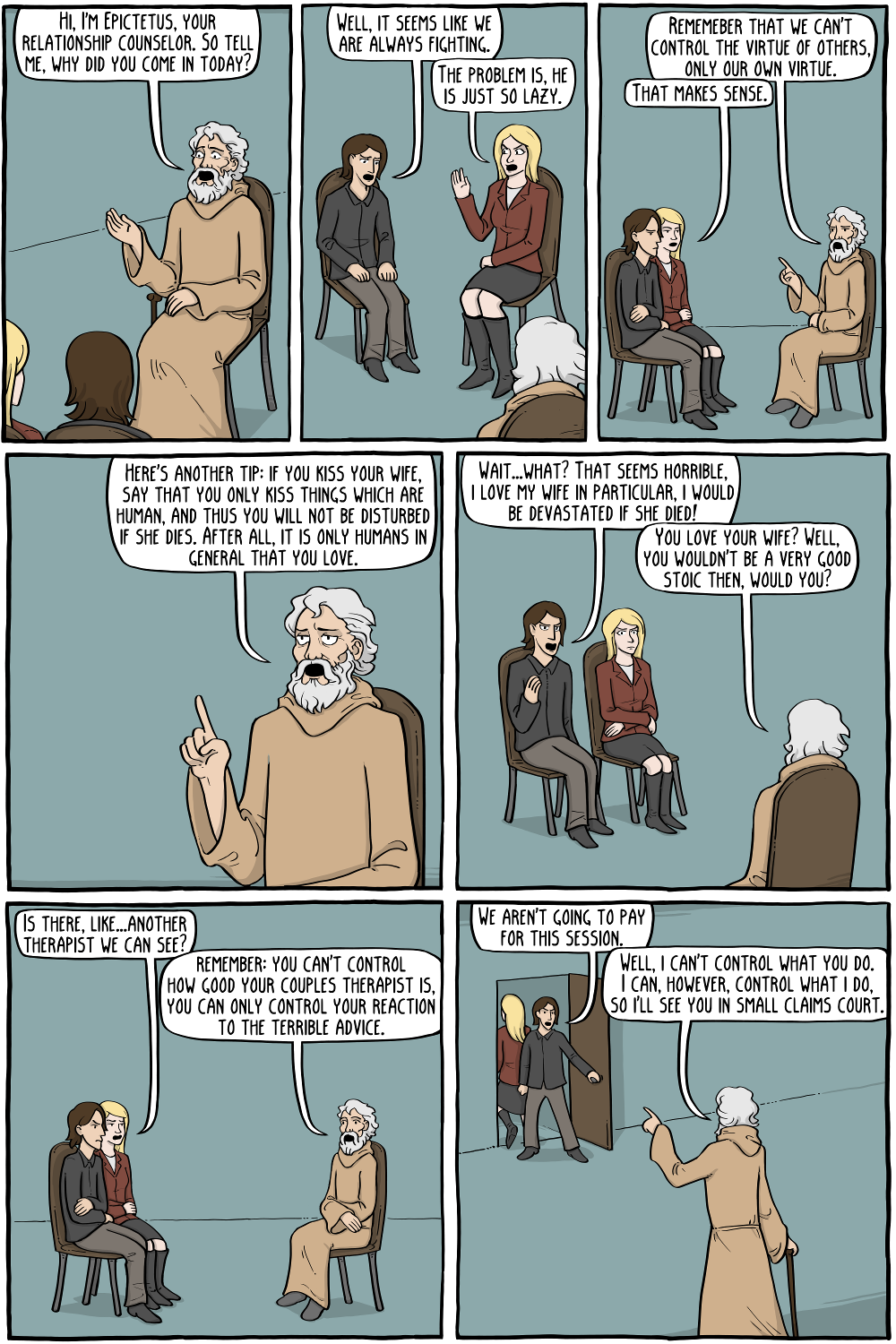
  • Is it possible to live like a Stoic without becoming cold, heartless, and inhumane?
  • What do you think of when you hear the word "therapy"? Do you think philosophers can be good therapists? 
  • Do you think "the greatest happiness of the greatest number" is an appropriate goal in life? Can it be effectively pursued by those who shun "any direct involvement in public life"? 
  • If the motion of atoms explains everything, can we be free? 
  • Is it true that your private thoughts can never be "enslaved"? 
ALSO RECOMMENDED: De Natura Deorum (On the Nature of the Gods) Cicero's dialogue between a Skeptic, a Stoic, and an Epicurean... & JMH's smart commentary on it in Doubt: A History*... LISTEN (Sep '21)... Natalie Haynes on Lucretius and Epicurus (BBC radio podcast)... Feb 1 (more on Epicureans & Stoics)

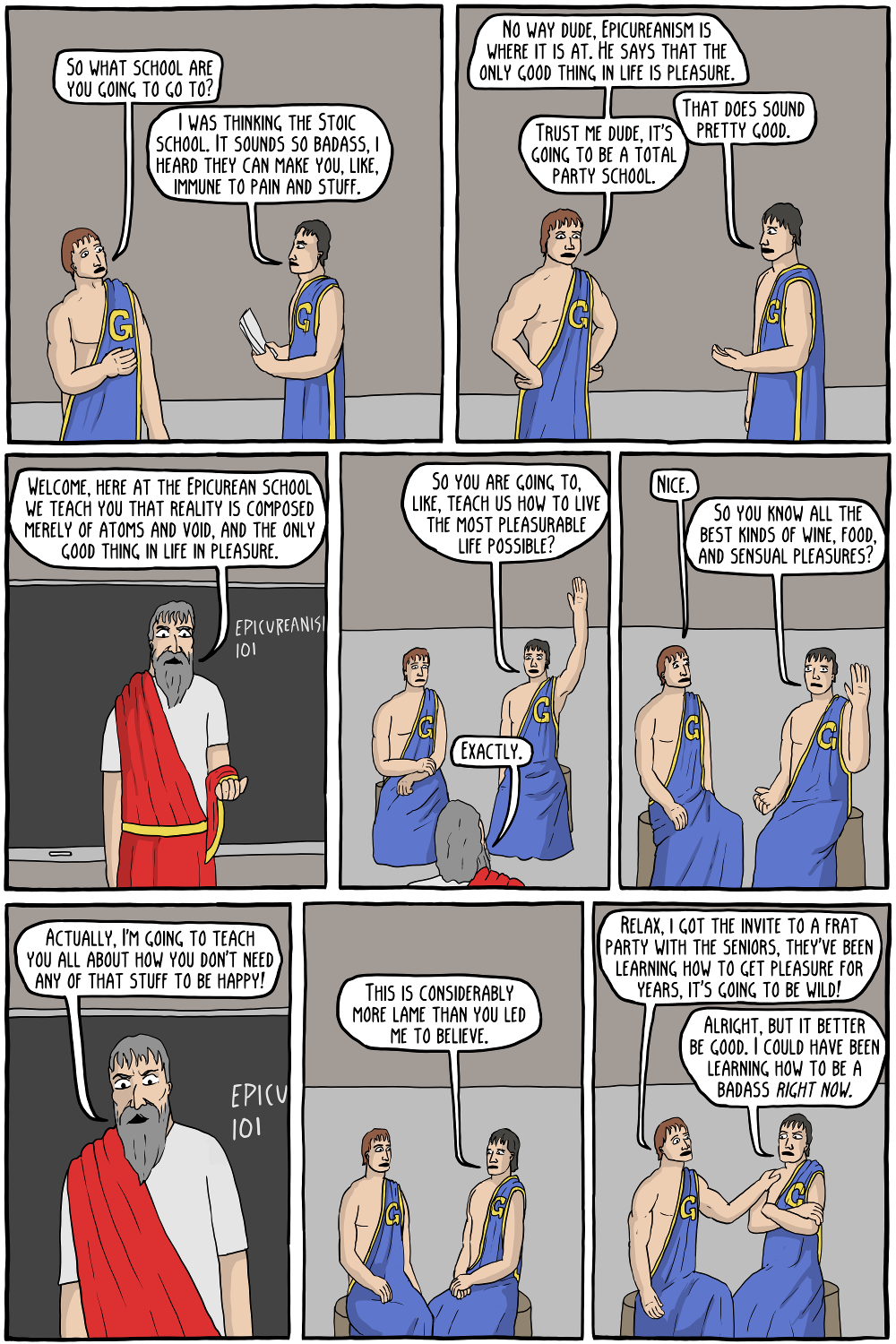
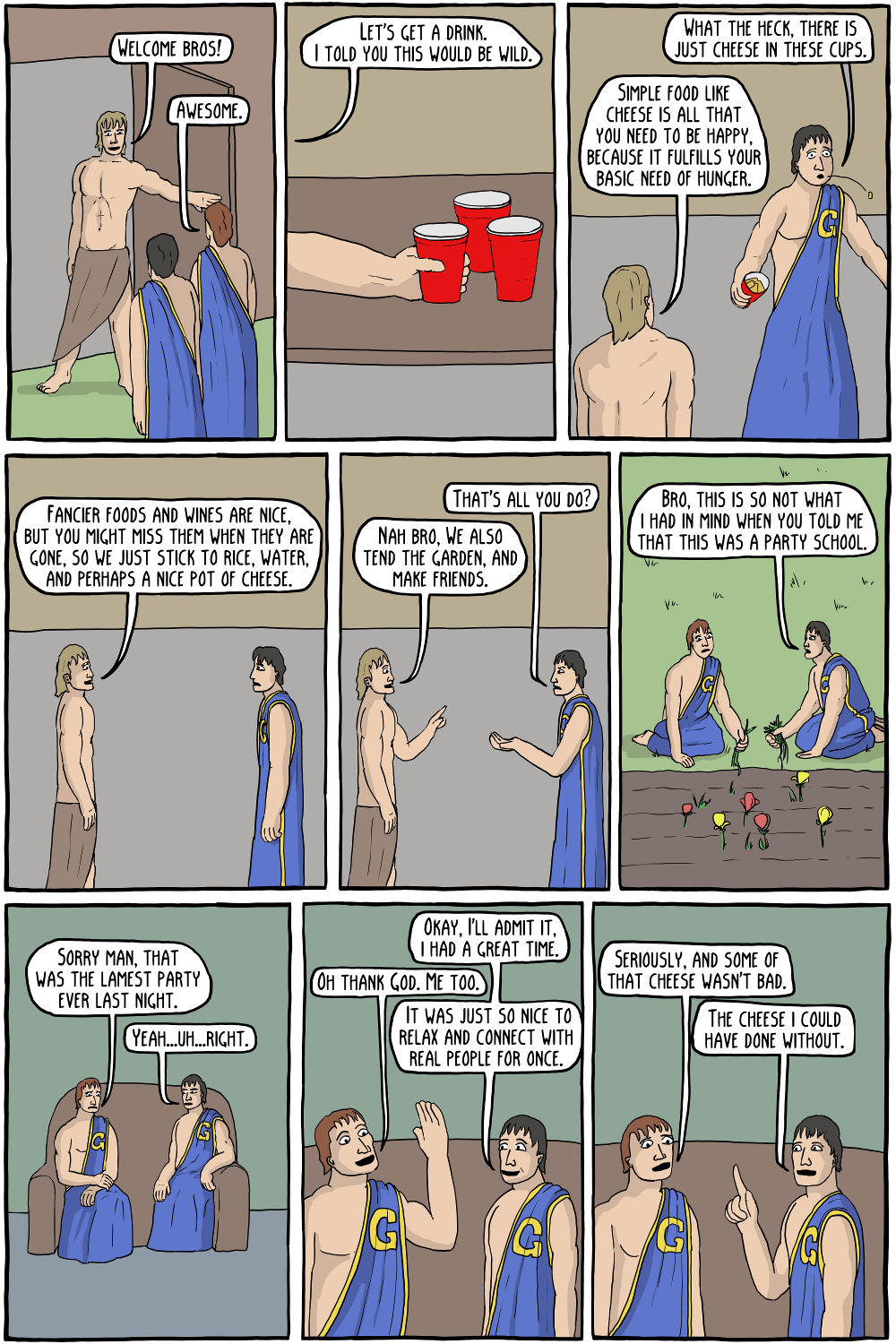
Epicureanism: The Original Party School


Over the years I've made a few slideshows (see "Oliver's slideshows" in the sidebar). Here's one: 

Tetrapharmakos

The etymology of “tetrapharmakos” is quite simple: “tetra” means “four” and “pharmakos” means “remedy” or “medicine.” They are both Greek words.

Originally, the term refers to a compound of four actual drugs: wax, tallow, pitch, and resin. Later, it’s used metaphorically by Philodemus, one of Epicurus’ disciples, to refer to the core principles of happiness in Epicureanism, since both of them function as a “cure” and are four in number.

Philodemus put together the tetrapharmakos from fragments of his master’s teachings, and summarized them into four points:

  1. Don’t fear God.
  2. Don’t worry about death.
  3. What is good is easy to get.
  4. What is terrible is easy to endure.

Sunday, September 8, 2024

Reality Check: How divided is America, really?


 Reality Check: How divided is America, really? If you listen to polls and pundits, you may assume that politics has polarized Americans. But correspondent David Pogue points out that, while we tend to have an exaggerated idea of what other people believe, statistics show Americans actually agree on a whole lot. https://www.cbsnews.com/video/reality-check-how-divided-is-america-really/ 

Epicurus & Epictetus

Don't be confused.


But they basically agree on these points:

"If you live according to nature, you will never be poor; if you live to please the opinions of others, you will never be rich." — Epicurus (341 – 270 BCE)

"Happiness and freedom begin with a clear understanding of one principle: Some things are within our control, and some things are not." — Epictetus (c. 50 – c. 135)

(—Yes, and responsibility begins with this caveat: you don't know what is within your control until you try.)

Saturday, September 7, 2024

Can Colleges Do Without Deadlines?

No.

"It's a big question for higher ed: when does a student become an adult?" Rogers said. "How much accommodation and hand-holding should there be? When does school become a job, where, if you don't do it, you get the F, and you move on?"

https://www.newyorker.com/news/annals-of-education/can-colleges-do-without-deadlines

Friday, September 6, 2024

Leaving Walden

On this day in 1847Henry David Thoreau (books by this authorleft Walden Pond and moved back to his father's house in Concord, Massachusetts. Thoreau had lived in the hut for two years, leading a simple life of gardening and contemplation, subsisting on a daily budget of 27-1/2 cents. When he moved back to Concord, he took with him the first draft of his book A Week on the Concord and Merrimack Rivers, strung together from 10 years of journal entries. WA

"...Most of the luxuries, and many of the so called comforts of life, are not only not indispensable, but positive hindrances to the elevation of mankind. With respect to luxuries and comforts, the wisest have ever lived a more simple and meagre life than the poor. The ancient philosophers, Chinese, Hindoo, Persian, and Greek, were a class than which none has been poorer in outward riches, none so rich in inward. We know not much about them. It is remarkable that we know so much of them as we do. The same is true of the more modern reformers and benefactors of their race. None can be an impartial or wise observer of human life but from the vantage ground of what we should call voluntary poverty. Of a life of luxury the fruit is luxury, whether in agriculture, or commerce, or literature, or art. There are nowadays professors of philosophy, but not philosophers. Yet it is admirable to profess because it was once admirable to live. To be a philosopher is not merely to have subtle thoughts, nor even to found a school, but so to love wisdom as to live according to its dictates, a life of simplicity, independence, magnanimity, and trust. It is to solve some of the problems of life, not only theoretically, but practically...
""""""
...I went to the woods because I wished to live deliberately, to front only the essential facts of life, and see if I could not learn what it had to teach, and not, when I came to die, discover that I had not lived. I did not wish to live what was not life, living is so dear; nor did I wish to practise resignation, unless it was quite necessary. I wanted to live deep and suck out all the marrow of life, to live so sturdily and Spartan-like as to put to rout all that was not life, to cut a broad swath and shave close, to drive life into a corner, and reduce it to its lowest terms, and, if it proved to be mean, why then to get the whole and genuine meanness of it, and publish its meanness to the world; or if it were sublime, to know it by experience, and be able to give a true account of it in my next excursion...

"""""" 

...I left the woods for as good a reason as I went there. Perhaps it seemed to me that I had several more lives to live, and could not spare any more time for that one. It is remarkable how easily and insensibly we fall into a particular route, and make a beaten track for ourselves. I had not lived there a week before my feet wore a path from my door to the pond-side; and though it is five or six years since I trod it, it is still quite distinct. It is true, I fear that others may have fallen into it, and so helped to keep it open. The surface of the earth is soft and impressible by the feet of men; and so with the paths which the mind travels. How worn and dusty, then, must be the highways of the world, how deep the ruts of tradition and conformity! I did not wish to take a cabin passage, but rather to go before the mast and on the deck of the world, for there I could best see the moonlight amid the mountains. I do not wish to go below now.

I learned this, at least, by my experiment; that if one advances confidently in the direction of his dreams, and endeavors to live the life which he has imagined, he will meet with a success unexpected in common hours..." 

LoA pics
 

“Divisive concepts” form (for the convenience of my students)

Why fascists hate universities | Jason Stanley | The Guardian

"…Even more so than Florida, Tennessee is a one-party state, with a Republican governor and a Republican supermajority in the legislature. The Tennessee house and senate passed a resolutionto honor the Danube Institute; on the floor of the Tennessee house, the state representative Justin Jones questioned why the state was honoring the Hungarian autocrat Viktor Orbán's thinktank. Tennessee has a state ban on the teaching of "divisive concepts", one that includes public universities. To report a professor for teaching such a concept (such as intersectionality), Tennessee provides an online form..."

https://www.theguardian.com/commentisfree/article/2024/sep/05/why-fascists-hate-universities-us-bangladesh-india

Thursday, September 5, 2024

Most people don’t take responsibility

"Most people don't grow up. It's so damn difficult. 
What happens is most people get older. That's the truth of it. 

They honor their credit cards. They find parking spaces. 
They marry. They have the nerve to have children, 
but they don't grow up. Not really. 
They get older, but to grow up costs the earth, the earth. 

It means you take responsibility
for the time you take up
 and the space you occupy. 

Grow up."

- Maya Angelou

https://www.threads.net/@femalepoetssociety/post/C_iBX9wCEbv/?xmt=AQGzmgcKbKxA5-EjXqp3iwuoYd0JqRgHWOS69z_2Miun4A

Wednesday, September 4, 2024

Oliver Cromwell

 Wolf Hall by Hilary Mantel is the Cromwell novel I was trying to recall... Recently rated the third-best book of this century (so far).

Book cover for Wolf Hall

3

Wolf Hall

Hilary Mantel 2009

It was hard choosing the books for my list, but the first and easiest choice I made was “Wolf Hall.” (“The Mirror and the Light,” the third book in Mantel’s trilogy, was the second easiest.)

We see the past the way we see the stars, dimly, through a dull blurry scrim of atmosphere, but Mantel was like an orbital telescope: She saw history with cold, hard, absolute clarity. In “Wolf Hall” she took a starchy historical personage, Thomas Cromwell, and saw the vivid, relentless, blind-spotted, memory-haunted, grandly alive human being he must have been. Then she used him as a lens to show us the age he lived in, the vast, intricate spider web of power and money and love and need — right up until the moment the spider got him. — Lev Grossman, author of “The Bright Sword”


https://www.nytimes.com/interactive/2024/books/best-books-21st-century.html?smid=nytcore-ios-share&referringSource=articleShare#my-reading