Epicureans and Stoics-LHP 4-5. Weiner 6, 12. Rec: FL 7-8. HWT 6-8. Select midterm report presentation topic & date: indicate your 1st and 2d choices for date and topic in the comments space below Midterm Report Presentations...
2. How is the modern meaning of "epicurean" different from Epicurus's? Do you consider yourself epicurean in either sense of the term?
3. What famous 20th century philosopher echoed Epicurus's attitude towards death? Do you agree with him?
4. How did Epicurus respond to the idea of divine punishment in the afterlife? Is the hypothesis of a punitive and torturous afterlife something you take seriously, as a real possibility? Why or why not?
5. What was the Stoics' basic idea, and what was their aim? Are you generally stoical in life?
6. Why did Cicero think we shouldn't worry about dying? Is his approach less or more worrisome than the Epicureans'?
7. Why didn't Seneca consider life too short? Do you think you make efficient use of your time? How do you think you could do better?
- What was Kepos? What did Voltaire say we should cultivate? What do you think that means, philosophically?
- What inscription greeted visitors to Epicurus's compound? And Plato's Academy? Which would you personally find more inviting?
- Whose side in School of Athens was Epicurus on, and why? Do you agree?
- What is tetrapharmakos, and how might it help you distinguish Epicurus from Epictetus?
- Every life is what, according to Epicurus? Do you agree that this is grounds for celebration?
- Which American founding father declared "I too am an Epicurean"?
- What does Eric think happens if you follow the "good enough" creed?
- A common Stoic exhortation is... ? What is its core teaching? Do you think this is too passive?
- What did Diogenes learn from philosophy?
- What does it mean to say Stoics are not Spock?
- What did Epictetus have in common with Socrates?
- What is premeditatio malorum? Do you agree with Eric's daughter's assessment of it? Or with his, of her?
- What's "the View from Above"? Does it help you put events in your life in a better perspective?
- Have you experienced the death of someone close to you? How did you handle it?
- Do you care about the lives of those who will survive you, after you've died? Is their continued existence an alternate (and possibly better) way of thinking about the concept of an "afterlife"?
- Do you consider Epicurus's disbelief in immortal souls a solution to the problem of dying, or an evasion of it? Do you find the thought of ultimate mortality consoling or mortifying?
- How do you know, or decide, which things you can change and which you can't?
- Were the Stoics right to say we can always control our attitude towards events, even if we can't control events themselves?
- Is it easier for you not to get "worked up" about small things you can't change (like the weather, or bad drivers) or large things (like presidential malfeasance and terrorist atrocites)? Should you be equally calm in the face of both?
- Is it possible to live like a Stoic without becoming cold, heartless, and inhumane?
- What do you think of when you hear the word "therapy"? Do you think philosophers can be good therapists?
- Do you think "the greatest happiness of the greatest number" is an appropriate goal in life? Can it be effectively pursued by those who shun "any direct involvement in public life"?
- If the motion of atoms explains everything, can we be free?
- Is it true that your private thoughts can never be "enslaved"?
Epicureanism: The Original Party School
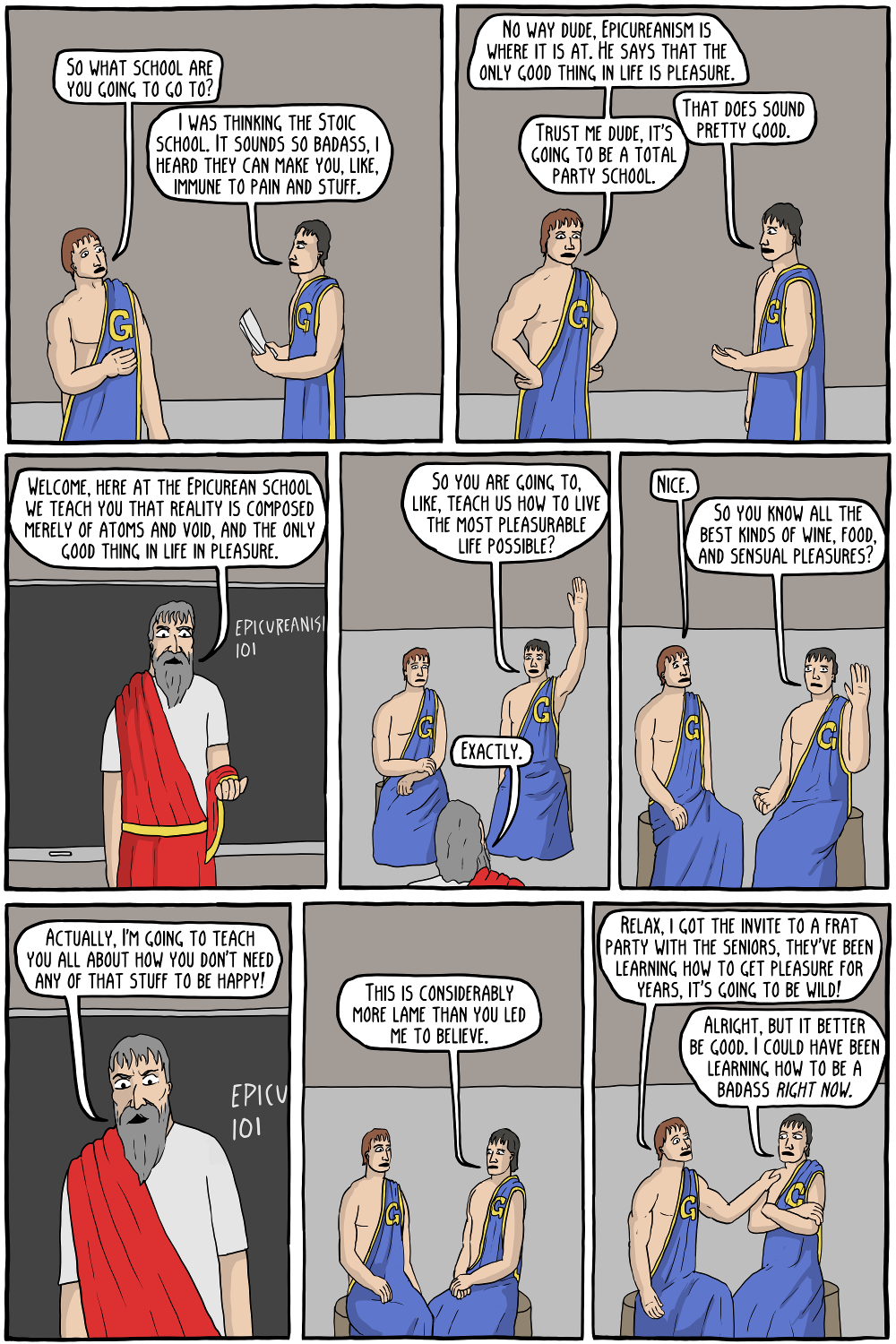
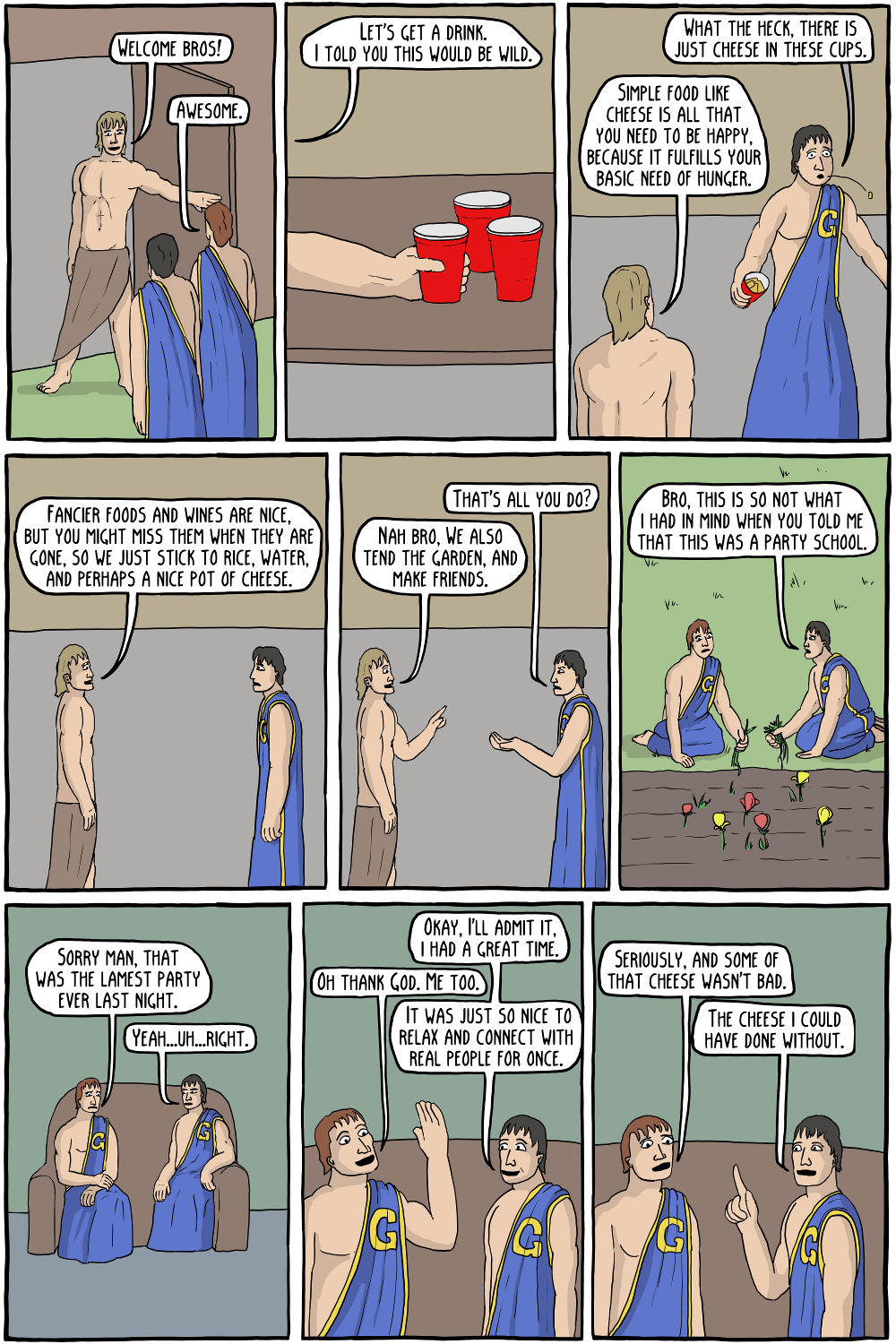
Permanent Link to this Comic: https://existentialcomics.com/comic/133
==
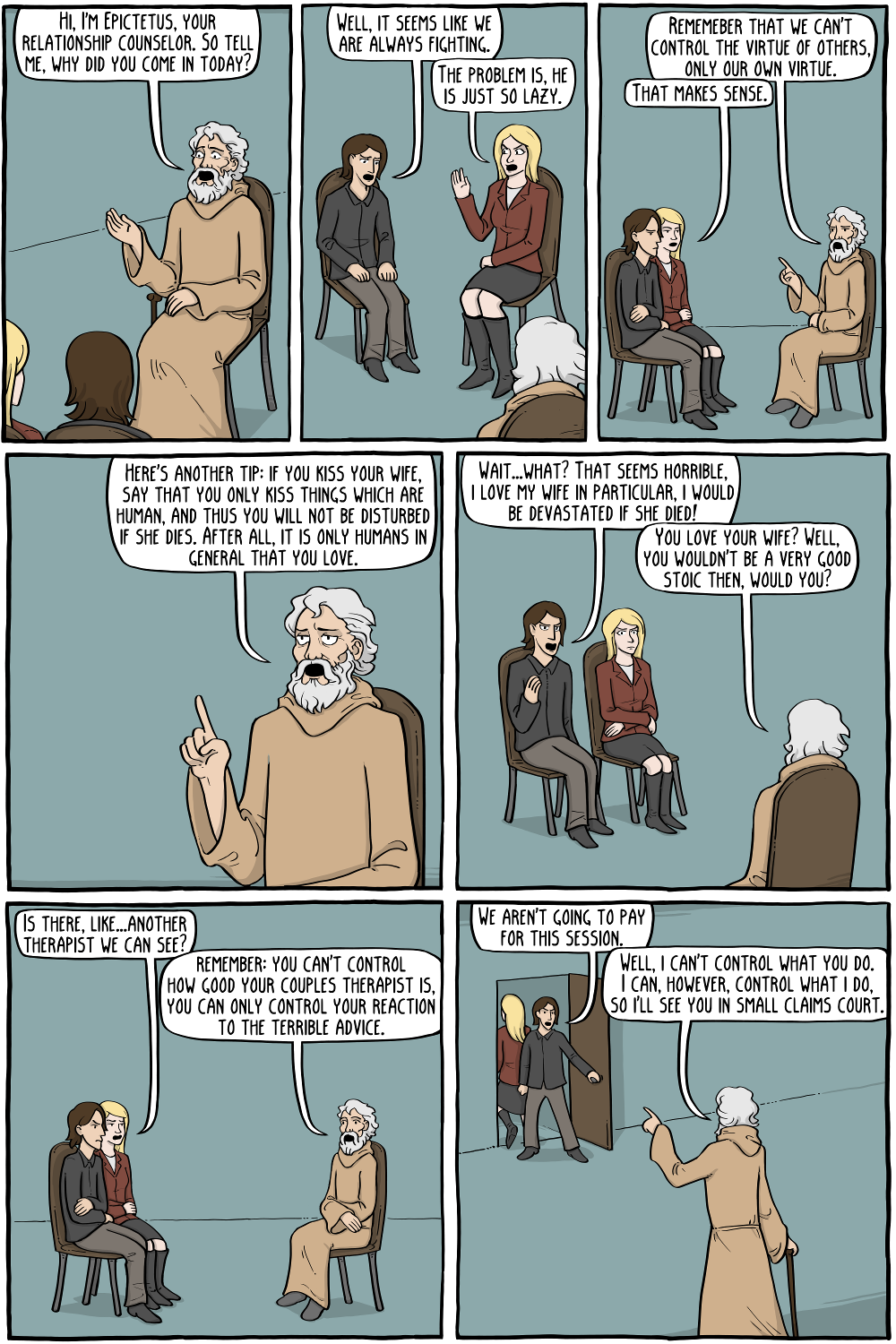
Philosophers in this comic: Epictetus. In The Enchiridion Epictetus gives the advice that in order to avoid suffering, we should not become too attached to particular things, so that when they inevitably end we are not caused undue harm. He starts with the fairly straightforward example of a cup that we like breaking:
With regard to whatever objects give you delight, are useful, or are deeply loved, remember to tell yourself of what general nature they are, beginning from the most insignificant things. If, for example, you are fond of a specific ceramic cup, remind yourself that it is only ceramic cups in general of which you are fond. Then, if it breaks, you will not be disturbed.
He then proceeds immediately to what seems a quite more drastic example:
If you kiss your child, or your wife, say that you only kiss things which are human, and thus you will not be disturbed if either of them dies.
Some may find that living in such a way is strange, to say the least.
Permanent Link to this Comic: https://existentialcomics.com/comic/264
==
Stoicism Man...The Next Great Stoic competition... Stoic apathy


Over the years I've made a few slideshows (see "Oliver's slideshows" in the sidebar). Here's one:
Tetrapharmakos
The etymology of “tetrapharmakos” is quite simple: “tetra” means “four” and “pharmakos” means “remedy” or “medicine.” They are both Greek words.
Originally, the term refers to a compound of four actual drugs: wax, tallow, pitch, and resin. Later, it’s used metaphorically by Philodemus, one of Epicurus’ disciples, to refer to the core principles of happiness in Epicureanism, since both of them function as a “cure” and are four in number.
Philodemus put together the tetrapharmakos from fragments of his master’s teachings, and summarized them into four points:
- Don’t fear God.
- Don’t worry about death.
- What is good is easy to get.
- What is terrible is easy to endure.

Malcolm Ashley Section 3
ReplyDelete2. The modern meaning of "epicurean" is opposite from what Epicurus originally intended. Nowadays, the definition means "a person who enjoys luxurious and refined pleasures, especially in food and drink". The original meaning is the philosophy of Epicureanism, which means seeking simple, achievable pleasures and the absence of pain to attain happiness.
4. Epicurus responded to the idea of divine punishment by simply implying the Gods do not care about meddling in mortal affairs. I'm very torn between the idea of a torturous afterlife for a multitude of reasons but the biggest is the "Divine Fallacy". In short, this term describes the logical error of assuming that a divine or supernatural explanation must be true simply because a scientific one is not yet known. This has been show multiple times throughout history for explanations of the weather, diseases, or even solar events. We still have plenty of mysteries today that we just simply misunderstand. But then again, maybe our human intellect will never be able to comprehend everything.
5. The stoics basic idea is to focus only on what you can control and achieve ataraxia (inner calm)/apatheia ( free from destructive passions and emotions). In my own life, it is very difficult to be truly stoic due to the unpredictably and overstimulation of modern 21st century life, but i try and exercise only worrying about what I can control.
Antonella Comaschi Section 3
DeleteI found your ideas on question 4 extremely interesting. I wonder what faith, if any, Epicurus believed in for I've never heard of the idea that the Gods don't care. Why would we be alive if they didn't care and why did people in ancient Greek spend so much time worshiping them if they were worried about them. I also wonder if he believed something else but express that believe to his followers to answer their questions and alleviate their worries.
ReplyDeleteLHP 4-5
1. According to Epicurus, fear of death is based on bad logic and the best way to live is to have a simple lifestyle. My beliefs around death are similar to Epicurus in that I don't believe anything happens after we die. I think so often people are afraid of an empty afterlife but do not realize that if no such afterlife exists, we will be unable to perceive it. The human mind struggles to comprehend what it'd be like to not exist. Because of this, I am not afraid of death for myself or others. However, I do fear for how the ones I love will die or what it would be like to live without them. Even if death is not to be feared, and I do not believe there is suffering after death, it would be agonizing to continue living without any of the people I love. A fear of death may be unnecessary, but that does not mean one shouldn't love life (or alternatively shouldn't fear dying).
2. An "epicurean" is one who indulges in luxury and sensual pleasures, a term completely at odds with Epicurus's own ideologies about how we should live. I'm more inclined to Epicurus's beliefs. If I know something is permanently out of my reach (extreme wealth, for example) there is no point in going my whole life longing for what I can never have. This is especially true when there's enjoyment to be found in things that are within my reach.
Weiner 6,12
Premeditatio malorum means "premeditation of adversity" or imagining the worst-case-scenario to rob future hardships of their bite. I agree that worrying about such things can be depressing but not that doing so is unnecessary. Part of Stoicism is accepting what you cannot change, and, throughout life, no one can avoid the risk of severe tragedy. Seeing death as the inevitable price of life removes the fear from the situation, another key point of Stoicism.
I particularly appreciate how you said, "this is especially true when there's enjoyment to be found in things that are within my reach." That is such an amazing way to put it. As somebody who dreams big, I find it all too easy to forget about the amount of fulfillment that can be found in the "little things." But when those things are what one truly finds joy and peace in, perhaps they are not the "little things" but instead the most important things of all.
Delete5. The Stoics believed in the ideology of not trying to control things that are not in one's control. This in itself is a good concept, but a hard thing to follow in my day-to-day life, as basically everything in your life truly isn't in your control.
ReplyDeleteTo expand on that, the book also touched on how Stoic ideology would sometimes go too far, because it tells them to not care about a thing. Not caring about anything out of your control can make you distant and unappreciative of the beautiful things in life that are beyond your control.
A lack of control is a necessary human aspect that we all need to accept and find the beauty in.
Weiner #6
Thomas Jefferson declared, "I too am Epicurian."
Morgan Conner Section #3
DeleteFirst of all, I agree with your idea that "a lack of control is a necessary human aspect that we all need to accept and find the beauty in." Second, your comment made me think of the psychological concept of the internal locus of control. It's a concept/belief that individuals are in control of their own fate, successes, failures, etc., with their actions directly affecting outcomes. Some people focus more on and worry about what they can't control, causing them undue stress. I'm not exactly sure when this concept came about, but I'm sure that Stoic ideology had some part in it ;).
Weiner, #7
ReplyDeleteWeiner believes that following the "good enough" creed for long enough drops the "enough" and just leaves the "good" part. This section quite literally changed my life. I tend to view myself as a recovering perfectionist, always seeking ways to improve at what matters to me. Interestingly enough, the methods of "improving" are often merely unnecessary ways to save a few minutes and some effort and reward me with spending more money on gadgets I do not need. As a musician, I have long been tempted to keep buying guitars and amps, chasing different sounds and different levels of playability, and spending untold amounts of money in doing so. And once I have grown bored, the process is repeated until I am surrounded by so many material objects with no real value that I do not even want to play guitar at all. All that to say, I have been plagued by what Eric Weiner describes as "Just-a-bit-more-ism." Epicurus has changed my life. Perhaps good enough is not merely good enough, perhaps it is even better than perfect. Perhaps the endless quest for "bigger, better, faster, stronger" compared to what one really needs is poison to enjoying the true potential of something in the first place. Weiner stated, "not only is perfect the enemy of the good but the good is the enemy of good enough." From now own I will not endeavor to seek the best or most perfect or even good but instead seek the good enough. I am curious to see what will happen as a result of this.
Philosophy CAN change your life!
DeleteWeiner, #10
ReplyDeleteWhen Weiner says that Stoics are not Spock, he is referring to the common misconception that Stoics are not just deadpan beings devoid of emotion. What they instead seek is to remove emotions that are not beneficial to them. Stoics do not pretend to lack positive emotions and joy. Truthfully, I had some misconceptions about Stoicism that were proven very wrong after I had done the reading. I am curious to hear who else felt the same. I have grown to love some of its ideas, particularly the call to positive action in place of negative rumination. I will have to implement this more in life.
I feel similarly, though I have recently learned about concepts such as Stoicism through this class and therefore had minimal misunderstanding. I feel too many people label Stoics as an unfeeling people who do not care. Their beliefs and actions aren’t out of a lack of care, they are out of a desire to avoid needless pain. Why stress over that which you cannot control? It will happen regardless and therefore how you handle it is meaningless so you may as well handle it productively so you can move on quicker.
DeleteMakenzie Collins Section 1
ReplyDelete1. According to Epicurus, fear of death is based on what, and the best way to live is what? Are (or were) you afraid of death, or of dying? Are you more afraid of losing others?
Epicurus believed that we will have no sensation or awareness of death, therefore we should not fear it. He believed that pleasure is the most important thing in life. I am not afraid of death, however, it is not for the same reasons Epicurus wasn't afraid. As a Christian, one of our fundamental beliefs is that if we believe in and Love God and Jesus, we have a promised life of eternity with him when we die. Therefore I have hope and great expectations for when I die in the flesh, because my spirit will live on with the Father. I am afraid of losing others who have not given their life to Christ because they do not have that same hope waiting for them after they die.
Antonella Comaschi Section 3
DeleteMakenzie, I completely agree with your post I believe that Epicurus states that we should not fear death so we can enjoy life and not be worried about something we have no control over. I also don't fear death for I know that there is something much greater then this life and this reality we live in waiting for us.
Bella York, section #3
ReplyDelete8. What does the author say might be the cost of stoicism? Is it possible to be stoical but also appropriately compassionate, caring, sensitive to others' suffering, etc.?
Although stoicism may provide an escape from suffering, it also creates distance between yourself and others. Suppressing all of your emotions means that you will miss out on the pleasures of life. Some people may be able to walk this line, balancing not caring about things you cannot control while also balancing allowing care and compassion for other people’s experiences.
Section #1
DeleteBella, I definitely agree with your comment about balance between emotions and stoicism. I understand this was in response to Warburton's text, but your answer is why I enjoyed Eric Weiner's explanation for the stoics. He said that stoics do have moderation in their emotions (or as he described "passionate" emotions). Though it may not be as lenient as how we express ourselves, philosophers like Seneca encouraged a time for things like grieving-- but then also a time to cease grieving. I suppose the lines are somewhat blurred around how much grieving is acceptable for a stoic (or how much expressing deep emotion is acceptable).
Section #1
ReplyDeleteLHP
1. Seneca saw the scope of the average human life and believed in the potential in it. From his experience, humans were capable of accomplishing many things in life when you stop focusing on the things that do not truly matter. I think I have phases when I spend my time very wisely and phases when I do not. In my opinion, any period of time spent reading, writing, practicing, or helping my friends or family is a period of time spent well, as it improves upon my talents, skills, and my character.
I completely agree with you. I definitely think that sometimes I use my time more effectively than other times. As Sinatra said, "That's life." Sometimes, we choose the quick pleasures rather than the long-term benefits just because our brain wants a break, and I think that's okay.
DeleteBella York, section #3
ReplyDeleteHow do you know, or decide, which things you can change and which you can't?
This brings up an interesting point about stoicism. I know some people who continually have a victim mentality. They believe that no circumstance is inside their control and blame others for everything. I tend towards the belief that most things are in my control. Or if they are not I am able to take actions to change the situation. Even if certain situations feel out of your control it is not helpful to believe that.
Is it easier for you not to get "worked up" about small things you can't change (like the weather, or bad drivers) or large things (like presidential malfeasance and terrorist atrocites)? Should you be equally calm in the face of both?
I tend towards getting emotional about things, especially if I feel an injustice has been committed, even if this injustice is cutting me off in traffic. While wallowing in sadness about global issues you will never be able to change is not productive, completely ignoring them isn't either. The only issues which will get solved are the ones people pay attention to.
You bring up a pretty good point. While you can't change everything, I think that it is actually possible to change most things. As you said, we can't change the weather, but we can change how the weather makes us feel. Instead of being down about the fact that we can't go outside, you can change what you can do. For example, you might not be able to mow your lawn, but you can do the laundry. That's a really dumbed-down version, but the point gets across. You might not be able to change what other people do, but you can always change what you do.
DeleteJay Triplett, Section 2:
ReplyDeleteLHP
1. I think more than fearing death, I feel a sadness or longing for what I won’t experience once I’m gone. It’s less of a sense of incompletion in my own life, but rather the fact that the world will continue to (hopefully) improve after I’m gone, and I won’t be able to experience it. But I think this could also foster some hope. A proper life would focus on steering society onto a forward-moving track for the next generation, rather than feeling upset that they won’t reap the benefits.
2. The definition of epicurean and “Epicurean” (as Weiner differentiates the two) split to mean either “someone who finds fulfillment in the simple pleasures of life” or “someone who indulges in luxury and expense”, respectively. I don’t think I’ve achieved either of these lifestyles, as I still indulge in guilty pleasures on a regular basis, but I don’t (or rather, can’t) sustain a life of expensive gluttony.
Other: I wonder if the goalposts of “simple” have shifted since the time of Epicurus? Weiner questions if Epicurus would have gotten coffee from Starbucks rather than a local café, and determines that he would have. Would Epicurus consider a cold brew a natural and necessary desire? We treat it as such in the modern world, but what role do marketing and social pressure play in this perception?
Section #1
ReplyDeleteWeiner
13. The "View from Above", I think, can be taken two ways. There is the future option, where you look at the past with a better understanding of how trivial your worries seemed at the time. And there is the present option (more active and immediate option), where you gauge your current situation and try to ascend to a point where you are content with all that you have tried to do to improve it. I actually find a lot of comfort in this notion, because in the grand scheme of things, we are a blip in history-- so the tedious things that happen to us are even less than a blip. I'll need to remember this the next time I struggle with worry.
1. According to Epicurus, fear of death is based on what, and the best way to live is what? Are (or were) you afraid of death, or of dying? Are you more afraid of losing others?
ReplyDeleteEpicurus believed that fear of death was based on faulty logic that death is an item to be feared when in reality death was the end of fear. Epicurus also believed that the best way to live was to alleviate yourself of desire by living simply. I personally don't fear death in the sense that Epicurus describes it but rather I fear not being everything I can be before death. I do also fear losing others due to the perceived loss of time and experiences I could have with any said person.
I feel much the same about your views on death and wonder how Epicurus would respond to that. Would he tell us to live simply through life to be everything one can be, or perhaps to let that notion go?
DeleteCorbin Medley - Section 3
DeleteI think your perspective on death is really interesting, there is a quote that I heard that kind of aligns with it. It goes something like "I fear that when I go to heaven and face God, he will show me my life and then show me the life I could have had." I am not especially religious but I think the quote emphasizes the feelings you shared, the fear of not being everything I can be.
Skylar Bishop, Section 3.
ReplyDeleteLHP 1: I am not afraid of death, but I am afraid of dying. I am not concerned with what happens after I die. I think it will either be fantastic, or be nothing at all. I am afraid of the process of dying. I imagine it to be painful, shocking, and scary. Three adjectives I try to avoid. I am much more afraid of losing others. Though I know it's inevitable, I try not to think about losing my friends and family. I know that they will be at peace, but selfishly, I need them here with me.
5. The aim of the stoics was to gain full control of your emotions, and achieve an inner peace through apathy to troublesome situations. I do not consider myself a stoic. I agree with Burke, who said that "All that is necessary for evil to triumph is for good men to do nothing". Sometimes though, stoicism can be useful. That I can only focus on things that are in my control is something that I frequently need to remind myself of.
7. Seneca didn't believe that life is too short, he believes that we mismanage and waste the time that we're given. I think that I haven't lived life long enough to make proper use of my time. During my life so far, I haven't really had a choice. I've had to do things that are required of me, like school and work. I think once I'm done with school and have more of a choice of what I do with my time, I will be able to pursue things that are good and make me happy. Not that I think school is a waste of time, I think that it's tedious and tiresome.
I really agree with your perspective on dying. What happens after, whether it's nothing at all or a utopia heaven, is less of a concern to me as to how I die. I think this ties into Seneca as well. Knowing that I could die any day forces me to think about how I'm spending the time I do have. It can definitely be frustrating that in life so many things are planned for us, especially at our age, leaving little room for deviation to make our own life choices.
DeleteSection 1 - Stone Sakson
ReplyDeleteLHP
-According to Epicurus, fear of death is based on what, and the best way to live is what?
"Epicurus summed up his whole philosophy in his epitaph:
‘I was not; I have been; I am not; I do not mind’ ". This quote explains how Epicurus believed that the state of non-existence after death is the same as before birth, so there is no reason to fear it. I agree with this standpoint from a non-religious perspective, since it of course makes perfect logical sense. However, for people who are religious, I'm not sure if this would work with their way of life. Epicurus also believed that "If your desires are simple, they are easy to satisfy, and you will have the time and energy to enjoy the things that matter." He thought that since we all seek pleasure, we might as well seek things that are actually attainable. I think that this is a good way to increase happiness, since a majority of sadness comes from desiring something that we cannot have. However, I do think, if done incorrectly, it could lead to some other issues like lost potential.
-Are (or were) you afraid of death, or of dying? Are you more afraid of losing others?
Personally, the older I get the less I fear dying, which I know might sound kind of funny since it will probably switch at some point in my life. The reason I think this happens is because I become more aware of the fact that (as long as I do everything correctly) death is out of my control. With this in mind, it does honestly seem illogical to fear something that either won't be in my control or that I won't see coming. Basically, in this instance, the emotion of fear has no real use. Of course, I will fear and worry about things that may bring me closer to death, but not the idea of death itself. I am definitely more scared of others dying than myself (or at least I worry about it more). I think it is because I kind of agree with a perspective like Epicurus', where the pain from others death is much more harmful and long lasting than our own deaths, since we technically don't even experience it. However, I think what does scare me is the inability to experience life because of death, but death itself I don't fear much.
I have to agree with your sentiment in the second part of the question. I also believe this leads into an interesting idea that we get wiser as we get older but at the same time we also seem to know less and less as we get older as well.
DeleteGracyn Schmidt Section 1
ReplyDelete5. The general idea of the stoics was reason over emotion and the art of having self control. They also believed that inner peace was achieved by accepting your fate. I try to be stoic in my life but it is definitely challenging. My experience as a pilot has shown me that logic over emotion is incredibly valuable.
7. Seneca did not consider life to short, however, he felt like we spend most of our lives wasting time on pointless things and fail to live with purpose and intent. I try to make my time meaningful but sometimes it is nice to relax and spend time on pointless things. I think I could do better by managing my priorities (focusing on what matters) and practicing mindfulness by being fully present.
8. The author mentions that the potential cost of stoicism as the risk of becoming emotionally detached. Though increasing strength and self control, stoicism also teaches detachment which could lead to becoming indifferent towards the suffering of others. I think it is possible to be stoic and compassionate but it depends on the way you practice. I think if you take a balanced approach you can maintain strength without losing compassion.
I appreciate Epicurius's argument about death, I think accepting the fact that it is a fact and it won't be an event in our lives is freeing as well. I don't think it's productive to dwell on death—like how and when we die—but knowing that life is fleeting makes it more precious. Honestly the thought of other people whom I love dying is worse than the thought of my own death. But is that selfish or is it unselfish? I could see either way!
ReplyDeleteCorbin Medley - Section 3
DeleteI have a conflicted perspective on Epicurus' philosophy on death, in one hand it is the temporary life span of existence that makes it all the more significant and purposeful, but on the other, it is an incomprehensible horror to imagine non-existence. I absolutely agree that the thought of those I love dying is an even more horrific concept to me, but both death of others and of ourself are not things we should dwell on all the time; I do believe it is important to think about it every once in a while and remind ourselves of the value of human life.
I feel like Epicurus' views about suffering shouldn't be applied to everything. He thought that eliminating all suffering and living a simple life would help us achieve a better life of happiness. However, I think that you need life's experience, suffering or non-suffering moments, to be able to feel complete and happy about the life you've lived. It's in those moments that shape who we are in life. However, I do find comfort and wonder in his thoughts about death. As someone who fears the unknown after death, it brings a sense of comfort and fact to perceive it not as an event but as something non-existent, such as the time before someone's birth. I do agree with one of the past commentators that it would prove a problem to bring this philosophy to someone who is perhaps religious, and to that I say that everyone has their own opinions on death and should follow the one that makes them not fear it, but to see it as a fact about life.
ReplyDeleteI like what you said about the unknown after death. I think it's a very rational thing to be scared of and your statement about following the beliefs that brings the least amount of fear of death is a great piece of advice. At this point, I don't have an opinion about what will happen when I die. I don't think there's any way to scientifically prove anything at this point. But I really like imagining. Maybe the concept of the unknown is where the human desire of creativity and fiction stems from.
Deletegroup #3, Question #1. Seneca didn't view life as too short but instead argued other's waste their time on non-essential worries/pursuits. I think I make pretty well use of my time, I've began focusing only on objectives that bring me happiness or make my life easier. I could do better by not overthinking the small negative details of day to day life. Question #2 Ludwig Wittgeinstein, he shared the argument of why fear death when it's inevitable and not something you really experience. I agree with this mindset, there's no point in worrying about things you cannot control. Question #3, I agree that private thoughts can never be "enslaved", this is why we still experience "intrusive thoughts". You can have negative thoughts without having negative intentions. I believe that is part of your brain viewing all possible outcomes of the decisions you make or have the opportunities to make.
ReplyDeleteAntonella Comaschi- Section 3
ReplyDelete2. How is the modern meaning of "epicurean" different from Epicurus's? Do you consider yourself epicurean in either sense of the term?
The modern meaning of epicurean is someone
who loves eating fine foods and who indulges in luxury
and sensual pleasure. However Epicurus philosophy was to live simply with only what you need not what you want. He even thought that it was better not to strive for items or goals that would be outside our reach, or that we would have to spend a lot of time working towards, instead enjoy and be grateful for the items you have. I consider myself in the middle I don't indulge in luxuries items or food everyday, but I also don't live a simple lifestyle with only what I need. I enjoy luxury items when I can afford it or when I believe I deserve it, and I'm willing to work hard for something I want. While still enjoying and being grateful for the stuff I have.
1. Despite having a somewhat Epicurean philosophy on death myself from a young age, it is still hard for me to grapple with the concept and overcome the fear that most of us have. While logically I fully agree that we shouldn't be scared of non-existence in the future because we have already dealt with it in the past, ultimately it is difficult for my emotions to entirely come to terms with this fact in order to combat the fear of death.
ReplyDelete5. I generally do consider myself quite stoic in life. While many situations may annoy me or frustrate me, generally speaking whenever I encounter a negative situation I am focused on seeing the upside and finding a solution that mitigates the problem if possible. For a long time, I have held that being highly emotional about misfortunes is very counterproductive and the only way to move forward is to accept the situation and deal with it logically.
8. I do think it is entirely possible to be generally stoic but to also be human in your emotions. As has been seen throughout the class and book so far, one of the key factors in the practical success of a philosophical belief is how you implement it and to what degree. While it is entirely possible that one who implements stoicism to the absolute extreme will become cold and heartless, one who adopts the stoic ideology with care and reason will see that stoicism is a helpful tool to navigate life but not something to force onto others. I think the chapters in LHP so far largely demonstrate that we need to have nuance in our beliefs and not adopt any philosophical system in an absolute fashion.
I love your point from question 8 and I cant exaggerate enough the important of nuance especially in philosophy's that emphasize the sedation of ones emotions.
DeleteBrilliant comment on 8! One of the reasons why I was initially hesitant to get into philosophy was because I was heavily opposed to the idea of fully devoting oneself to the beliefs of a single person (especially a person from centuries ago). I definitely do not see it that way anymore and I accept the importance of listening to the ideas of the great philosophers from all times. I think that philosophy is most definitely not an exercise of single-minded devotion, but maybe it could be considered a continuous, open-minded practice of curiosity.
DeleteCorbin Medley - Section 3
ReplyDelete1. According to Epicurus, fear of death is based on what, and the best way to live is what? Are (or were) you afraid of death, or of dying? Are you more afraid of losing others?
Epicurus believed the fear of death resided in the belief part of you or some form of you would exist after death to experience it - he also believed this isn't true and that the best way to enjoy life is to appreciate a simple life void of unnecessary desires. I'm afraid of death in the way I am afraid of not existing in any form. I do not want to leave my loved ones in a world where I cannot be there and help them or live in a world where I do not have them. Mortality is frightening, even as it provides purpose/significance to existence.
5. What was the Stoics' basic idea, and what was their aim? Are you generally stoical in life?
Stoicism's basis of philosophy was rooted in the idea that you can control the way you react/feel to events that happened out of your control, and that you should not only limit them but as often as possible, remove them. I am not even slightly a stoic, I think the concept is not a step in the right direction for living your life. Emotions are a very important part of being a human being and having real connections to both the environment and other people. I understand the necessity of an absence of emotions during critical and deprave conditions such as those of James B. Stockdale, but generally I do not hold those values.
8. What does the author say might be the cost of stoicism? Is it possible to be stoical but also appropriately compassionate, caring, sensitive to others' suffering, etc.?
The author shares my perspective on the cost of stoicism; viewing the world with a cold, heartless, indifference will lead to a life of dull unhappiness. Not only that, but you lose part of what makes you human, compassion and a general sense of humanity/empathy. If you don't feel at all how will you feel for your fellow people who suffer and need people to recognize their plight as to being attention to their cause? How could you help anyone with out an ounce of care? I do not think you can be a stoic, a person void of emotions, and still have the level of human compassion and empathy one should.
Your perception of stoics interests me. While it may seem easy to view them as heartless, I believe it is important to keep in mind their points of when a lack of emotion is due. They specifically tried to remove emotions from situations they couldn’t control. It was less of a broad lack of compassion and more a release of the painful emotions one might experience when something tragic and unavoidable happens. Not to say that this is the correct answer. One cannot experience joy without knowing pain. I simply want to point out why they might have chosen this path and they likely weren’t as heartless as portrayed.
DeleteIf the motion of atoms explains everything, can we be free?
ReplyDeleteThis is a fascinating and very exciting question to me, and one I have given much thought to throughout my life. It began, for me, with my atheistic/agnostic upbringing that informed my surface level perspectives on concepts of an afterlife, souls, and similar topics (that which being I do not believe them to be real, or at least have not seen convincing enough evidence of their existence to realistically consider them as options yet). These thoughts and their implications were more or less not evaluated or truly explored, though, until I reached late middle school and early high school. At this time and beyond, I started considering the train of thought that, if it is true that the mind (or, more specifically, the system that enables the perception and internalization of stimuli within the body; the part of you that ‘experiences’, or what many call consciousness) is a purely physical collection of cellular machinery, then at what point along the way does automatic, predictable physics become choice and agency? Though I am no psychologist or neuroscientist (and, granted, they don’t even seem to have much certainty on the subject either) and I surely am not able to wholly and completely account for the most foolproof answer to this question, I do believe I have come to one that has yet to be disproven to me and which seems (at least for now) to make the most sense to me. The answer I’ve come to over whether or not a completely physical mind can still have autonomy, like much of philosophy, is kind of yes but kind of no. To elaborate, I believe that yes, the mind is beholden to physics and is a product of unthinking, automatic chemical reactions, but to then determine what affect that has on ‘agency’, i think, requires us to first define the word itself. In the sense that our minds have the ability to enact changes, external to physics or whatever rules may or may not govern the interactions of particles, such that a reversal of time could yield different decisions regardless of the stimuli, I do not believe in agency. I, however, have found a definition that is much more helpful to me: just as the elementary laws of the universe are supposedly automatic, linear, and un-branching (being that an interaction between particles will always turn out exactly the same so long as every single aspect of the particles and their environment is EXACTLY the same each time), I believe the mind is not capable of removing itself or its decisions from its situational context. Essentially, going back in time will always yield the same choices so long as every aspect of the world at that time is correctly restored as well; same environment, same outcome. Where it becomes interesting to me is in the respect to the compulsion many seem to have when presented with this thought; if every action is predetermined, do we have no agency? Under the most common definition of agency, I do not think we do, but that seems to assume we care for rewinding or traveling farther forward through time than (currently) possible. The only way I could see this as revoking my sense of agency is if someone told me how things will occur in the future forever. Even then, it feels paradoxical to me to become so wrapped up in a thought such as this when it has no affect on your literal ability to make choices; we still all make choices, even if the hypothetical ones we don’t take are physically impossible. I see this used constantly as justification for doing nothing, which I suppose is a viable enough choice for some, but it feels so strange to me that one needs to rely on the idea that they COULD have done something else when they in fact did not in the actual continuity of events. It feels irrelevant to worry about the reality of hypotheticals because the very nature of a hypothetical is that it has not happened.
Abby Vinas - Section 2
ReplyDeleteLHP
1 Fear of Death is based on feeling as though it will be an event which you will over see and the best way to see death is to imagine it as something you will not have to see as an event occurring in your life but rather as something that you will no longer feel or be aware of when it happens. I feel as though losing a loved on is much sadder because most of the time you live through the pain and must keep going without that person who was one moment there and the next now not.
7. He believed that in life there is not enough time to truly do everything that it is very to have life pass by and realize that you did not do all the things that you could have. I feel as a young adult it is so easy to lose yourself in studies and careers and not give yourself time to experience all the beauties life has to offer, I currently work and I'm in school and this is what I need to do to further my education and then after hopefully find a good career but I do see that I could be better at experience while also working towards my future.
8. That one can become heartless when they desensitize so much, emotions are very normal and living a life in which you to an extent wish to not feel them then it can cause a buildup of pushed back feelings, I believe there are more balanced approached to stoicism and it does not necessarily have to mean someone is cold to everything in life, I think being understanding and compassionate as well as a kind human being is stoic, but there has to be a line drawn when understanding someone's pain while not absorbing someone's pain as own that's where you lose track and begin to lose yourself.
Eric Youngkins, Section 3
ReplyDeleteSeneca makes an interesting point that I definitely think is worthwhile but perhaps if applied to a level of extremity, could be perceived as robotic. Disciplined practices, routines, and exercises are definitely beneficial to the growth and health of a person, but is it possible to take it too far? I don't personally have a strong opinion on the matter yet but I can definitely understand both arguments. For example, I always feel good when I am practicing and improving my skills on my instrument, or working on creative projects. But I also know that I have limits and that burnout is real. I think, for the time being, growing and getting better at things is something that I feel deserves my attention, but I also recognize my limits, as to not shoot myself in the foot.
Y'all are mostly doing a great job of turning factual questions into discussion questions, and not repeating the same factual answers that others have already supplied. For the few who are not: do better. Thanks in advance.
ReplyDeleteAddison Baird- Section 2
ReplyDeleteWhen reading Weiner's book, I find it interesting how Epicurus says that pleasure it not adding something good, but rather the absence of something bad. I have noticed that some of the most fulfilling moments of my life are not ones where I am actively adding something to try and feel good, like eating expensive food or attending large concerts, but relaxing and enjoying what I have. Having my needs being met and an absence of anxiety in the moment is where I feel the happiest and most fulfilled.
I've had similar experiences with pleasure. It's so easy to get caught up in thinking about how life could be better, but I am able to find so much more joy in my day-to-day life when I let go (of wants, anxieties, etc.) and enjoy my life for what it is.
Delete1. According to Epicurus, fear of death is based on what, and the best way to live is what? Are (or were) you afraid of death, or of dying? Are you more afraid of losing others? According to Epicurus, fear of death is based upon bad logic, and the best way to live is to recognize that we all seek pleasure, I am afraid of death and dying, not because I am afraid of what might happen to ne, but of what I have to leave behind. Yes I am more afraid of living my life without loved ones.
ReplyDelete2. How is the modern meaning of "epicurean" different from Epicurus's? Do you consider yourself epicurean in either sense of the term? An epicurean is someone who enjoys fine foods, luxury, and sensual pleasures. I consider myself a historic epicurean, because I find joy in the simple things in life, and in that I am content.
3. What famous 20th century philosopher echoed Epicurus's attitude towards death? Do you agree with him? Lutwig Wittgenstein echoed Epicurus’s attitude towards death, and I do agree with him, that death is the removal of an experience of life.
4. How did Epicurus respond to the idea of divine punishment in the afterlife? Is the hypothesis of a punitive and torturous afterlife something you take seriously, as a real possibility? Why or why not? Epicurus thought that life was symmetrical, and our memories of what happened before birth will align with memories post death, in which they don’t matter, and you should stop worrying about them. I do not take the tortuous afterlife seriously, but I have no idea what it could look like. I think it is different for each person.
5. What was the Stoics' basic idea, and what was their aim? Are you generally stoical in life? The Stoics’ basic idea was that we should only worry about things we can change. Their aim was for a calm state of mind. Generally, I am stoic in life, as I try to worry about only my internal problems instead of the external ones.
6. Why did Cicero think we shouldn't worry about dying? Is his approach less or more worrisome than the Epicureans'? Cicero’s attitude was that we should both accept the natural process of growing older and recognize that the attitude we take to that process need not be pessimistic. His approach is more worrisome than the Epicureans because he believes that we should not worry about death, but work to be productive human, whereas the Epicureans believe that we should worry about our time on Earth.
7. Why didn't Seneca consider life too short? Do you think you make efficient use of your time? How do you think you could do better? Because there was enough time to accomplish the important things in life, like studying philosophy. I think I make a pretty efficient use of my time, because I plan and get my things done, but I feel like I could be better about planning time for sleep.
Weiner 6/12
What was Kepos? What did Voltaire say we should cultivate? What do you think that means, philosophically? Kepos was the perfect garden to build a school and a community. Voltaire said that we must cultivate our garden. I think that means we cultivate our minds, and help them grow and flourish.
What inscription greeted visitors to Epicurus's compound? And Plato's Academy? Which would you personally find more inviting? Stranger, your time will be pleasant here. Here the highest good is pleasure. Let no one ignorant of geometry enter here. I find Epicurus’s compound more inviting, because it says that my time will be pleasant, and the highest form of content is pleasure.
Philopateer Iskandar section 3
ReplyDelete1. the fear of death stems from the fact we don't know what happens after we die, he believed to live was to make use of the little time we had and to forget about death. I am afriad of death but i am more scared of losing somebody.
5. stoics basic idea was to never be to emotional over a event, don't concern themselves with extravagant things, and to not fear death. for me i am not a stoic
4. he believed that in the after life there would be nothing no pain no joy just notingness so that is why be believed to make use of your time here on earth. For me i do believe in after life with punishment and it stems from my christian belief.
You bring up a good point, while not everyone is afraid of death, most people are afraid of losing somebody. I am a Christian and believe in salvation, heaven, etc. Even though I know what happens after death, it doesn't mean I'm not afraid of losing a loved one. Not having someone who was always there for you is hard. My Papaw recently had a heart attack, and I was scared that I might lose him. While I knew I would see him again, I still didn't want to lose him, and that's a side of the argument that I think gets lost.
DeleteThe Christian belief that possible punishment lies past death is interesting in this context. You earlier mentioned that it is the unknown that is feared but in this case fear seems to come from punishment. Explaining away the fear of the unknown with an idea that, in its own right, sparks fear seems counterintuitive. Perhaps the threat of punishment is not meant to soothe but to encourage behavior that better aligns with the morals. I myself, while being God-fearing, still chose to question because blind following would be a disservice to that which you follow. How is one meant to defend their beliefs if they don’t know why they believe it.
DeleteLHP 1.
ReplyDeleteI am still terrified of death. An equal amount of losing others and dying myself. It’s the fear of the unknown that gets me. Even though I am catholic, not REALLY knowing is so scary. No one knows what happens when we die except when you die and find out for yourself. However, I would lay down my life for those I love. If there were an option between me and someone I love, then I would lay down my life for them.
Mackenzie M #3
DeleteHey! I am also terrified of death. As a Christian who has recently strayed away from the church due to their political views and judgemental values I have been worried about what life would be like for me after death. I also have a growing fear of getting older and losing who I am as a person. I agree with your point of laying down your life for someone you love, I would absolutly do that for the people in my life even with my uncertainty.
1. Epicurus based the fear of death on not knowing what happens after death. The best way to live based on Epicurus is to not fear death but enjoy the time that you have. I am not afraid of death as it is inevitable, but I am worried that my time will come too soon, so that I won't be able to accomplish what I want to. I am more afraid of losing others as I am more unable to feel when their time will come. Most people could feel when their time might be, but you can't do that for others, so that is more of my worry.
ReplyDelete2. The modern meaning leads to someone constantly indulging in the senses and the pleasures of life. While Epicurus told people to indulge but in moderation. As it is important to remember the past pleasures, so you're not constantly left uncraved. I consider myself a mix of both. I indulge because of my own interests and sometimes I indulge more than I need to, but I do try to limit myself so that I cannot be greedy with the things that I enjoy in life.
3. Albert Camus with his "absurdism" that states that the fear of death is irrational and that living life to its fullest is a beneficial way of life. I do agree with him, a fear of something unknown and that you cannot know about does not help anything but build the stress inside you.
Bennie McTier #3
DeleteLHP 2.
ReplyDeleteAs spoken about in class I learned that the modern definition of a epicurean is the opposite of its former meaning given by Epicurus. I believe the definitional change occurred from years of misrepresentation to create an image of Epicurus's followers as gluttons. Personally, I relate with the original context of epicurean. From an early age I could tell that time was moving faster and had a good understanding that all good things come to an end. I feel as though this has effected my perception of life to where I try my best to cherish the things in my life. I try to enjoy the moment instead of looking for the next thing to look forward to. All this to say, it has made me content with the life that I have rather than indulging in consumerism or simply being unsatisfied with what I have.