
https://philocyclevl.wordpress.com/wp-content/uploads/2016/10/nigel-warburton-a-little-history-of-philosophy-yale-university-press-2011.pdf
I know most everyone has it, but here is a link to the PDF of Nigel Warburton’s Little History of Philosophy.
A Review
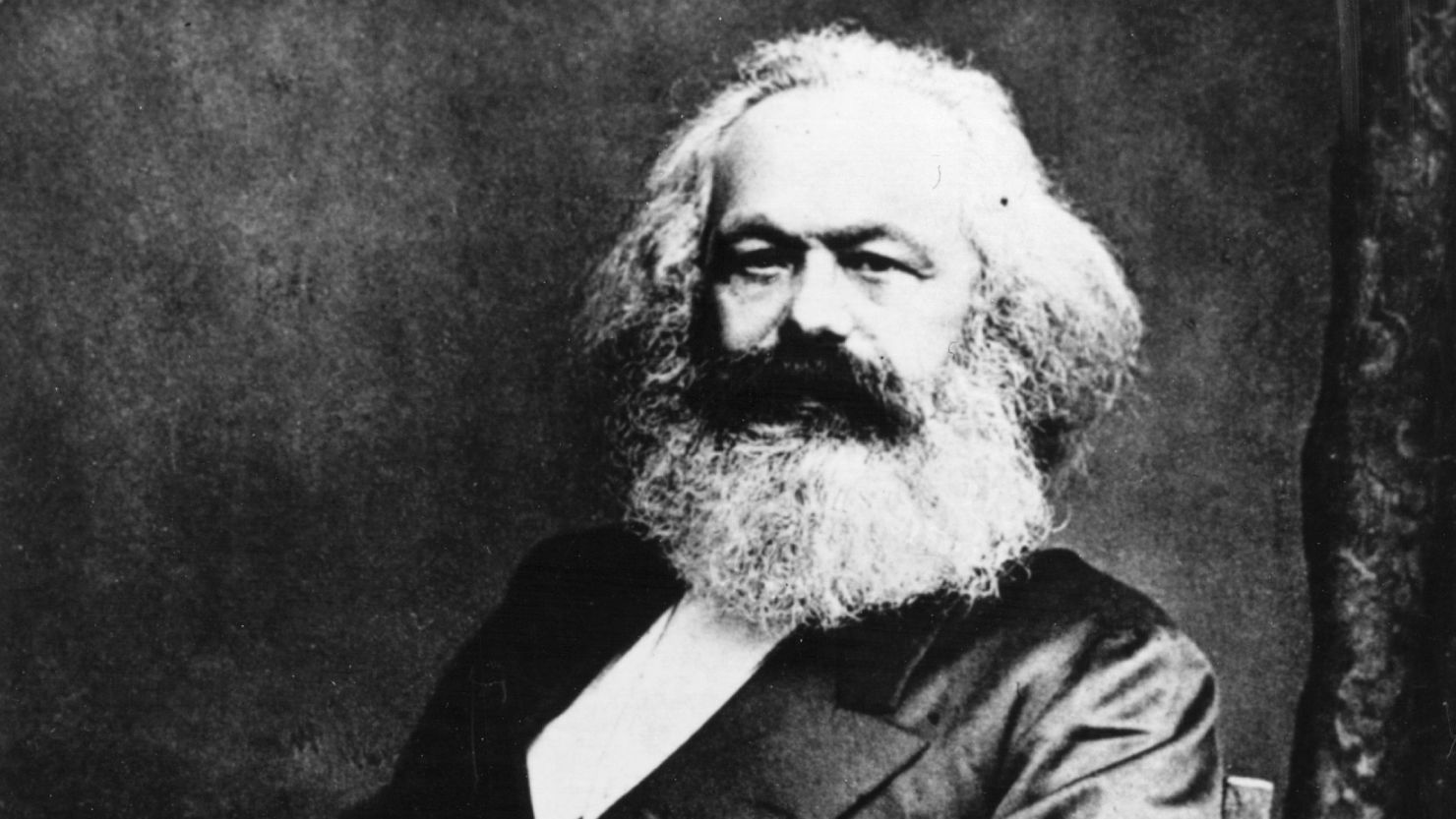
Marx’s life began in 1818, he was born in Germany, and he lived until his death to acute bronchitis in London, 1883. In his lifetime, he saw one of the most horrific eras of industrial working conditions in all of human history – the height of the industrial revolution. It made him sick to see men, women, and children working for 12 hours a day or more in dismal and dangerous working conditions simply to earn enough of a wage to survive. While the working class suffered under these conditions, the ruling class in which they served – the ones who owned the factories and machinery – collected the majority of the profits generated by the labor of these workers. These living conditions alongside the rapidly rising inequal distribution of wealth are what inspired Marx’s future works as the founder of Communism. He was a victim of this system as well; he spent most of his life impoverished and constantly fleeing persecution for his ideas of egalitarianism. Additionally, the conditions in which he was forced to live saw the deaths of three of his children before they could reach adulthood.
"Private property has made us so stupid and one-sided that an object is only ours when we have it – when it exists for us as capital, or when it is directly possessed, eaten, drunk, worn, inhabited, etc., – in short, when it is used by us. Although private property itself again conceives all these direct realisations of possession only as means of life, and the life which they serve as means is the life of private property – labour and conversion into capital. . . The abolition [Aufhebung] of private property is therefore the complete emancipation of all human senses and qualities, but it is this emancipation precisely because these senses and attributes have become, subjectively and objectively, human. The eye has become a human eye, just as its object has become a social, human object – an object made by man for man. The senses have therefore become directly in their practice theoreticians. They relate themselves to the thing for the sake of the thing, but the thing itself is an objective human relation to itself and to man, [In practice I can relate myself to a thing humanly only if the thing relates itself humanly to the human being. – Note by Marx] and vice versa. Need or enjoyment have consequently lost its egotistical nature, and nature has lost its mere utility by use becoming human use."
Link to a PDF of the section of "Economic and Philosophical Manuscripts" that explores this concept and the whole of private property within the framework of Communism.
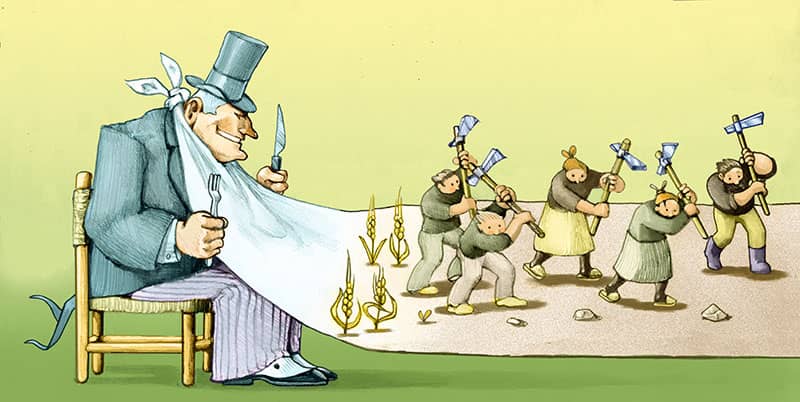
Furthermore, Marx believed that this ownership of private property as a result of industrialization led to impersonal, repetitive, alienated labor: labor that distanced the workers from what made their work human, that being their creative agency over the unique quality of their work - the division of labor moved away from specializations such as blacksmithing to an assembly line of labor. Through this alienated labor, the bourgeoisie (the ruling class) siphons the surplus value, which is the additional value brought to a product through the work put into it, out of the products of the proletariat (the working class)'s labor to generate vast amounts of wealth while doing little to nothing to participate. Marx believed this relationship was inherently exploitative.
Our Species-Being

Hegelian Influence
To put it simply (and reductively), Hegel’s concept of dialectics was the relationship between two conflicting things, often referred to as the thesis and the antithesis moving towards a resolution known as the synthesis. Additionally, it is important to note Hegel never used these terms and this is not an entirely correct analysis of his idea.
Materialism is the concept that human beings are shaped by their environment.
Historicism is the idea that you need to explain social phenomena historically and you need to view history as changing through interconnectedness and evolution.
Marx combined his concept of materialism with Hegel’s concept of dialectics into what we know as dialectic materialism: which is the belief that the world is constantly changing due to environmental conflicts. He believed that we could understand the relationship between the Bourgeoisie and the Proletariat this way. This concept, combined with historicism, creates Historical Materialism which argues that a society’s economic base (also known as its mode of production) shapes its superstructure (culture, politics, religion). As a historicist like Hegel, Marx believed that history was naturally heading towards a point of equilibrium, to him, he saw this transformation as a transition from Feudalism, to Capitalism, and finally, to a society that would for the first time, be free of class conflict – a Communist one. That is why he and Engels wrote the Communist Manifesto in 1848, to hopefully speed up this process.

Instead of just reductively summarizing the Marx's most critical philosophical, economic, political, and system building theory - I have a video by an incredible theological historian that I think explores the concept better than I ever could - especially in a blog-post. That being said I will also provide some of my own insight as well as an additional video made by the same guy that explores the history of socialist ideology.
In a communist society, Marx saw that the proletariat would dictate the ruling ideas of this era, as he felt that capitalists dictated the ruling ideas of their era. He felt this would be fundamentally socialist. I’d like to define socialism here, as our understanding of it in modern society is often misguided. If you were to look up a definition, you would get an answer about the government owning the means of production. While collectivism is a critical part of socialist theory, this definition is unusably broad and fails to incorporate the fundamental values of social, those of socio-economic egalitarianism, and an elimination of inequality. A definition I have come across through a historic recounting of the development of socialism is this: a socioeconomic philosophy primarily concerned with shaping wealth, institutions, or economic activity according to various interpretations of equalitarianism. To Marx, this new social order would see the control of industry and all branches of production taken out of the hands of competing individuals, and into the hands of the collective of society, replacing competition with association/cooperation. As defined in Engel’s works “The Principles of Communism:” finally, when all capital, all production, all exchange has been brought together in the hands of the collective, private property will naturally disappear, with money becoming superfluous.
It is from the previous video and this one that I was most inspired for my formatting and foundation of my research.

From Saint-Simon and Robert Owens to Karl Marx and Vladimir Lenin, Chapman explores the historical development of socialist ideology into the creation of Communism - more specifically Marxist-Leninism. To conclude, he creates a modern definition, the one I used above, for socialism to better encompass what it means to be a socialist. Marx and Engel's Communist ideology is a branch of Socialist thought.

Corbin Medley - Section 3
ReplyDeleteI have no idea why the implementation of the first photo changed the format to be single-space nor was I able to alter it. Other than that odd change halfway through the formatting looks fine.