Epicureans and Stoics-LHP 4-5. Weiner 6, 12. Rec: FL 7-8. HWT 6-8. Select midterm report presentation topic & date: indicate your 1st and 2d choices for date and topic in the comments space below Midterm report presentations...
2. How is the modern meaning of "epicurean" different from Epicurus's? Do you consider yourself epicurean in either sense of the term?
3. What famous 20th century philosopher echoed Epicurus's attitude towards death? Do you agree with him?
4. How did Epicurus respond to the idea of divine punishment in the afterlife? Is the hypothesis of a punitive and torturous afterlife something you take seriously, as a real possibility? Why or why not?
5. What was the Stoics' basic idea, and what was their aim? Are you generally stoical in life?
6. Why did Cicero think we shouldn't worry about dying? Is his approach less or more worrisome than the Epicureans'?
7. Why didn't Seneca consider life too short? Do you think you make efficient use of your time? How do you think you could do better?
- What was Kepos? What did Voltaire say we should cultivate? What do you think that means, philosophically?
- What inscription greeted visitors to Epicurus's compound? And Plato's Academy? Which would you personally find more inviting?
- Whose side in School of Athens was Epicurus on, and why? Do you agree?
- What is tetrapharmakos, and how might it help you distinguish Epicurus from Epictetus?
- Every life is what, according to Epicurus? Do you agree that this is grounds for celebration?
- Which American founding father declared "I too am an Epicurean"?
- What does Eric think happens if you follow the "good enough" creed?
- A common Stoic exhortation is... ? What is its core teaching? Do you think this is too passive?
- What did Diogenes learn from philosophy?
- What does it mean to say Stoics are not Spock?
- What did Epictetus have in common with Socrates?
- What is premeditatio malorum? Do you agree with Eric's daughter's assessment of it? Or with his, of her?
- What's "the View from Above"? Does it help you put events in your life in a better perspective?
- Have you experienced the death of someone close to you? How did you handle it?
- Do you care about the lives of those who will survive you, after you've died? Is their continued existence an alternate (and possibly better) way of thinking about the concept of an "afterlife"?
- Do you consider Epicurus's disbelief in immortal souls a solution to the problem of dying, or an evasion of it? Do you find the thought of ultimate mortality consoling or mortifying?
- How do you know, or decide, which things you can change and which you can't?
- Were the Stoics right to say we can always control our attitude towards events, even if we can't control events themselves?
- Is it easier for you not to get "worked up" about small things you can't change (like the weather, or bad drivers) or large things (like presidential malfeasance and terrorist atrocites)? Should you be equally calm in the face of both?
- Is it possible to live like a Stoic without becoming cold, heartless, and inhumane?
- What do you think of when you hear the word "therapy"? Do you think philosophers can be good therapists?
- Do you think "the greatest happiness of the greatest number" is an appropriate goal in life? Can it be effectively pursued by those who shun "any direct involvement in public life"?
- If the motion of atoms explains everything, can we be free?
- Is it true that your private thoughts can never be "enslaved"?
Epicureanism: The Original Party School
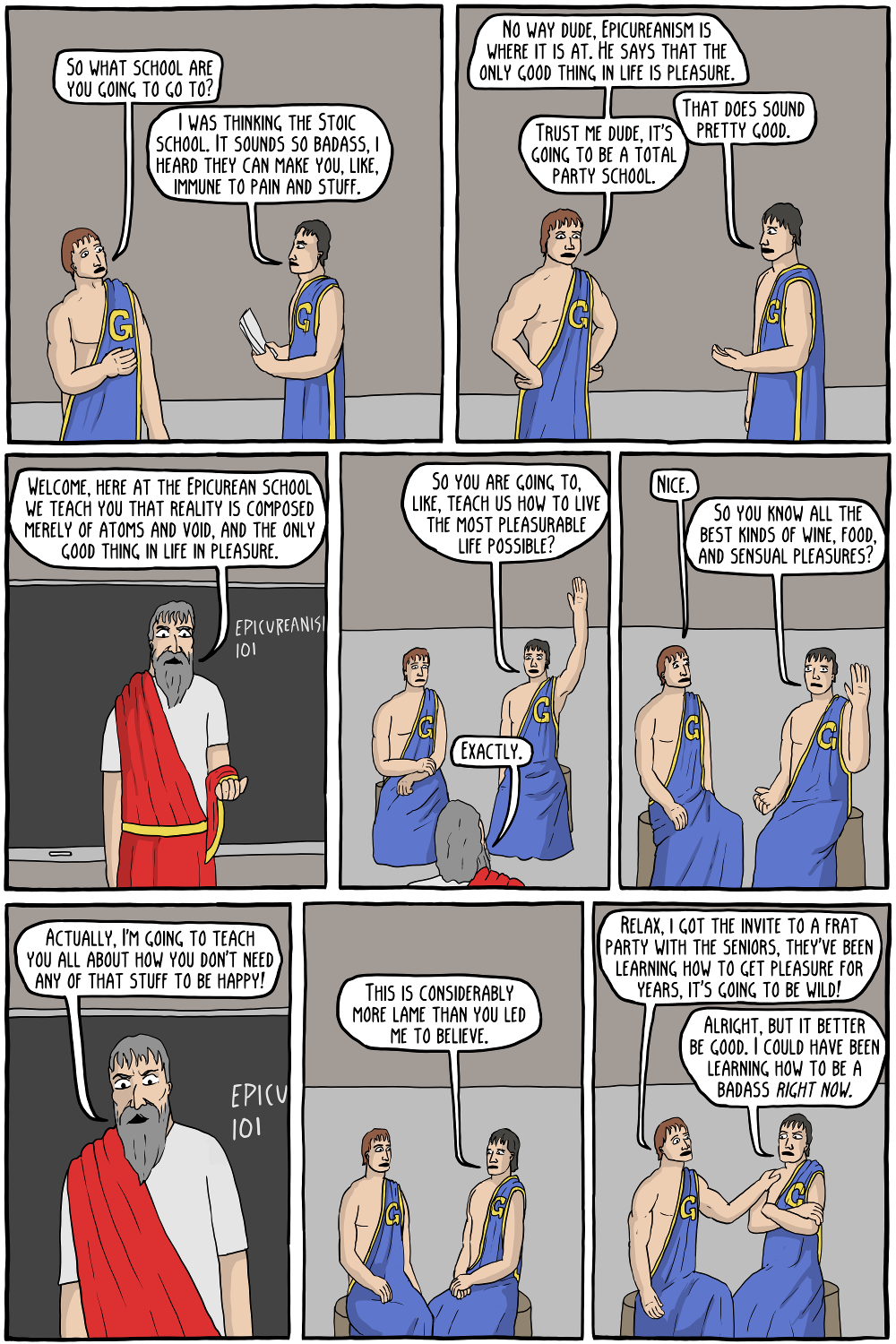
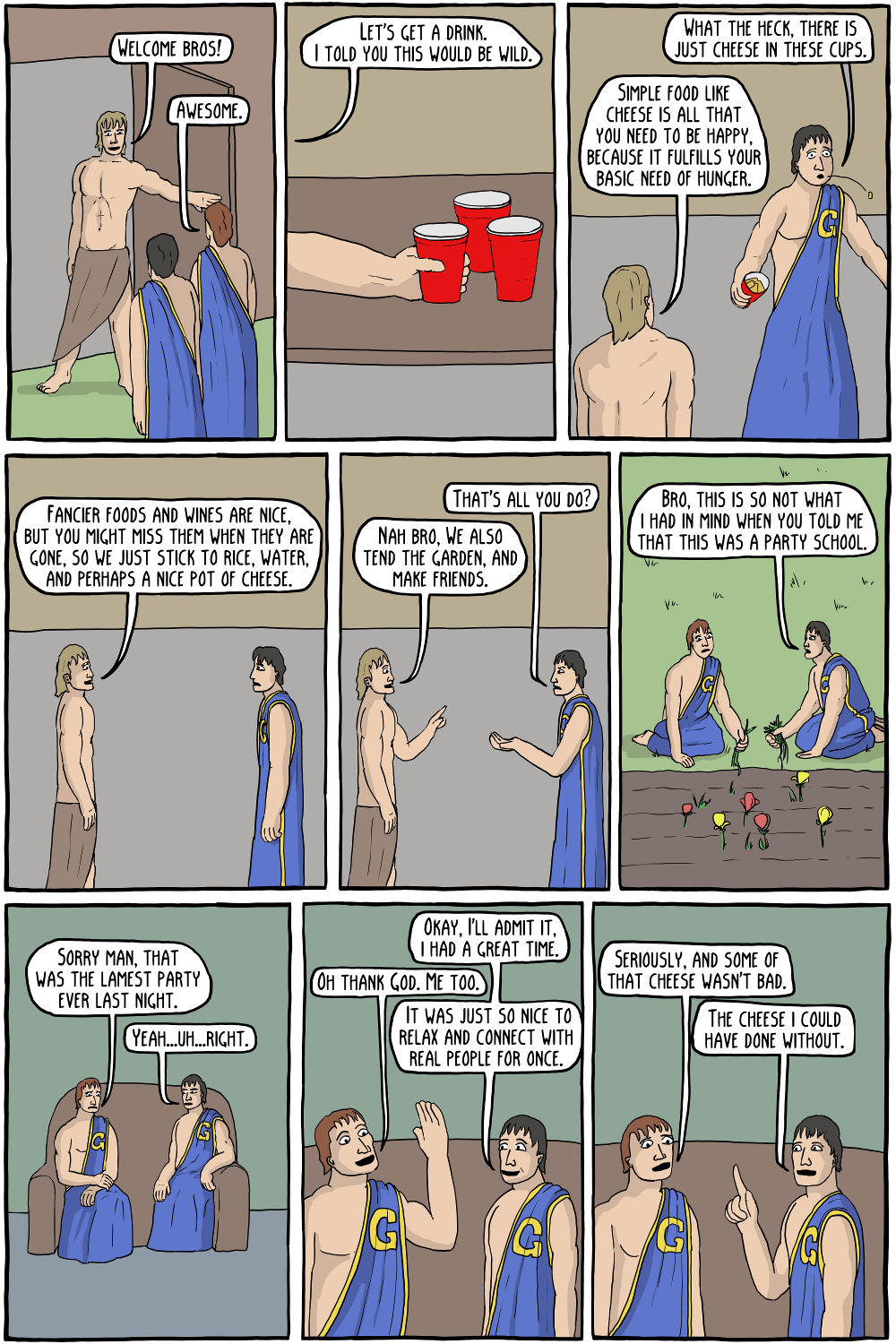
Permanent Link to this Comic: https://existentialcomics.com/comic/133
==
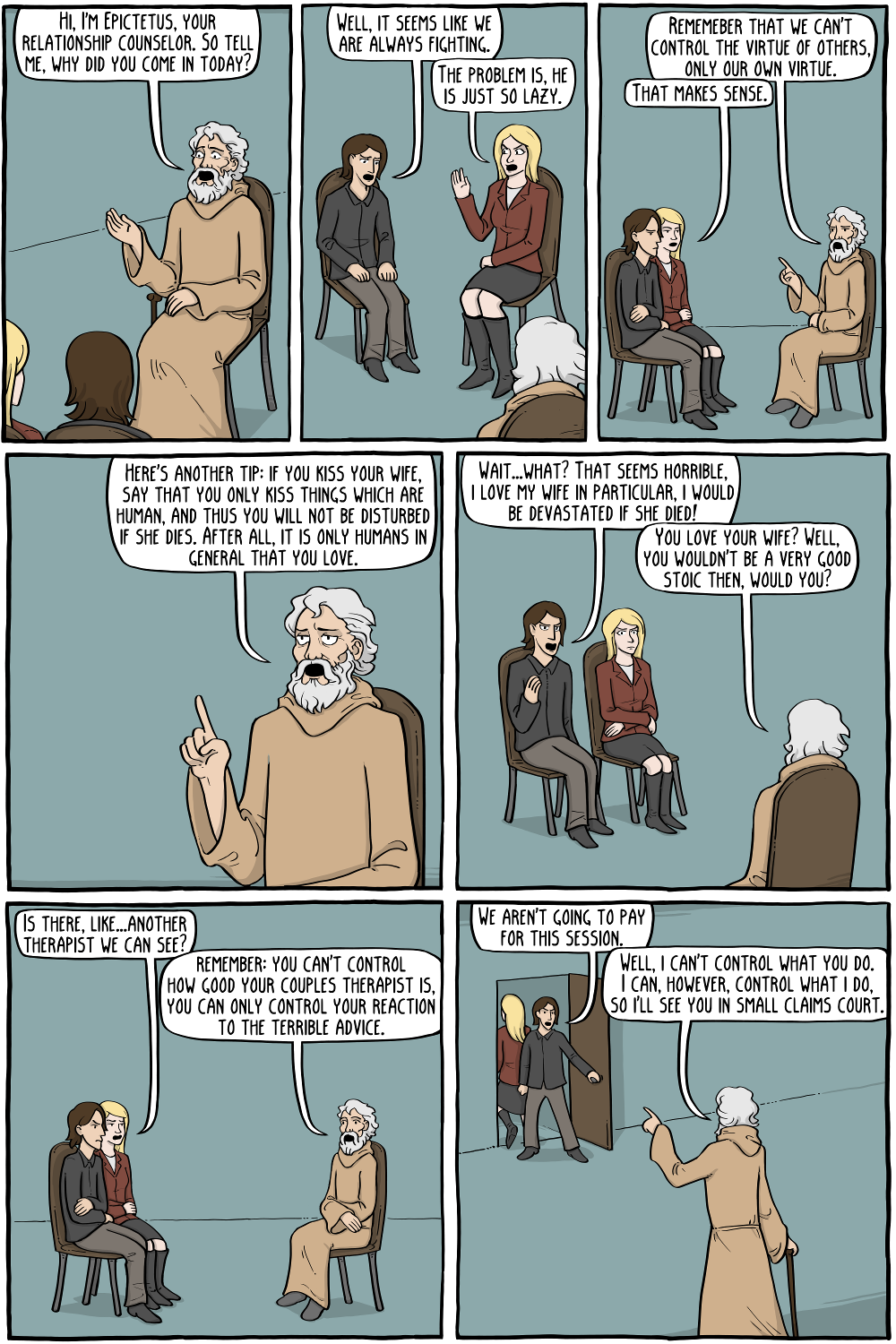
Philosophers in this comic: Epictetus. In The Enchiridion Epictetus gives the advice that in order to avoid suffering, we should not become too attached to particular things, so that when they inevitably end we are not caused undue harm. He starts with the fairly straightforward example of a cup that we like breaking:
With regard to whatever objects give you delight, are useful, or are deeply loved, remember to tell yourself of what general nature they are, beginning from the most insignificant things. If, for example, you are fond of a specific ceramic cup, remind yourself that it is only ceramic cups in general of which you are fond. Then, if it breaks, you will not be disturbed.
He then proceeds immediately to what seems a quite more drastic example:
If you kiss your child, or your wife, say that you only kiss things which are human, and thus you will not be disturbed if either of them dies.
Some may find that living in such a way is strange, to say the least.
Permanent Link to this Comic: https://existentialcomics.com/comic/264
==
Stoicism Man...The Next Great Stoic competition... Stoic apathy


Over the years I've made a few slideshows (see "Oliver's slideshows" in the sidebar). Here's one:
Tetrapharmakos
The etymology of “tetrapharmakos” is quite simple: “tetra” means “four” and “pharmakos” means “remedy” or “medicine.” They are both Greek words.
Originally, the term refers to a compound of four actual drugs: wax, tallow, pitch, and resin. Later, it’s used metaphorically by Philodemus, one of Epicurus’ disciples, to refer to the core principles of happiness in Epicureanism, since both of them function as a “cure” and are four in number.
Philodemus put together the tetrapharmakos from fragments of his master’s teachings, and summarized them into four points:
- Don’t fear God.
- Don’t worry about death.
- What is good is easy to get.
- What is terrible is easy to endure.

#1
ReplyDeletePerhaps I'm just biased, but Epic-Curious is a great name for a philosopher, so that's how I'm going to pronounce his now.
1. According to Epicurus, fear of death is based on what, and the best way to live is what? Are (or were) you afraid of death, or of dying? Are you more afraid of losing others?
hoo... many questions in one here, so many places to start with this question. Best place to start though is at the very beginning. Epic Curious believed that fear of death was illogical, because we won't exist then. The pain will last for a little bit and then poof, it's everyone else's problem. Best way to live is to search out pleasure, but more importantly, mitigate pain (which he did by mitigating desires, especially unobtainable ones or ones you'd have to suffer for).
Do I fear death? No. Not really. I fear the pain I will cause to others-- but that's not the same. Fear of death is something I thought through ages ago and decided was silly. After all, I die every unit of time I exist. I'm dying constantly. Why? Well, I don't have some disease that is slowly destroying me (besides you know mortality, time, and consumption of telomeres). Its because death, or rather non-existence happens every second for me. I cannot remember what it is to be yesterday's me. I don't know what it's like to be a child. I can't imagine me tomorrow or two years from now-- because that won't be me. I will have a different personality, a different sense of self, a different ever so brief span of life. So either "I" am an infinite number of existences and immortal till someone ends my chain inhabitance of the flesh surrounding me, or I am constantly dying. Constantly dying made more sense. The person who started writing this sentence has long since died by the time it is finished. A new Sarah is in her place and continues on her quest.
Of course, I don't expect that to work for everyone, it's just what makes sense to "me" or perhaps "us" is better fitting in this case.
2. How is the modern meaning of "epicurean" different from Epicurus's? Do you consider yourself epicurean in either sense of the term?
"Epicurian" now is only the pleasure seeking, none of the pain reduction that our little Epic Curious taught. He shunned expensive luxuries because if you had them, then they would instigate greed inside you (very monk reminiscent) One could be happy by simple pleasures and friendships, nothing expensive. This is something I can agree with.
But do I consider myself a follower of Epic Curious's teachings? No. Although I came to many of the same conclusions he did, I did so without his help and there are many key differences. How he and I view death as it were. And also, his teachings say not to strive. Do not want. Do not live your life working towards a goal you'll never achieve.
I cannot believe in that.
My goal is to make the world a more perfect place. A better place. An infinitely better place. It's as impossible as the thought of being immortal when anyone can end my existence in this flesh of mine. If I followed Epic Curious, I'd never start, because I already acknowledge that Utopia is impossible. Humans will ruin it. He says if it's impossible, then I shouldn't waste time with it. I disagree, that doesn't mean we can't spend our entire lives striving for an infinitely better world, climbing up an endless metaphorical mountain as our bodies give out and the thin air fails us and others drag us down. As our knees weaken and fail, as our skin blisters, burns, and peels away, I- we- must still reach up towards the impossible to make the world better. Because it can be better, but if no one tries, it never will be.
Epic Curious said to not devote oneself to an impossible cause. I say devote yourself if you deem the cause worth your suffering (worth all my sufferings), but remember not to let yourself break until you are almost at the mountains summit and your friends can carry you the rest of the way. Because it is impossible, failure means nothing, but even small successes mean everything.
DeleteNow, if I lived in ancient Greece, considering his compound was one of the few if not the only that allowed women and slaves, I'd be epicurian. It probably wouldn't do to have a woman starting her own school of thought after all.
Another side note: I found his "Why do you worry about what happens after when you don't worry about what happens before" really funny and poignant, but there is an obvious answer. Even if we are not living, we have an impact on what comes after. We bear responsibility for creating that world we no longer exist in. (Sure: no afterlife means no self-judgement, but empathy/sympathy still says we should care for those who survive us. And if you have no empathy/sympathy, what's the cause of your morality? Route memorization? Determination?) Sure it won't impact us, but that doesn't mean we have no impact. You may have no impact then, but you can make an impact now that will outlast you and your friends (and enemies) will feel it. It's a nice thought and a great quip Epic Curious, but I don't think it works.
4. How did Epicurus respond to the idea of divine punishment in the afterlife? Is the hypothesis of a punitive and torturous afterlife something you take seriously, as a real possibility? Why or why not?
"The gods don't care" (Probably because he didn't want to say they don't exist and get force fed poison) -- Epic Curious
I have never worried about hell. I've always considered myself a good person, even before I knew much of anything, before I understood that most people consider themselves good people. By the time I made that stunning realization (and the one that not everyone was as focused on my flaws as I was). I was also reconsidering 'God' and 'Hell'.
If a Christian god exists, and he is as nice as people say he is, he'll forgive me my disbelief because I've done lots of good (pretty sure that's legit in the bible). I won't get any honors, but I won't go to hell either. Worst I'll get is purgatory. If he doesn't see it the same, that's not my fault. I'm not going to spend all my time and effort worshiping and begging when there are things to do.
If no God exists well then I'm not out anything. I'll either cease to exist, move on to whatever is next, or float around in the foggy darkness forever. Perhaps I'll get to haunt people. That could be fun.
If multiple gods exist, or the god that exists isn't Christian, (because there are so many many other gods that it's really a crapshoot and all of their followers claim they've done devine things and there is evidence and people will die for those beliefs-- all arguments I've heard before) then I can't have known better and have to hope they're nice.
Seriously, this is getting kinda ridiculous. This takes me over an hour to organize and write each time, and I can't even post it in one piece.
DeleteMy responses are only going to keep getting longer as the semester goes on, you do realize that, right? You're going to have to keep reading these as I breach three and even four comments just answering three questions.
/light hearted and well intentioned
Epi-Curious would be a tolerable deliberate mispronunciation IF it didn't remind me of the culinary website instead of the philosopher.
DeleteKeep those long posts coming, Sarah. We can always ask AI to give us a terse summary.
Not sure what an "infinitely better place" would look like, but it's good to aim for the stars.
DeleteSection #1
ReplyDeleteAdditional Question 1.) In November 2024, I experienced the loss of my great-grandmother. She had gotten sick in late July, and we thought she’d get better, but in reality, she was slipping away slowly. It’s been hard since her loss, but I’ve found ways to cope. Well- really only one. I love writing poetry, so I poured my pain out into that, and that’s helped me in more ways than I could describe.
Additional Question 2.) I do think about those whom will live after me. It’s frightens me, actually. One day down the line, I may be forgotten— my quirks, my personality, my history will all just fade away. And that terrifies me more (not more than death does). However, if I have a family of my own, I hope I teach them to keep my memory alive. Maybe they could do a ritual for me that goes on for 100 generations of mine!
Additional question 8.) When I think of therapy, I think of clinical psychology (surprise, surprise, but it’s my major!) I believe philosophers could be amazing therapist. Philosophers would ask relevant questions, and it could also make a patient dive deeper into themselves and realize why they’re feeling this way. The only problem philosophers may have is coming to a clear diagnosis, if they’re one that likes to keep the discussion open. You never know.
I'm sorry to hear about your great-grandmother, but I'm glad you've found an outlet that helps you process and heal.
DeleteI think we all just have to accept that we won't remain alive to hundreds of generations of our successors. How much do you know about your own great-grandparents, for instance? Just remember Shelley's Ozymandias: "My name is Ozymandias, King of Kings;Look on my Works, ye Mighty, and despair!" What works, Ozzy? Marcus Aurelius was emperor of the mighty Roman empire, but he expected to be forgotten. I think we only remember him because he wrote those wonderful meditations FOR HIMSELF, not posterity. But most of us will not be philosopher-kings. Our happiness depends on being okay with that.
DeleteSection #1
ReplyDeleteLHP:
1. Ludwig Wittgenstein wrote “Death is not an event in life,” (Warburton, p. 25) meaning that death is the end of our experience and consciousness; we may experience the process of dying, through sickness or injury, etc., but we cannot experience our own deaths. Those still living experience it for us. Death is not something that should be feared, and it is not something that we should spend our lives worrying about. The fear of no longer being alive can trap us and stop us from truly living. There is a type of finality to death (I personally believe there is a life beyond it), but that end does not have to be scary or saddening if it is the capstone of a life well lived.
2. Seneca did not think that life was too short, he just thought that people did not make good use of the time they’d been given. If we had any more time, we would just waste it anyways, so best to make do with what we have. Recently, I have had spans of productivity followed by spans of rotting, and I think the time spent rotting unfortunately outweighs the times of productivity. I’m trying to teach myself to become a morning person, with gradual success, and I think I would lead a much better life full of better activities if I could just figure out how to put my phone down, which I think I am also doing with gradual success (though the screentime notification that I got while typing this might suggest otherwise). One thing I’m learning from trying to create better habits is that progress is not a straight line upwards, instead it’s a line that goes up for a little bit, then down, then maybe back up for a time, and then there’s a peak, and then a crash, and then it slowly climbs back up. I think life’s shortness and the unpredictability of its true length should not cripple us with fear and uncertainty, but should motivate us to do and see and learn as much as we can while here.
Weiner:
3. Epicurus’ garden wall bore the inscription “Stranger, your time will be pleasant here. Here the highest good is pleasure,” while Plato’s school said “Let no one ignorant of geometry enter here.” One philosophy comes with a promise, the other with a prerequisite. In order to enter Plato’s school and learn, one must already be educated. That eliminates everyone who is not a free man. All Epicurus asks for is someone who is even mildly interested in what he has to say, someone with a desire to learn and a mind that can change. His garden is open to anyone who wants to enter.
As a confirmed morning person I strongly recommend continuing to cultivate that lifestyle. You can count on a fresh start and a new beginning every 24 hours, when you rise with the dawn and thus reserve the best part of your day for yourself, for reflection and appreciation of the gift of life.
DeleteI'll take the Garden over the Academy, hands down. But Aristotle's Lyceum has its appeal too.
#3
ReplyDelete1) According to Epicurus, fear of death is based on what, and the best way to live is what? Are (or were) you afraid of death, or of dying? Are you more afraid of losing others?
Epicurus believed that the fear of death was, quite frankly, a waste of time. He thought that the best way to live is just to use death as a kind of motivator to live a good life. To be honest, I am more afraid of losing the most important people in my life to death, rather than being scared of dying myself. I think everyone fears death at least a little bit, though that fear may stem from sifferent issues such as a divine reckoning or simply fear of the unknown.
2) How is the modern meaning of "epicurean" different from Epicurus's? Do you consider yourself epicurean in either sense of the term?
The modern meaning behind "epicurean" is a person who lives a lavish lifestyle full of luxuries. Meanwhile, Epicurus lived a life of simplicity. I myself fall somewhere in between these two lifestyles. I throughly enjoy my simple pleasures, but I do indulge in nicer things sometimes.
3) What famous 20th century philosopher echoed Epicurus's attitude towards death? Do you agree with him?
Ludwig Wittgenstein was the modern day philosopher that agreed with Epicurus' teachings on death. I believe that depending on how you die, death can be an experience, the final experience of all.
LHP 4-5
ReplyDelete1. According to Epicurus, fear of death is based on what, and the best way to live is what? Are (or were) you afraid of death, or of dying? Are you more afraid of losing others?
Epicurus believed fear of death is based on bad logic and was a state of mind to be overcome. He believed the best way to live was to have a very simple lifestyle, be kind to those around you, and surround yourself with friends. I would say I’m more afraid of dying than of death. I have ideas about what death is like, but I have no way to test or prove those theories, so my fear of death would come more from the fear of the unknown than fearing what death would be like. I would say I’m more afraid of dying because dying is something I can try to avoid, so my fear results in action. I’m not sure if I’m more afraid of dying or losing others—of course I’m afraid of both, but the only reason the fear of my own death may be equally as significant would be because I’m afraid of hurting the people I care about.
2. How is the modern meaning of "epicurean" different from Epicurus's? Do you consider yourself epicurean in either sense of the term?
The modern meaning of epicurean is almost opposite what Epicurus’ definition was. An “epicure” indulges in luxury, fine foods, and sensual pleasure, but Epicurus prioritized simplicity and not longing for things you can’t have. I don’t think I would consider myself to be either version of epicurean because I don’t prioritize indulgence in my life, but I also don’t prioritize simplicity. I know I have big goals, but I’m not going to give up on them simply because they might never come true. I think it’s worth chasing after the things I’m passionate about, and for me, it’s part of what makes life worth living.
3. What famous 20th century philosopher echoed Epicurus's attitude towards death? Do you agree with him?
Ludwig Wittgenstein echoed Epicurus’ attitude towards death. I don’t really agree with him because we as living people have no way of knowing what we can or can’t experience in death. We have no idea what death is like, so how can we know that it would mean nothing happens to us at all? Also, a fear of death based on fear of dying or how you will die I think would also make sense. We would experience dying even if we don’t experience anything in death.
5. What was the Stoics' basic idea, and what was their aim? Are you generally stoical in life?
The Stoics’ basic idea was accepting what you can’t change. They believe we choose our attitude about things that we can’t control and that we’re responsible for what we feel and think. They believed emotions clouded reasoning and damaged judgement. I would say I’m only a little bit stoical. I believe in trying to accept things that you can’t control without being overly upset by them, but I don’t think I tend to suppress emotions all the time.
6. Why did Cicero think we shouldn't worry about dying? Is his approach less or more worrisome than the Epicureans'?
Cicero believed we shouldn’t worry about dying because the soul lived forever. I guess someone could think Cicero’s approach could be more worrisome because it allows for eternal punishment or other theories about the afterlife to also be true. The Epicureans don’t believe anything could happen to you after you die, so you don’t have to worry about that.
7. Why didn't Seneca consider life too short? Do you think you make efficient use of your time? How do you think you could do better?
Seneca didn’t consider life too short because he considered it long enough to get plenty done if we make the right choices. I think I sometimes use my time efficiently. I’m working to spend less time on my phone and more time with friends and working towards the things I’m passionate about. I usually think about it like this: if it’s something that is going to make me a better person, something that I’m going to remember, or something that is helping me work towards a goal, then it’s worth my time.
One's own death may not be an event in one's own life, but the deaths of precious others definitely are.
DeleteSeneca saw his peers (and himself) wasting too much time back in antiquity, without any electronic/media diversions of any kind. Imagine what he'd say about us!
1. According to Epicurus, fear of death is based on what, and the best way to live is what? Are (or were) you afraid of death, or of dying? Are you more afraid of losing others? According to Epicurus, the fear of death is based on bad logic, and the best way to live is to have a very simple lifestyle, be kind to those around you, and surround yourself with friends. I’ve never really been afraid of death or dying, I try not think about it too much, because if I did I think it would cause me to hyperfixate on the concept of death and cause me to go down too many rabbit holes. I am 100% more afraid of losing others. I lost my grandma and my dad within a span of 2 months at the age of 11, which is a very bad age for this to happen since it is a very important developmental age. I have the irrational fear that since I lost them both to cancer so close together, that anyone I meet who has family members with cancer will pass away because of what happened to me.
ReplyDelete5. What was the Stoics' basic idea, and what was their aim? Are you generally stoical in life? The Stoics’ basic idea was that we are responsible for what we feel and what we think, and their aim was a calm state of mind. Generally, I think I am stoical in life most of the time. I try to keep the idea that I am responsible for what I feel and think in the back of my mind, but sometimes its just easier to blame someone else for something we have the control over.
7. Why didn't Seneca consider life too short? Do you think you make efficient use of your time? How do you think you could do better? The problem that Seneca saw was not how short our lives are, but rather how badly we are at using the time we have. I don’t think I make the most efficient use of my time on earth. I procrastinate badly, which causes me to feel so much stress and i’m not able to enjoy the time I have outside of school. I think I could do better if I remind myself of how short life is and just get my brain to realize that yes, there are a lot of once in a lifetime opportunities, but I also need to focus school and get the tasks that I don't quite enjoy but stress me out if I don’t get them done.
Section #1
DeleteFellow procrastinator here. I also spend a lot of time thinking about wasted time and missed opportunities. Most of the time, this comes from inactivity, or what I like to call “going horizontal” (laying on the couch and falling asleep). I also lose a lot of time scrolling through non-essential content on YouTube. The only thing that has consistently helped me get out of that rut is re-examining why I have to do things in the first place. When it comes to school, I remind myself that I chose to go to college to pursue knowledge, face my fears around coursework, walk the halls of great teachers and alumni, and accomplish something that only about 10% of the world achieves by earning a bachelor’s degree.
DeleteLHP 4: Epicurus stated that the gods don't care about what happens to their creations. Your soul is bound to your flesh and blood, and when those cease function, your soul no longer exists. I don't really take the idea of a hell seriously, or a heaven. Hell is something we've already got on Earth. If hell actually existed, it'd be derivative. I believe that when you die (specifically when your brain stops completely), that's just it. You don't see anything, you don't even see nothing. You don't perceive, or think, or exist anymore. That just kinda makes the most sense biologically to me.
ReplyDeleteLHP 5: The stoic worldview was one where any event can happen to a person, but however that person feels about it is up to them. The world will throw you things that are completely out of your control ("it is what it is" -Thundercat, among others); the only thing you can truly be in full control of is your emotions. Stoics also thought that the natural endpoint was to remove emotion from judgement entirely, to think in terms of pure logic. I think the first half of that is great, I strive to be emotionally intelligent and resilient when I can. I don't think the end goal should be complete removal of emotion, because empathy is one of the strongest tools humans have. Being void of all emotion would mean losing that. Whenever I hear about stoicism nowadays, it's usually associated with toxic masculinity, "manosphere" content, other harmful worldviews. Not letting emotions cloud judgement is different from bottling emotions, suppressing yourself from expressing them as they gnaw away at you. Basically, I'm glad that 'therapist' is a more established job title than 'stoic.'
Extra question 2: This line of thinking has actually helped prevent me from doing things like harming myself or committing suicide. I hate being a burden on people. If I were ever go through with it, it would create grief that would be a bigger burden than I could ever be while alive. I think that's better than imagining an afterlife. I think you should leave things better than how you found them, and that's a more tangible and actionable idea than just imagining what might happen when you die. You can't really hypothesize or theorize about what happens in the afterlife, because that requires proof. You can only write fiction about it.
The toxically-"masculine" stoic bros' attraction to stoicism seems weird to me, and I suspect they've misunderstood something basic about it.
DeleteLeaving things better is a worthy goal, but doing no lasting harm may be the more realistic.
Section #1
ReplyDeleteI'm mostly questions and comments this time around.
1) While reading Weiner's chapter on "How to Enjoy like Epicurus," I found myself wondering if the "good enough" attitude could become pernicious. If I'm always satisfied with things that are good enough, why would I have any reason to strive for anything better? Doesn't the desire for more drive personal and societal progress? Thankfully, as these thoughts were racing through my head, Weiner addressed my concerns. "Good enough doesn't mean settling. Good enough isn't a cop-out. Good enough represents an attitude of deep gratitude toward whatever happens at you." .... I really like that
2) To go with my previous comment, I wonder if it's alright to not settle for a "good enough" when you can settle for a "good." If it's available, why settle for less when you can have more? Hear me out... Towards the end of the chapter, Weiner recalls asking Tom for a coffee shop recommendation, hoping he would suggest a "quirky" local spot where every coffee is made with love. However, Tom recommends a generic Starbucks, and Weiner decides it's "good enough." Why? A more delightful experience is a Google search away... a local coffee gem might be hidden 2 blocks behind that generic Starbucks. So why settle for less when you can have a more unique and certainly more enjoyable experience if you seek it? I wonder what Epicurus would say.
3) A more general question.
Often, I find myself fascinated by the beauty and goodness of philosophical thought. There are a lot of great ideas I've read about, and many times have I sought to implement them into my own lifestyle, but with varying success. I read about an idea, fall in love with it, implement it, and then, after a couple of weeks pass, the new perspective/idea completely slips my mind. For example, I might read about Epicurus' perspective on gratitude. I will then implement that attitude into my daily life to improve my happiness. But then, after a few weeks, when the pressure of life adds on, I completely forget about the attitudes I was trying to cultivate. Then, I will come across another idea, perhaps Stoicism, and the cycle repeats. Is it normal for philosophy to lose its practicality when you need it most? I mean, it happened to Eric Weiner when he was cold.
Section #1
DeleteI guess, we must practice applying philosophical thought to the real world if we want consistent, practical results. There, I answered my own question. :)
I think we can't blame philosophy for our own busy forgetfulness. The right philosophy (which for me is Pragmatism) never loses its practicality because it always poses the same practical question: "What practical difference will it make for you and me" to believe and act on this or that idea, proposal, explanation, description (etc.)?"
DeleteI think the "good enough" philosophy is less about settling for mediocrity than resisting an impossible and disabling perfectionism. Honors students are often susceptible to that malady. We'll never be perfect. It's good enough to just try and be better.
ReplyDeleteSection #2
DeleteThis is so true for a good number of honors students, including myself, because we are in a more technically advanced class than usual, with more gatherings of very serious-minded and intellectual individuals, increasing the tendency to be prone to the "good enough philosophy".
Section #1
ReplyDeleteLHP 1.) Fear of death, according to Epicurus, was a waste of a person's mental energy and based on "bad logic." In fact, Epicurus encouraged mulling over death in a more positive light, as he figured it would make a person's life happier. The best way to live was to recognize that we all seek the highest form of pleasure naturally. To satiate these pleasures, we need to live a simple lifestyle, be kind to our peers, and surround ourselves with friends. I agree with this statement, as it's psychologically proven that to mitigate some problems in the brain, consistent social interaction with loved ones is essential and actually benefits certain regions in the brain. I'm not really afraid of dying, as it's something that happens to everyone, so there's no way I'm escaping it. I think more so I am worried about losing other people. Humans are social creatures and we become attached to the ones we love. Losing those people would make me feel like some of my purpose on Earth has been stripped away from me.
LHP 6.) Cicero argued against worrying about aging simply because there are benefits to becoming older. For example, working for a short period of time can lead to more benefits; there are more meaningful conversations with peers as you get older. Cicero, unlike Epicurus, believed that death just meant that the physical body was gone, but the soul still remained. This is his main evidence as to why nobody should worry about death. To some, this may be more worrying than Epicurus, who said that death was the end, and there was no way for the gods to punish you after death. With Cicero's explanation, there may be some way for the gods to punish you for your actions on Earth. With my own personal beliefs, I feel more comforted by Cicero's explanation. I'm not entirely sure, but part of me feels like there's some level of cosmic spirituality inside of us that doesn't simply vanish when we pass away.
Weiner 10.) Stoics are not "Spock" simply means that the stoics are not complete pessimists that go through life's terrible events acting as though nothing is going wrong. They still feel strong emotions such as joy and fulfillment; they just decide to not give attention to the things that give them strong negative emotions such as anxiety, worry, or anger. I find it interesting that Weiner said that older people seem to be more aligned with stoicism. Again, this is a developmental psychology topic that has to do with the social and cognitive development of elderly people. In order to live a more fulfilling lifestyle during retirement, they decide to focus on the people and things that give them joy while ignoring the negative emotions from other situations.
Extra question #1- I've experienced the death of my great-grandmother, who I basically looked up to as my grandmother since I never got to know who my dad's mother was. This happened back March 28, 2022, so I was a freshman in high school at the time. There was an extremely long grieving period that I went through, and it caused me to question more existential questions like the existence of God or what purpose I even had. It was hard for me to comprehend that she was fully gone. However, this grieving period helped me look inwards and begin to understand some of the pain that I'd been carrying for a long time, and it made me happier. This is why I disagree with the Stoics' belief of grieving for only a short period of time, similar to Weiner's viewpoint. That grieving period shaped me into a healthier and better person, and it taught me lessons that I wouldn't have learned without the passing of my great-grandmother. I appreciate life more because of that grieving that I went through with my family.
LHP Q#6.
ReplyDeleteCicero taught that we should not worry about dying because the soul lives on forever and we should only worry about things in our control. Since death is out of our control, Cicero believed it was not worth the energy. Epicurus also reasoned that the fear of death is a waste of time and something to be overcome. He argued that death is not something we can experience, and therefore should not be feared. I do not think either of these views are worrisome, but I prefer Cicero’s way of looking at death. Death can happen at any moment and at any age, and when it does happen it will be out of my control, so worrying about it seems pointless.
When it comes to the physical process of dying, however, I think Epicurus misses the mark. His idea of recalling happy memories sounds good in theory, but there are circumstances around death that are horrific and cannot be escaped by positive thoughts. In those cases, I would rather try to focus on Cicero’s idea that the soul cannot be created or destroyed. Realistically, I do not know how I would respond while dying, and I think shock may take over.
LHP Q#8.
Warburton highlights an uncomfortable truth about Stoicism that is often overlooked: when taken too far, it can make people indifferent and apathetic. This can dull the emotional highs and lows that make life meaningful and make it harder to connect with others. Warburton even suggests that Stoicism can make us “less human.” For example, if a friend says they are devastated over a breakup and a Stoic responds by saying they are choosing to feel sad, that response invalidates their emotions and places the blame entirely on them. While it may be a Stoic response, it is not helpful. In that situation, empathy matters more than emotional detachment. Stoicism works best for me in truly uncontrollable circumstances, and it also teaches us to embrace challenges rather than chase comfort.
Weiner Q#8.
The common Stoic exhortation is to live in accordance with nature. As cited by Weiner, the core teaching of Stoicism is “change what you can; accept what you can’t” (pg. 664). Some people interpret the word accept as passive, but if something is truly unchangeable, acceptance is a rational and productive response. I do not agree that accepting an outcome means giving up. Living in accordance with nature may seem more passive because it is a broad statement with no clear parameters. However, the Stoics lived disciplined lives, which is anything but passive. It takes focus and emotional control to choose not to be consumed by something distressing.
I went over the word limit so this post is a condensed summary of my original ideas. However, the stoics would probably have appreciated this abbreviated version more than the word salad I had before.
1. Epicurus argued that fear of death was a waste of time. He thought that when you're not worried about death you better enjoy your time on earth. I agree with him in a way, because obviously worrying about death takes away from living in the moment. However, in most cases people aren't worried about death 24/7, and I think it's an interesting concept to think about. The concept of fearing death is not an entire waste of time, but fearing death constantly is. And to answer the question of if I'm scared to die, I am more scared of losing people than I am of dying.
ReplyDeleteEpicurus believed in eliminating pain and only seeking pleasure, but I think that pain helps people be a good person sometimes. Obviously I'm not talking about crazy trauma, but heartbreak and feeling sad over things helps us learn. A part of living is feeling, and that includes displeasure.
I don't think that wanting to own a mansion one day but knowing you'll never get one is a displeasure. Some goals are unattainable but I don't think dreaming for things that probably won't happen is bad, I think it makes it life fun sometimes.
On the other hand, I agree with Epicurus that remembering happy moments gets people through bad times. Good moments far extend the time they're.experienced and follow people almost forever. When I'm experiencing bad things I remember happy moments and I'm hopeful for more to come.
Section H01
ReplyDelete1.) According to Epicurus, fear of death is based on the irrational fear of pain after death. Many people are attached to their bodies and cannot imagine any sort of existence without them, therefore they fear death because of their inability to separate themselves. Epicurus thought the best way to live was to seek out tranquility and freedom from fear. He believed people's fear of death kept them from living.
While I don't have a strong fear of death or dying, I would say I do fear dying from something that kills you slowly. A few years ago, I watched my uncle pass away slowly from Amyotrophic Lateral Sclerosis, or ALS. While he lived a wonderful life (had a loving wife, kids, and even met the still-living Beach Boys!), he knew he was going to die, and could feel himself withering, years before he eventually did. If I fear anything about my mortality, its a fate like that.
2.) Epicurus goals and desires in life were simple; he focused on living simply and without fear and worry. He also urged his followers to live within your means and avoid excessive and unnecessary desires (like the expensive wine mentioned in the chapter), as they could limit you and cause pain in the future, near or far.
Despite Epicurus' teachings, the meaning of Epicurean has changed drastically in modern times. Nowadays, being an Epicurean entails living lavishly and almost hedonistically, seeking out pleasure as much as possible. Modern Epicureanism encapsulates the modern mindset of thinking "you only live once".
I would say, while not strictly following one definition, I am take in a little bit of both versions of the philosophy. I don't spend my time constantly finding the next thrill, instead focusing on eventual happiness and peace, but I also don't limit myself to avoid future pain. I used to be a person who saved everything. Everything needed to be savored "at the right time". I often found that the right time never came. I had boxes of stickers and candies as a child that I hesitated to eat. Now, they rot in a landfill somewhere. I think, while staying within your means and not going too far, that it's okay to treat yourself every once in a while, even if that treat is a little more than what you can normally attain.
4.) The Stoics' basic idea was to not care about anything. By staying stoic and emotionless, they aimed to not be affected by anything. I am most definitely 𝘯𝘰𝘵 a stoic. While not as overly emotional as I used to be (thanks fluoxetine!), I allow myself to feel emotions when I need to. I spent a long time bottling up emotions, which would almost always lead to an explosive release more unhealthy than just letting myself feel. I have no doubt that some of these Stoics, while denying themselves the ability to feel what needed to be felt, hurt themselves and denied themselves inner peace. I am a big benefactor of not being so nonchalant about everything.
Extra Question 1.) I have experienced the deaths of people close to me. As mentioned before, my uncle passed of ALS, but I have also had two family members (technically, close family friends, but family nonetheless) whose deaths have affected me tremendously. My Uncle Mike, who passed in April 2019, and my Aunt Lisa, his sister, who passed in December 2022, both lost their fight to suicide. Seeing people I grew up with, people who changed my diapers and whose house's I stayed in over summers go from something so preventable changed my outlook on life entirely. I myself have had struggles in the past, but seeing how the people who loved and cared about my aunt and uncle grieved and what they had to go through made me immensely grateful for the life I have, and for the ability to live another day. I have allowed myself to feel, while also knowing that that dark place they once knew is something that can be emerged from and recovered from. There is beauty beyond the darkness in my eyes.
DeleteWhat is premeditatio malorum? Do you agree with Eric's daughter's assessment of it? Or with his, of her?
ReplyDeletePremeditatio malorum is the “premeditation of adversity”. It relies on anticipating worst-case scenarios and visualizing specific, catastrophic scenarios. Weiner describes that this practice allows us to develop a sense of gratitude for our circumstances, as well as prepare for bad situations. Eric’s daughter dismissed the notion, saying that we already worry enough, so why invest more time into thinking bad things? Although his daughter makes a compelling case, Weiner describes the distinction between worrying and premeditating adversity. He reasons that worrying is aimless, but that premeditatio malorum is intentional and the more detailed, the better. I think the example he describes provided me with more clarity, and I can understand the thought process. Personally, though, I try to avoid imagining the worst-case scenarios. In my experience, investing more energy into visualizing problems brings negative thoughts and, therefore, brings negative situations to life. While it may be true that imagining the “best-case scenario" leads to disappointment. I would rather be met with dismay while anticipating success and happiness. Dreaming about good things allows me to be hopeful and happy, and I can cope with being let down, if that happens to be the case.
“I was not; I have been; I am not; I do not mind”
Throughout each of the readings, I felt such profound revelations while reading such simple, seemingly obvious statements. This quote specifically struck me, because it’s short and clearcut, but packs a lot of meaning to me. I have always had a devastating fear of death, and learning about these philosophies has proved to ease some of my fears. It’s relieving to think we can release ourselves from the fear of death, because we won’t be around to experience death. The comparison of pre-birth with death was especially thought-provoking, and I regret not contemplating this before. I can pay more attention to the life I am living, because there is no reason to worry about a death that will have no impact on my present self.
How do you know, or decide, which things you can change and which you can't?
Personally, this question sticks out to me the most in terms of understanding stoicism. Aside from distinguishing between what is and is not within our realm of control, stoicism makes a lot of sense to me. Maybe it's the modern-day conditioning Weiner explains in chapter 12, but I believe it is good to maintain a high internal locus of control. To me, it’s a slippery slope deciding that things are simply out of our control, because it can lead to helplessness, perhaps disguised as passiveness. Sometimes, acceptance can be the greatest obstacle in developing and advancing. If major figures in our history believed things simply where the way they were, we would not be where we are today. While I will be the first to admit that anger is not as pleasant as peace and acceptance, but it is healthy and human. I don’t think we are meant to be content with circumstances, and I think it’s optimal that we stay disturbed and yearning for enhancement and invention.
1. According to Epicurus, fear of death is based on what, and the best way to live is what? Are you afraid of death, dying, or losing others?
ReplyDeleteEpicurus thought fear of death comes from misunderstanding it. We imagine death as something painful or scary, but his point was simple: when death happens, we’re not there to experience it. So there’s nothing to fear. Because of that, he thought the best way to live was calmly, seeking peace of mind, simple pleasures, and freedom from unnecessary fears.
Personally, I’m not really afraid of being dead. I think I’m more afraid of the process of dying, especially pain or unfinished things. But more than that, I’m definitely more afraid of losing people I care about. Death itself feels abstract, but losing someone hits immediately and emotionally.
2. How is the modern meaning of “epicurean” different from Epicurus’s? Do you consider yourself epicurean in either sense?
Today, when people say “epicurean,” they usually mean someone who loves luxury, good food, expensive tastes, indulgence. That’s actually pretty different from Epicurus’s real idea. He wasn’t about excess at all; he believed simple pleasures were better and that chasing luxury usually causes more stress than happiness.
I wouldn’t call myself epicurean in the modern sense. I’m not big on luxury for its own sake. But in Epicurus’s original sense, valuing peace, simplicity, and avoiding unnecessary stress, I’d say yeah, I lean that way. I’m more interested in being content than constantly chasing “more.”
4. How did Epicurus respond to the idea of divine punishment in the afterlife? Do you take that idea seriously?
Epicurus basically rejected the idea of divine punishment after death. He thought the gods (if they exist) are not concerned with human affairs, and since we don’t experience anything after death, punishment doesn’t make sense. Fear of hell or divine torture, to him, was just another way people scared themselves for no reason.
I don’t really take the idea of a torturous afterlife seriously. Not because I’m dismissive of religion, but because it seems more like a fear-based idea meant to control behavior. I think if there is something beyond death, it wouldn’t revolve around eternal punishment. Fear-based beliefs just don’t sit right with me.
8. What might be the cost of stoicism? Can someone be stoical and still compassionate?
The author suggests that the cost of stoicism can be emotional distance. If you’re too focused on controlling emotions and accepting everything calmly, you might come off as cold or detached, even when compassion is needed.
I do think it’s possible to be stoical and compassionate, but it takes balance. Being stoical doesn’t have to mean not caring, it can mean not letting emotions completely control you. You can acknowledge suffering, help others, and still keep your inner stability. The problem is when stoicism turns into emotional shutdown instead of emotional control.
Hello Daniel, I agree that someone else's death can have a emotional toll on us because we have Beene very close to them.
Delete#2
ReplyDeleteLHP
5. What was the Stoics' basic idea, and what was their aim? Are you generally stoical in life?
--The stoics thought that you had complete control of what you think and feel and that there are some things that you cant control, so what's the point of getting worked up about them? Almost to the extreme of removing emotions altogether. I resonate with the stoics for some of this. I do live with the thought that there's no point of being sad or distraught about something, you feeling that is not going to change the situation, but I do believe there is a boundary to this. Emotions are natural, and in some cases its healthier to feel them than hold them back. I think a good example of this is the classic story of "don't cry over spilled milk." The drink is already spilled, crying wont bring it back into the cup, so why bother? just clean it up and pour another glass. Also I think parents having and explosive reaction to something is another example, yelling and screaming at your kid isn't going to change the fact that there's crayon marks on the wall, its just gonna create more emotion. But I think they go too far by saying remove them all together. Emotions are human, and we like being human.
7. Why didn't Seneca consider life too short? Do you think you make efficient use of your time? How do you think you could do better?
--He didn't think that life is too short, he thought that people said that because they weren't using the time they had to the fullest and they had regrets or things they still wanted to do. I'd like to say I make good use of my time. I'm studying to do something I love, I have free time hobbies i love to do, I go to events/concerts/conventions when I can, of course I'd love to go to more. I want to travel to cool places around the world, I can't do that right now because I don't have the money, but that has been a plan of mine since I was little. Sometimes I think I spend too much time on school and I wont be able to actually live because I was studying the whole time. There are so many fun things I'd love to do, but I can't because I have to set myself up for a successful career and future. But I still think about what it would be like if I took all the opportunities I came across.
Weiner
5. Every life is what, according to Epicurus? Do you agree that this is grounds for celebration?
--Epicurus thought that life was a product of chance, a miracle he says. I do believe life should be celebrated, it is a very special thing. I know from my faith that life is a gift from God and that we should treasure it. The thought that life is just a freak chance or a miracle that it happened, makes it seem insignificant, instead of purposeful. Thinking that you were put here on this planet for a purpose is a lot more comforting that thinking that you just happened to be here by chance. At least for me, it might not be that way for someone else. They might find more comfort in the thought that life is a miracle of atoms, and that is okay too.
By the way, today is my birthday :)
Deletefirst off HAPPY LATE BIRTHDAY!! also when answering Seneca's claim would you not be contradicting yourself based on Seneca's ideas because you said you have a goal but no money to achieve it but then your doing all these other things that wont help u achieve it. also I like to have fun as well IU promise but I'm solely basing this off Seneca right now and because of that are you really making good use of time if its not going to benefit your goals or future?
Delete#2
ReplyDeleteLHP q3- Ludwig Wittgenstein echoed Epicurus's idea on death. He thought that death wasn't an event because an event is something we live through. I agree with this because someone's life is the event. Therefore, death would be after the event. Also, its unknown what exactly happens to us after death, so if it was an event it's an imaginable event.
LHP q7- Seneca didn't consider his life short because he did what he loved/ wanted to do with his life instead of waiting. I don't think I'm making efficient use of my time because I feel like I spend too much time working. I can do better by relaxing and taking a break.
Weiner q1- Kepos is a house that Epicurus bought. He thought it was the perfect place to have a school and community. Kepos means the garden Voltaire said we should 'cultivate our garden". I think this means we should make in choices in our life that builds on to happiness.
section #2
ReplyDelete1.Epicurus argues that the fear of death is based on a mistake in thinking. We tend to think of death as this painful process where full of uncertainty and sadness. While Epicurus does agree that death can be painful, he believes that death cannot harm us. Death is where the soul and body both stop. He claims that death is essentially the same as before one existed. The best way to live is to have peace of mind and enjoy life as best as you can. If you cannot change it, why fear it? I am Christian so I would say I am not afraid of dying. I am more afraid of losing loved ones than death itself.
2."Epicurean" in today's standards means the complete opposite of Epicurus's meaning. It typically means someone who loves indulgence and a lavish lifestyle (fine food and drink). Epicurus, however, taught people that the best parts of life were simple and natural. They consisted of happiness and memories. For example, friendship, peace, and comfort were some of the three biggest things he stressed in his teachings. He believed that humans should steer as far away from pain and suffering as possible. I would consider myself somewhat of an old Epicurean since I always try to make the most with what I have, keep a positive attitude, and worry as little as I can.
4. Epicurus believed that there was no divine punishment in the after life. The gods, as he puts it, are not concerned with human affairs. He firmly believed that the fear of divine punishment only caused suffering by fear and uncertainty. I personally disagree since I believe that when one dies, they either end up in heaven or hell.
Hello Jonathane, I also think that we as humans think death is a painful process but I kind of believe that it is not an event in our life and should not be much worried.
DeleteSection H01
ReplyDelete1. According to Epicurus, fear of death is based on what, and the best way to live is what? Are (or were) you afraid of death, or of dying? Are you more afraid of losing others?
A: According to Epicurus, the fear of death is drawn from the dread of eternal oblivion (non-existence) and the realization that our time has an expiration date. Additionally, people who've derived unsatisfactory gratification from their own personal experiences exhibit an irrational fear of death. However, this practice is inherently counterintuitive, as Epicurus believed that life's temporary/volatile nature enhances the human experience. He offered a multi-faceted remedy to this line of thinking: having a very simple lifestyle, being kind to others, and surrounding yourself with good company. Limiting the scope of desire can, in Epicurus' eyes, help sustain happiness. I do not fear death. However, I am in no rush to prove that assertion. As Mark Twain famously stated, "I had been dead for billions and billions of years before I was born, and had not suffered the slightest inconvenience from it." I am more afraid of losing a loved one, but I cannot change those outcomes, so I tend to deal with these occurrences relatively well.
2. How is the modern meaning of "epicurean" different from Epicurus's? Do you consider yourself epicurean in either sense of the term?
A: The modern interpretation of "Epicurean" implies overindulgence. This absolutely contradicts with Epicurus' emphasis on the moderation of consumption. He believed that avarice produced "mental anguish of unfulfilled craving." I consider myself a traditional "Epicurean." Being able to live simply poses less problems in the long-rum
3. What famous 20th century philosopher echoed Epicurus's attitude towards death? Do you agree with him?
A: Ludwig Wittgenstein reflected these beliefs of Epicurus in "Tractatus Logico-Philosophicus". He believed that "death is not an event in life." While we'll all face death at some point, we won't be around or conscious to process that we are dead. Death is not something that humans are aware of when it occurs, and for that reason, I am not fearful of it.
The fear of death is based on the belief that death with be painful or frightening and Epicurus argued that when we exist death isn’t present but when death is present we do not exist and that idea scares most people, I am not afraid of death or losing anything when my death comes as there is no point to man made things when I am dead I am scared of the pain associated with death.
ReplyDeleteThe original meaning of the word was to live a life that was full of tranquility and anxiety free by doing and cherishing the simple things in life while the modern meaning is living a lavish life of luxury and indulgence which is the opposite of Epicurus’ wants for the word as he rejected excess or greed. I don’t think I am necessarily Epicurean however I long for an anxiety free life which comes with being Epicurean.
Bertrand Russel agreed with Epicurus because there is nothing left to fear when you are dead and I feel similarly to this, like I said I don’t fear death I fear the pain.
Epicurus rejected gods and divine punishment, as the fear of hell is a social construct. I take the hypothesis of afterlife seriously but I don’t think about it in the same way that most people do. I don’t think the after life looks like the physical world we live in today, but I also can’t believe that when we die we simply just stop existing, all our thoughts all our memories just gone, I can’t believe that. Instead I believe that there is somewhere, not a physical place but that same place that essences are, where all of mans memories and thoughts and dreams live. like a library of thought, most of them never being seen by another person.
The basic idea of stoicism is to focus on what you can control and ignore what you cant because if you can’t control it you shouldn’t worry about it with the idea that it leads to freedom and integrity. I would not consider myself stoic in any sense of the word, I stress about EVERYTHING even if I know I can’t control it. I have learned to make my responses to things better to suit my mental health which has lead to les arguments and thus less stress but I still worry about things in which I inherently cannot do anything about.
Cicero believed that we shouldn’t worry about death because the two options are you keep going into the after life or you fade into non existence and either way nothing bad happens you just have to wait til the end to see which is true. I think this makes it sound less scary for most people as a lot of the fear of dying is the unknown of what comes next, however his ideology doesn’t change the way I view it because the not knowing doesn’t scare me and I like to focus on living rather than what happens when I die.
Seneca believed that life wasn’t too short, instead it was long enough we just spend our life wasting it. I know I don’t make good use of my time, I procrastinate til the last second to do things, I work basically a full time job on tope of being a full time student and the little time I get to myself I spend it doom scrolling online or cleaning. I could do better by working less hours at my job, prioritizing getting things done way before the deadlines and having more time for my hobbies, however before I do any of that I just need a couple of days to rest my mind as it’s been all over the place lately, stressing on things I cannot control.
The cost of stoicism is the loss of empathy and you run the risk of becoming emotionally detached. I believe stoicism and compassion can exist at the same time inside the same person so long as they understand that compassion is a feeling that is not to be suppressed but regulated.
Sorry I forgot to post my name (Savannah) and section #1
DeleteLHP
ReplyDelete2. The modern meaning of epicurean is someone
who loves eating fine foods, someone who indulges in luxury
and sensual pleasure. This is the opposite of Epicurus's way of thinking. He believed it is better to live a simple life because it prevents the want of more and more desires. I believe I do live the way of a modern epicurean. Though I would like to be more like Epicurus. The way he lived is actually similar to how the Quran says that muslims should live. The Quran encourages a simple, balanced life focused on moderation, gratitude, and spiritual growth rather than material excess. So, I hope I can follow this better to prevent things like greed and unhappiness.
4. Epicurus dismissed the fear of divine punishment in the afterlife. He claimed the gods were not interested in their creation, as they live apart from us and don't get involved with this world. I do take the afterlife seriously. As a practicing muslim, I believe that every choice we make in this world will have a direct consequence on our fate in the afterlife. If you spend your life lying, cheating, and acting immoral, then you will be punished after death. I also believe if you are a bad person but you don't get your karma in this life, then you definitely will later. But if you life a virtuous, moral life, then you will be rewarded later. In Islam, we don't have Karma, We have Kifarah. What you give, you'll get back; if you are good, good will come to you and vice versa.
8. The author says that the cost of stoicism is that we become cold, heartless, and less human. I don't agree. I believe it is possible, if not necessary, to have compassion and care to be stoic. Both pilot Stockdale and Epictetus used stoicism to remain indifferent to the negatives in their lives. I believe being stoic means not dwelling on life’s hardships, which allows the good things to hold greater value.
section #1
DeleteLHP 2: How is the modern meaning of "epicurean" different from Epicurus's? Do you consider yourself epicurean in either sense of the term?
ReplyDeleteThe modern meaning of epicurean is someone who loves eating fine foods, indulging in their own passions and pleasures in luxury. This really reminds me of the 7 deadly sins. It seems people who live in this kind of state would be envious and wild. The difference between the modern meaning and the man is dramatic. Epicurus would likely never indulge in luxury and expensive foods. He believed in moderation. The more you might have, the more one might desire things they can’t have. This leads to suffering. I wouldn’t consider myself to reflect either meanings. I definitely don’t indulge in more than is necessary. But I also allow myself to desire things that might not be obtainable now, but may be in the future.
LHP 7: Why didn't Seneca consider life too short? Do you think you make efficient use of your time? How do you think you could do better?
Seneca doesn’t consider life too short. He believes there is plenty of time to do what is necessary in one’s life. He believes that people don’t use their time efficiently. He believes that everyone wastes their lives doing things that are useless. If people had a thousand years to live, they would waste it all the same. I personally don’t think I use my time as effectively as I should. One of the bad habits I have partake in is doom scrolling. I spend so much time online looking at media that adds no value to my day. It’s a hard habit to break. If it were this easy, I would choose to paint, or create things that in some way contribute to society instead of scrolling on the internet.
LHP 8: What does the author say might be the cost of stoicism? Is it possible to be stoical but also appropriately compassionate, caring, sensitive to others' suffering, etc.?
The author says the cost of stoicism is that we may become cold and heartless. It could even make us less human. I do agree with this. Emotions are what gives us the ability to connect with others. Empathy for others is one of the most important qualities of humans because it helps us understand the value of another person. I think that stoicism has value but should be applied sparingly. When it comes to events that affect yourself, stoicism may be the key, but in events that affect others, we should seek compassion and love.
Hello Christopher, I agree that being stoic means being very emotionally detached and that it should be applied sparingly so you don't lose your humanity.
Delete#2
ReplyDeleteWhat stood out to me earlier on from Epicurus' philosophy was his interest in ensuring the mental well-being of his students. Epicurus constantly highlighted a simple and more relaxed lifestyle to his students, pushing that as the means to really find true happiness and let go of the fear of death. He advocated for the removal of complicated desires and circumstances, which lead to a more complex lifestyle of trying to acquire and gain more. The book noted his teachings as really a form of therapy, which was no surprise to see a good number of the rare minority in ancient Athens: Women and slaves, a good part of his caucus. In a way, I recognize that a good number of people just need to really tone down several complicated activities and go for a simpler one.
Name is John Aduroja
DeleteFall '26...
ReplyDeleteSection H01:
ReplyDelete1. Epicurus believed people fear death because they imagine suffering after they die. He thinks that death cannot hurt us because we are no longer conscious. I think many people fear the process of dying more than death itself, and losing loved ones can also be very scary.
5. The Stoics believed we should focus on what we can control and accept what we cannot. Their goal was to achieve inner peace and calmness. I think being stoical can be helpful, but it is also important to express emotions instead of holding everything inside because we as humans are social creatures.
8. The cost of Stoicism could be becoming emotionally distant and detached. However, I think someone can be calm and somewhat stoical while still being compassionate and affected to other people's problems.
(section 1)
ReplyDeleteLHP questions 5, 7, 8
5, Stoics aim was to take life as it came not reacting emotionally and to not seek out pleasure.
7, He considered life to be a measure of efficiency rather than time, I personally believe I have spent my time well so far.
8, Personally i see the cost of stoicism being the loss of pleasure by not attempting to attain the opportunities, but also not reacting in positive ways to positive ways takes away from the whole point of life in my opinion.
Section #2:
ReplyDelete1.) According to Epicurus, fear of death is based on bad logic, and that it was just “a state of mind to be overcome.” He said that the best way to live was to eliminate suffering from your life and increase happiness, or more specifically, “have a very simple lifestyle, be kind to those around you, and surround yourself with friends.” Honestly, I am afraid of death. I don’t like thinking about just ceasing to exist, and I definitely hope there is an afterlife of some kind because I want to continue seeing my family. However, I think I’m more afraid of losing others than myself dying. If there is an afterlife, then I’d be able to see my loved ones again, but if there’s not an afterlife, I just won’t feel anything, including pain. If I lost someone close to me, I would be in so much pain that death wouldn’t seem bad anymore because at least I wouldn’t feel that pain then.
2.) The Stoics’ basic idea was that we are responsible for what we think and feel, and that we should only worry about controlling the things we can change. They also believed that “emotions clouded reasoning and damaged judgment. We should not just control them, but wherever possible remove them altogether.” I do not consider myself stoical in life. In fact, I feel like I am the complete opposite. I believe I am a pretty emotional person; I’m one of those people that easily tear up at those sad dog commercials, and even happy things often make me cry. I just feel emotions deeply, and I like to think that I am a very empathetic person, so seeing others suffer makes me sad. I also believe that we should allow ourselves to feel emotions; it’s what makes us human after all. It’s natural to feel sad when a loved one dies, to feel angry when we’re offended, and to feel happy when something good happens to us. In my opinion, emotions are just part of the human experience, and people should embrace their emotions rather than trying to suppress them (within reason of course, you shouldn’t just get super angry at everything, for example).
Section 2
ReplyDelete1. According to Epicurus, fear of death is based on what, and the best way to live is what? Are (or were) you afraid of death, or of dying? Are you more afraid of losing others?
According to Epicurus, fear of death comes from false beliefs. He thought fearing death was very illogical, as when you are dead, there is no death to fear. The best way to live is in ataraxia, which is freedom from anxiety. Also, to enjoy the simple pleasures of life. I have been afraid of death, but not of dying myself. I mean, there is a bit of worrying about my friends and people around me whom I support, hoping that if I die, they’ll find new support. I am scared of death in the way I am afraid of losing the people I love. Dying myself would, of course, not be terrible, because I understand Epicurus’ viewpoint and agree with it, but some losses I don’t know if I could truly ever finish grieving.
5. What was the Stoics' basic idea, and what was their aim? Are you generally stoical in life?
Stoics believed in not allowing things you can’t control to control you. You can’t control some things in life, but you can control how you respond to them. Their aim is to remain peaceful and have a level head. I do try not to allow things I cannot control affect me, but I am not truly in touch with the idea of always controlling your emotions to a certain level. I think in some ways, feeling things deeply and fully is not very stoic, but it is human.
8. What does the author say might be the cost of stoicism? Is it possible to be stoical but also appropriately compassionate, caring, sensitive to others' suffering, etc.?
The author says the cost may be that we become cold, heartless, and less human. Just like I said in my previous comment, it is a worry of mine, and the way the old Stoics line it up, it can seem that way. I do, however, think it is possible to be compassionate and stoic. There is an area where you can both control your emotions and not suppress them.
I meant to comment under my Google account! It's Lindsey Eavey Section 2
DeleteSection 2
ReplyDelete1. I think that everyone is to some degree "afraid" of fear, whether that be loosing loved ones, the unknown of what comes with death, or just the pain and suffering of death. I agree with Epicurus that we worry too much about death and I enjoy that he uses the worry almost as an excuse to find moments of happiness in life. I am partially afraid of death in the aspect that I didn't live my life to its fullest and didn't appreciate the times of happiness, which is interesting because Epicurus basically says that you don't have to worry about that with a simple fulfilling life without other desires.
2. Epicurus ignores the speculation of punishment in the afterlife and I align my belief with him. I don't think that there is a such thing as a "painful afterlife". In the first place, I wouldn't say there is much of an afterlife and secondly I find it hard to believe that in all of the great we have in front of us there is something after we live causing us harm, no matter how you decide to live your life.
3. The inscription "Stranger, your time will be pleasant here. Here the highest good is pleasure" is more inviting than "Let no one ignorant of geometry enter here". It makes the bystander feel more confident in their entrance because it is providing a promise of a good life which most strive for while the other sounds like a threat, which can scare people away. I would enter the first compound because it focuses on what someone may gain by entering, in contrast to pointing out what someone may fall short in.
I really liked your point about being afraid of death because of the feeling that you may not have lived your life to the fullest. I think that connects well with Epicurus’s idea that we should focus on enjoying the life we have instead of worrying about what happens after death. I also agree with your point about the two inscriptions. The first one feels much more welcoming because it focuses on what people can gain, such as happiness and pleasure, instead of making them feel like they are not good enough to enter. I think that is a good example of how the way something is presented can affect how people respond to it.
DeleteSection 3 – Spencer Hebel
ReplyDeleteLHP
1. Epicurus thinks that fear of death is based on bad logic and is a waste of time, while thinking the best way to live is to simply enjoy the pleasures of life. I am not so afraid of dying, and I think that the way the readings put it with how there was so much time before me that I’m not particularly concerned about, and the time that will be after me is so vast, that I really shouldn’t worry. I am more worried about losing those close to me before I’m gone, even if maybe that’s a selfish view to take.
2. The modern meaning of epicurean is vastly different that how Epicurus was. In modern times it is essentially the equivalent of indulgent, and I would say that I try my best to be more the “big E” Epicurean but often find myself to be more of the “little e” epicurean.
7. Seneca didn’t consider life to be too short because he believed life was perfectly long enough if you made the right choices. He said that many people waste too much time and would waste all of it even if they had 1000 years. I think there are many ways that I waste my time, and things that I think are relaxing that actually aren’t, and I feel like the best way to do better at that is to find enjoyment in learning again, just like a little kid.
I really liked your point about not being afraid of death because there was so much time before us that we never experienced, and there will be so much time after us that we also will not experience. I agree that losing people close to us can be much harder to think about than our own death. I also found your point about being both a “big E” and “little e” Epicurean interesting. I think a lot of people can relate to enjoying pleasures while still trying to live a simple and peaceful life. Your point about wasting time also stood out to me because I think we sometimes spend time on things that we think are relaxing but do not actually make us happier. I agree that finding enjoyment in learning, like children do, could be a good way to use our time more meaningfully.
DeleteI will always enjoy a good pot of cheese!!
ReplyDelete1. According to Epicurus, fear of death is based on what, and the best way to live is what? Are (or were) you afraid of death, or of dying? Are you more afraid of losing others?
I am not afraid of dying. I am, however, afraid of what happens to my children if I were to pass in the near future. We have a “village” of people that help me care for them, but the uncertainty and just the trauma of what they would experience having lost both parents hurts my heart and makes me anxious.
2. How is the modern meaning of "epicurean" different from Epicurus's? Do you consider yourself epicurean in either sense of the term?
Epicureans did not eat luxurious foods, having the “best” wines. This would contradict the teachings, but currently, it relates to those who prefer the good stuff, only eating and drinking to their hearts content among other things, which likely originated with those who were trying to demean the movement. I think those that spoke against Epicureanism were viewing the value of seeking pleasure over pain too literally without seeing other portions of the teachings.
3. What famous 20th century philosopher echoed Epicurus's attitude towards death? Do you agree with him?
Ludwig Wittgenstein held the same view, but I believe that death is an event, the same way birth is an event. I think death labors the same way birth does for an individual. I find all things related to hospice and death & dying very interesting and am most interested in philosophy that looks at the dying process.
4. How did Epicurus respond to the idea of divine punishment in the afterlife? Is the hypothesis of a punitive and torturous afterlife something you take seriously, as a real possibility? Why or why not?
Epicurus believed nothing happened after death, which I agree. My early life was informed by a family of evangelical, biblical literalists and I have moved away from that point of view substantially over the decades through a lot of internal processing of trauma and reading different perspectives. I, however, disagree that death is not an “event” of life. I think people definitely experience death and that is just part of life.
Baker Kilmartin Section 1
ReplyDelete2
The shifted meaning now reflects a constant want to indulge in nicer, better, or more expensive things, which is not at all what Epicurus thought was right. He was far more interested in finding pleasure in what someone already has, or in what others could teach you. In general, I don’t think there is anything inherently wrong with enjoying nicer things, but if your whole life revolves around owning a nicer car, house, foods, drinks, or others, then perhaps you need to rethink things.
7
The argument Seneca brings forward about people not using their time wisely is definitely true, however I think to understand that there are better things to be doing with your time, you first need to understand that you have already wasted time, which I think is where people wasting their time will benefit, as they learn from their mistakes. I wish I used my time well, but I certainly think I am not the best user of it, I hope in the future I can become better at prioritizing my time toward more valuable things.
8
I personally loved Warburton’s interpretation of the problems inherited by full stoicism. Ignoring emotions and thoughts to the point where the new ones pumped out are no longer ones the person truly cares about, in my opinion, totally feels accurate. I still think that there is an appropriate amount of stoicism one can achieve before this point, but I don’t think it takes all that much effort to surpass this point.
1.According to Epicurus, the fear of death comes from believing that death will cause us pain or suffering. However, he argued that when we are alive, death is not present, and when death comes, we no longer exist to experience it. Therefore, there is no reason to spend our lives being afraid of death. Epicurus believed the best way to live is to seek happiness, peace of mind, friendship, and simple pleasures instead of constantly wanting more. I am not necessarily afraid of being dead, but I think I would be more afraid of the process of dying and the uncertainty that comes with it. I am also more afraid of losing people I love because their absence would affect me emotionally and change my life.
ReplyDelete2.The modern meaning of “epicurean” is different from what Epicurus actually taught. Today, an epicurean is usually someone who enjoys expensive food, luxury, comfort, and other physical pleasures. Epicurus, however, believed that happiness came from living a simple and peaceful life and avoiding unnecessary desires. He valued friendship, moderation, and freedom from fear more than wealth or luxury. I would consider myself epicurean in Epicurus’s sense because I believe that happiness comes from appreciating simple things, having good relationships with people, and being at peace rather than always wanting more material things.
3.The famous 20th-century philosopher who echoed Epicurus’s attitude toward death was **Bertrand Russell**. Russell believed that we should not allow the fear of death to prevent us from enjoying life. He recognized that death is a natural part of existence and that constantly worrying about it does not make life better. I agree with this attitude because death is something that everyone eventually has to face, and spending our entire lives fearing it would take away from the time we have. I think it is better to appreciate the people around us and make the most of our lives while we are here.
2. The modern meaning of Epicurean refers to someone Who indulges in luxury and sensual pleasure while Epicurus taught the need to be moderate. I think I’m somewhere between the two as I do believe in living humbly and being grateful for what you have but also having goals and wanting things for fun or pleasure isn’t bad in moderation, so I wouldn’t say longing is bad as long as you are still appreciative.
ReplyDelete3. Ludwig Wittgenstein echoed Epicurus attitude towards death. I agree and have for a long time. I think that all consciousness is gone when someone dies. You’re here and then you’re not.
5. Their basic idea was that we should only worry about what we can change. They aimed for a calm state of mind. I don’t think I’m generally stoical in life as I do struggle with worrying about what I can’t change and think that it’s ok to feel emotions when something happens like the death of a loved one. It’s natural and healthy to grieve as long as it doesn’t overcome you.
Zander, Section 1
ReplyDeleteLHP
1. Epicurus believed that the fear of death comes from believing that we will experience death after dying. He argued that we cannot experience death when we are dead because we are not alive to experience it. He stated that the best way to live is to stop worrying about death and focus on a happy life. I personally am not afraid of death, but I am afraid of losing others. The thought of never being able to see my loved ones again after they pass is a disturbing thought.
5. The stoics believe that we should accept the things that are outside of our control and instead focus on the things we can control. Things like our own decisions, thoughts, and reactions are controllable. While we cannot always control what happens to us, we can control how we respond to such a situation. They aimed to achieve a calmer and more rational life by not allowing the uncontrollable to destroy our happiness. I strive to be as stoical as I can be. I used to be bothered by a lot in my life that I did not have any control over, and in acknowledging that some things are uncontrollable, it allowed me to be happy more often than not.
7. Seneca argued that life isn't too short, but people waste the time they are given. People tend to spend their time preoccupied with things that matter very little to their futures. This causes people to have regrets and miss out on potentially life altering experiences. I don't believe that I make the most efficient use of my time. I sometimes spend too much time on things like entertainment when I know I should be doing something productive. I could do better by managing my time better and procrastinating less.
Section 3:
ReplyDeleteLHP 4-5
Q1: Epicurus believed fear of death comes from mistakenly thinking death is something we will experience. His advice was to live simply, seek pleasure through friendship and moderation, and avoid unnecessary anxiety. A reasonable response is to fear the process of dying more than being dead; losing loved ones can be especially painful because we remain to experience that loss.
Q5: The Stoics taught that we should live according to reason and nature, focusing on what lies within our control. Their aim was virtue, inner freedom, and tranquility. A person is stoical when they respond calmly to hardship, but complete emotional detachment is neither necessary nor desirable.
Q6:Cicero argued that death should not worry us: if there is an afterlife, it may be pleasant; if there is no afterlife, we will not exist to suffer. His approach is arguably less stark and more comforting than the Epicurean argument.
Section 2:
ReplyDeleteQ2: I find it funny how the modern meaning of epicurean is practically the exact opposite of what Epicurus taught at The Garden. To Epicurus, it meant that in life we are programmed to seek pleasure and avoid pain however the pleasures one seeks should be attainable and not outsourced. If anything what is most important is the absence of pain (ataraxia) however the modern meaning translates to an over indulgence in pleasantries and pursuiting more and more lavish experiences.
Q5: The stoics basic aim was to eliminate illogical suffering by removing emotion. One primary teaching from the stoics is to let go of what can not be controlled and act where you do have choice. It is pointless to worry about aspects out of our control, like death, health, etc however, we can control how we react to the events. There was a time I devoted a lot of my thoughts to the stoic processes and I did find myself to be more indifferent to pain that I would have felt in the past but with that came a coldness due to the indifference. To me, emotions are a big part of what makes us human, so it is hard for me to fully give my life to Stoicism, yet I constantly try to use a variety of its teachings.
Q7: Seneca's argument was not that life was short; it was that we waste so much of it. I could not agree more with this especially in the modern day of technology and indulgence. Even I find myself failing as I read the chapter on Seneca. So much time is wasted via social media and the variety of digital exposure when there are plenty of other goals and experiences out there that would be more memorable and worthwhile to pursue.
Do you think "the greatest happiness of the greatest number" is an appropriate goal in life? Can it be effectively pursued by those who shun "any direct involvement in public life"?
ReplyDeleteI think no because there are so many other things in life than can matter at different metrics for different people and reducing happiness to one singular metric really limits our perception of what true happiness can mean.
2. If the motion of atoms explains everything, can we be free?
Yes because I think that freedom is determined by one’s own reasoning and interpretation. I think that the atoms are the physical desires and feelings that we get when we are happy and they explain everything.
3.No I think now more than ever people let others do their own thinking for them because of outside factors like their social status or something like their appearance. A lot of people have social fear and get peer pressured to have the same thoughts as someone because they don’t want to feel left out of a conversation or friend group.
Section #3 (2:40 P.M.)
ReplyDelete1. According to Epicurus, the fear of death is based on a misunderstanding of what we are, as most people mistake the fact that part of them will remain alive after death. Our lives end our consciousness and sensation, so we can never fully experience death. Therefore, the best way to live is to seek peace and live a simple life full of simple pleasures. I'm not afraid of death itself, more so what comes after it. Does anything come after death, or is it just total darkness for all eternity? I think, however, I'm more upset at the thought of others dying, so I think losing others is a bigger fear of mine than dying myself.
2. In modern definitions, "epicurean" refers to someone who loves and lives a life of luxury, which is the exact opposite of what Epicurus practiced. I do not personally view myself as epicurean in either sense. I live a comfortable, simple life that has some luxuries in it, ones that I recognize I may not need, but I do still like them. However, I'm not constantly searching for these luxurious pleasures, as I'm perfectly content with living my own comfortable life that's neither not too simple nor too extravagant.
3. Ludwig Wittgenstein was the philosopher who echoed Epicurus's attitude towards death, also arguing that we do not live to experience death. Logically speaking, I do agree with them up to an extent; if all consciousness is removed at the time of death, and we're not alive to experience it, then it cannot necessarily be bad for the person experiencing it. However, death is just a sudden halt of life, meaning that future opportunities are no longer present or available, memories are cut short, love is lost, and more. Death may not be painful or "bad" in a physical sense, but psychologically speaking, even the thought of it is painful.
1. According to Epicurus, fear of death is based on what, and the best way to live is what? Are (or were) you afraid of death, or of dying? Are you more afraid of losing others?
ReplyDeleteEpicurus believed that fear of death is based on bad reasoning because when we are dead, we no longer exist to experience anything. He thought the best way to live was to pursue simple pleasures, avoid unnecessary pain and worry, and surround yourself with good friends. I don't think I'm particularly afraid of death itself, but I am more afraid of dying. Death is something I can't really experience or understand beforehand, so I don't have much reason to be afraid of what happens after it. Dying is different because it can involve pain, fear, and knowing that you're leaving people behind. I think I'm probably even more afraid of losing people I care about than I am of dying myself. The idea of having to continue living without someone I love is much more upsetting to me than the idea of eventually not existing.
5. What was the Stoics' basic idea, and what was their aim? Are you generally stoical in life?
The Stoics' basic idea was that we should focus on the things we can control and accept the things we can't. Their goal was to achieve a kind of inner peace by not allowing things outside of their control to completely dictate their emotions or behavior. I agree with some of this, especially the idea that worrying about something doesn't give you any more control over it. If something has already happened, there isn't much point in constantly being upset about the fact that it happened. At the same time, I don't think I'm particularly stoical because I don't believe emotions should always be pushed aside in favor of reason. Sometimes being upset, angry, or sad is a completely reasonable response to something. I think the healthier approach is learning how to feel those emotions without letting them control every decision you make. So I guess I'm somewhat stoical in principle, but probably not very good at actually practicing it.
7. Why didn't Seneca consider life too short? Do you think you make efficient use of your time? How do you think you could do better?
Seneca didn't think life was too short because he believed we have enough time to live a meaningful life, but we don't always make good use of the time we're given. I think there's definitely some truth to that. I know I waste a lot of time, especially when I get caught up on my phone or procrastinate things that I know I should be doing. At the same time, I don't think every second of your life needs to be productive. Spending time with friends, relaxing, or doing something just because you enjoy it is still time well spent. I think the real problem is wasting time on things that don't actually make you happier or get you any closer to where you want to be. I could probably make better use of my time by being more intentional with it instead of looking back at the end of the day and wondering where all of it went.
Epicurus said that the fear of death was just thinking about what will happen when you are no longer alive, and the way I perceived that as is just wondering how people will fare when you are no longer in your own life. I am fortunate enough to have not gone to a funeral but I know so many who have mourned their love ones and I constantly question will I be mourned? I think the main fear Epicurious incites is will we have had an effect on people after we die, and we will fear if we will have had value and people will have cared about us similarly to how (I think it was Plato forgive me if I'm wrong) Plato told of how in order to have a good fulfilling life we need to have connections with others. personally I am afraid of dying I'm afraid that if I do die and watch my grave no one will mourn or care for me. If I die right now id have regrets, id have ambitions yet to be fulfilled and most importantly I wouldn't be able to mourn for anyone else and showed them that I cared for them. in truth I would be fine if no one else came to my funeral but only as long as I went to all of theirs first and not because I want to live long or be selfish but because I want to make sure that everyone knows that they had value, and if they don't care for that then oh well.
ReplyDeletemy b for the rant
Sorry I read the question wrong but I still stand by what I said but also I would argue that fearing death is not a waste of time. if we don't fear death it can make us do illogical and rash decisions. we can set are thinking straight for what we want to do it can help us progress but it cant stop us from looking at things that might go wrong especially if the goal we have set in mind could lead to our early demise because what's that point in wanting to better our lives and achieve our goals if we end up not being able to fulfil what we want.
DeleteSection #2 (1pm)
ReplyDeleteLHP
1. To Epicurus, the fear of death is a waste of time and based on bad logic. Because you will not experience death. He points out that the way we think and feel about the past and future differ. To him, the best way to live was to live simply and to surround yourself with friends. We try to forget the past and live for the future. I would say I am more afraid of how I would die. I would not want to die in a lot of pain. One of my biggest fears is losing other people.
2. The modern meaning of epicurean leans itself into the more devious and indulgent. To Epicurus, it was the opposite. Living simply and moderately. I would lean more towards Epicurus's definition then the modern one. I think it is good to indulge at times but being too greedy can end badly.
5. The Stoics' basic idea was that we should only worry about the things that we can change. They aimed to remain calm at all times. Because if we cannot change the thing that happens, then we can only control how we react to that event. But they believed that emotions clouded judgement and therefore should be removed. I would say that I try to remain calm in most situations. I think that is a good characteristic to have, remaining calm even under pressure. I do not think that shutting off all emotions is the way to go through with that. I think controlling your emotions is an important skill to have, but no emotions would be ridding yourself of something that is fundamentally human.
Epicurus believed that fear of death was essentially irrational because you dont experience death so how can you be fearful of something that in essence doesnt exist to you. I am not so much afraid of death as I am disgusted by it. Im not afraid of the process of death because its such a short temporal endeavor. Im not afraid of losing others. We act as if tragedy is so numerous when it happens to us. The fact of the matter is it will happen again, possibly to a worse degree and in no way, even then, has it been an insurmountable issue. These things happen.
ReplyDeleteEpicurus believed there was no thing as divine punishment. I often think about punitive post-mortality as a possibility, like any other agnostic. As far as im concerned, either god is just and I will given my deserved reward, or he is unjust and nothing I do would have made a difference. I know where I stand ethically and morally and I am fine with whatever outcome that leads me to.
Seneca says that life isnt too short, but rather people waste their time. I dont agree with this statement. When I die, regardless of the life I lived, I will still be in the position of wanting to continue. My life is my option, I always want to choose. I do not want that choice stripped of who I am. I am efficient, but i think the important question is efficiency for what end?
Tyler Scherr - H02
ReplyDeleteExtra Discussion Questions:
1. My grandfather was my favorite person and after he died I spiraled and I dealt with it unintentionally by growing up too fast. I started seeing things as they were and grew distant from people and struggled to get those connections back afterwards and still have the effects of it today.
4. Personally, I decide which I can change and which I can't with a simple test: Input. If I make a suggestion or talk to a person about it will my input change the result, and if it doesn't, then it is out of my control because forcing most issues usually makes them worse.
7. I believe the interpretation of Stoics being cold and inhumane is a bit of an extreme, and believe that you can be a stoic without being stone hearted, but to fully commit I believe would bring you closer to this view due to the driving principles of the lifestyle. So in conclusion, I believe the closer you get to the full immersion, the closer you are to this view,
Tyler Scherr - H02
DeleteAdding to Extra Discussion Questions:
2. I believe this falls into the idea of legacy and yes, I care a great deal about the people who will survive after me, particularly my little brother and my niece and I accept that this is a form of afterlife but I find this to be a more grounded approach to the afterlife than any other discipline I have explored. I appreciate this version of the afterlife model because it gives a concrete standard to weigh yourself against instead of an unknown counter tracking good and bad deeds but instead inspires to act for the sake of what is left after you are gone.
Section #3
ReplyDeleteAccording to Epicurus, fear of death is based on what, and the best way to live is what? Are (or were) you afraid of death, or of dying? Are you more afraid of losing others?
He believed that it was illogical to fear death as you would not be there for it. I am not afraid of death. Not in the way that I wouldn’t prevent myself from dying prematurely by a freak accident or by not taking care of myself. But I know that I am going to die and am not afraid at all. I don’t believe in an afterlife, although I recognize that none of us can know for sure I simply mean from a religious standpoint, so I think that the only thing we are promised is this moment. We could die any day and I want to be okay with who I am and who I lived as rather than worrying about who I die as. I am definitely terrified of losing others. Though my dad dying shifted the way I process death but only made me more scared because of how much that hurt. But that just further pushes the idea that things we live through and experience is all we have. Other people’s deaths are far worse than my own because I am here for theirs, not for mine.
What does Eric think happens if you follow the "good enough" creed?
At some point, the ‘enough’ falls and you are only left with the good. It is the idea of taking things for the good that they are by limiting the previous desires before you have them. Because you will always feel worse being hungry then you do good by eating.
What's "the View from Above"? Does it help you put events in your life in a better perspective?
This is the idea of taking such a far step back that you are ‘viewing from above’ and are able to see how meaningless all these trivial trials we experience truly are. This helps me all the time whenever I get too caught up in the details of something. Or stress too much. I View from Above and that new perspective, although depressive at times, allows me to let go and look at something else. Not only does this view show how little the things in our life are, but how big the rest of the world is so when I get my mind off X I am able to look at Y or Z instead.
Section #1- Midterm presentation
ReplyDeleteMy first option is Karl Marx on OCT 1st
My second option is John Stuart Mill for OCT 1st
Sorry I forgot to change it to show my name, Charlie Glendowne
DeleteH03
ReplyDelete1. Epicurus believed that being afraid of death wouldn't make sense because you wouldn't be conscious by the time it happened. I would be lying if I said I wasn't afraid of death myself... To know that something that's lived for so long could stop just like that? Horrifying.
2. Epicurean nowadays means to be someone who enjoys the luxuries in living, foods, and drinks, which goes against Epicurus' meaning of simplicity and humility. I don't think I am epicurean, but I do have a few luxuries here and there... I am lucky enough to own a Nintendo switch and play it at my leisure of course. I think it's good to have the middle between both. You can be greedy and enjoy things, but never become greedy.
The confluence of Epicurus' and the Buddha's ideas on desire being the root of suffering feel like they lean too much toward detachment. It reminds me of a story told by a niche video game titled "The Longing." In it you play as the servant of a mystical, god-like king who rules a cavernous, subterranean kingdom. The king instructs the you to wake him after 400 days so that he can "end all fear and longing." Among the time spent in the lonely caves, the player can meet a face carved in stone, who offers answers in exchange for various things the player can collect. If asked about the end of time and desire, he responds: "As long as there is time, there will always be longing. And once all longing has ended, the world will no longer need time, and those without longing will no longer need the world." I believe life lacks meaning without the pursuit of something, and philosophy clearly should not emphasize living a meaningless life, so I believe the conclusion that desire is the root of all suffering is wrong, or that perhaps the avoidance of suffering at all costs is not the highest aspiration.
ReplyDeleteForgot to sign the above: Robert Orr, Section 2
DeleteSection 3
ReplyDelete1. The fear of death is irrational, it is based on an idea of what we might experience after death, if there is anything for us afterward. The best way to live is though to have death make life more intense. I am afraid of death, the not knowing what could and would happen is a thought i don't like to dwell upon. Im more afraid of death than losing others because i can believe that others are somewhere nice.
5. The stoics basic idea was to have control over their life, control how they feel and react towards things that are out of their control. I feel as though everyone is a little stoical, we all choose how we react, our emotions, if we let them control us or if we control them.
Section 2
ReplyDelete1. What was Kepos? What did Voltaire say we should cultivate? What do you think that means, philosophically?
Kepos was a school of thought located in the garden of Epicurus. Voltaire said we should "cultivate our garden". I think this means that people shouldn't only think their thoughts, but act on them and broaden them, just as you would do a physical garden.
2. What inscription greeted visitors to Epicurus's compound? And Plato's Academy? Which would you personally find more inviting?
The inscription that greeted visitors stated, "stranger, your time will be pleasant here. Here the highest pleasure is good pleasure." Plato's academy stated, "let no one ignorant of geometry enter here". I personally would find Epicurus' Academy more inviting because it sounds more welcoming.
4. What is tetrapharmakos, and how might it help you distinguish Epicurus from Epictetus?
Tetrapharmakos is the "Four-Part Cure" for unhappiness. Epicurus follows the steps of tetrapharmakos more closely because his philosophy includes relaxing in moments of fear. Epictus, on the other hand, was a Stoic. Stoics believed that you should "live in accordance with nature". This means that you should accept what you can't change in life.