Augustine, Boethius, Anselm, Aquinas-LHP 6-8. FL 9-10, HWT 9-10
LHP
- [Add your own DQs]
- Would the existence of evil equivalent to good, without guarantees of tthe inevitable triiumph of the latter, solve the problem of suffering?
- Why do you think Boethius didn't write "The Consolation of Christianity"?
- Do you think you have a clear idea of what it would mean for there to be an all-knowing, all-powerful, all-good supernatural being?
- Do you think knowledge is really a form of remembering or recollection? Have we just forgotten what we knew?
- Is there a difference between an uncaused cause (or unmoved mover) and a god?
- Which is the more plausible explanation of the extent of gratuitous suffering in the world, that God exists but is not more powerful than Satan, or that neither God nor Satan exists? Why?
- Are supernatural stories of faith, redemption, and salvation more comforting to you than the power of reason and evidence? Why or why not?
- What do you think of the Manichean idea that an "evil God created the earth and emtombed our souls in the prisons of our bodies"? (Dream of Reason 392)
- Do you agree with Augustine about "the main message of Christianity...that man needs a great deal of help"? (DR 395). If so, must "help" take the form of supernatural salvation? If not, what do you think the message is? What kind of help do we need?
- What do you think of Boethius' proposed solution to the puzzle of free will, that from a divine point of view there's no difference between past, present, and future? 402
- Did Russell "demolish" Anselm's ontological argument? (See below)
- COMMENT: “The world is so exquisite with so much love and moral depth, that there is no reason to deceive ourselves with pretty stories for which there's little good evidence. Far better it seems to me, in our vulnerability, is to look death in the eye and to be grateful every day for the brief but magnificent opportunity that life provides.” Carl Sagan
- COMMENT: “Science is not only compatible with spirituality; it is a profound source of spirituality. When we recognize our place in an immensity of light‐years and in the passage of ages, when we grasp the intricacy, beauty, and subtlety of life, then that soaring feeling, that sense of elation and humility combined, is surely spiritual. So are our emotions in the presence of great art or music or literature, or acts of exemplary selfless courage such as those of Mohandas Gandhi or Martin Luther King, Jr. The notion that science and spirituality are somehow mutually exclusive does a disservice to both.” Carl Sagan
- If you were falsely imprisoned, tortured, and scheduled for execution, would you be able to achieve "consolation"? How?
- Can the definition of a word prove anything about the world?
- Is theoretical simplicity always better, even if the universe is complex?
- Does the possibility of other worlds somehow diminish humanity?
- How does the definition of God as omniscient, omnipotent, and perfectly good make it harder to account for evil and suffering in the world? Would it be better to believe in a lesser god, or no god at all?
- Can you explain the concept of Original Sin? Do you think you understand it?
- Is it better to embrace (or renounce) religious faith early in life, or to "sow your wild oats" and enjoy a wide experience of the world before committing to any particular tradition or belief? Were you encouraged by adults, in childhood, to make a public profession of faith? If so, did you understand what that meant or entailed?
- Does the concept of a never-ending struggle between good and evil appeal to you? Does it make sense, in the light of whatever else you believe? Would there be anything "wrong" with a world in which good was already triumphant, happiness for all already secured, kindness and compassion unrivaled by hatred and cruelty?
- Do you find the concept of Original Sin compelling, difficult, unfair, or dubious? In general, do we "inherit the sins of our fathers (and mothers)"? If yes, give examples and explain.
- What kinds of present-day McCarthyism can you see? Is socialism the new communism? How are alternate political philosophies discouraged in America, and where would you place yourself on the spectrum?
- Andersen notes that since WWII "mainline" Christian denominations were peaking (and, as evidence shows, are now declining). What do you think about this when you consider the visible political power of other evangelical denominations? Are you a part of a mainline traditon? If so, how would you explain this shift?


"Boethius (AD c.475–524) was a Christian philosopher and theologian from an aristocratic Roman family who worked as principal minister to Theodoric the Ostrogoth, the ruler of Italy from 493 to 526. Boethius was depressed by the rapid degeneration of intellectual life and by the fact that few people in the West could read the Greek classics any more. He set out to translate all of Plato’s and Aristotle’s works into Latin so that they would not be lost to future generations.
Unfortunately he was executed for treason before this ambitious project could get very far. Its only surviving fruits are Latin versions of Aristotle’s logical writings, which may help to explain why early medieval philosophers were so obsessed with old logic. They had little else to study. It is intriguing to speculate how much better informed the Latin world might have been if only the labours of Boethius had not been cruelly cut short.
On the other hand, his indictment on what were probably trumped-up charges did have one happy result, though not for him. It was while he was in prison under sentence of death that Boethius wrote his impassioned The Consolation of Philosophy. Impending extinction concentrated his mind wonderfully: this masterpiece became one of the most widely read books of medieval times. King Alfred the Great, Chaucer and Queen Elizabeth I were among those who made English translations of it. It might never have been written had Boethius lived to a ripe, uneventful and scholarly old age instead of getting caught up in politics.
The Consolation takes the form of a dialogue between Boethius, who speaks in prose, and Lady Philosophy, who replies mostly in verse. Lady Philosophy answers Boethius’ despondent meditations about the miseries and injustice of life with a mixture of Stoic and Platonic wisdom. Adversity in general and evil rulers in particular are powerless to harm a good man, she says, because a good soul will remain untouched by ‘slippery Fortune’; besides, divine Providence oversees everything.
Lady Philosophy steers him away from the many false roads to happiness and tries to guide him instead towards the contemplation of all that is good—which is to say, God: Grant, Father, that our minds Thy august seat may scan, Grant us the sight of true good’s source, and grant us light That we may fix on Thee our mind’s unblinded eye. Disperse the clouds of earthly matter’s cloying weight; Shine out in all Thy glory; for Thou art rest and peace To those who worship Thee; to see Thee is our end, Who art our source and maker, lord and path and goal.
The book never explicitly mentions Christianity. But it manages to address, in a non-technical manner, many of the philosophical problems that are likely to intrigue a believer. For example, it includes a solution to the puzzle of how man can be said to have any real choice in his actions if an omniscient God always knows beforehand what he is going to do. Boethius’ answer starts from the idea that there is no difference between past, present and future from God’s point of view. For God, all of eternity is like the present. So when God foresees what I will do, my freedom is no more curtailed by this fact than it would be by somebody observing what I am doing while I am doing it. Essentially the same solution was adopted by St Thomas Aquinas and some other late-medieval theologians.
Dream of Reason: A History of Western Philosophy from the Greeks to the Renaissance (New Edition) by Anthony Gottlieb

Section #1
ReplyDeleteLittle History of Philosophy
1.) Augustine originally believed in Manichaean, a religion that didn’t see God as extremely powerful. After that, he couldn’t see why the struggle between good and evil would be never ending, and he eventually converted to Christianity. Eventually, Augustine blamed God allowing evil on free-will. As a Christian, I do agree with him. (Some people will disagree with me, and that’s okay!) We are given free will to wake up, eat, breathe, and do whatever—just as we are given free will to be rude or kind to someone. I don’t believe God allows evil, and you will be repayed for your evil, but you still have the free will to choose evil.
2.) Boethius doesn’t mention he is a Christian in his book. I feel like this is a conflict in philosophy. Correct me if I’m wrong, but a lot of philosophers I know of do not believe in god, so this might’ve caused conflicts with his books when people found out he was a Christian.
4.) Anselm’s logic is that God must exist because the human brain cannot make up something greater than itself ( or something along the lines of such). I agree with him. Not everyone will, but that’s the beauty of life— people will have different experiences, different beliefs, different ways they are shaped. Some choose religion and faithfulness to their religion, some don’t. Thats what makes us human.
"I don’t believe God allows evil"-and yet, evil (= undue suffering) exists. Hence "the problem of evil" as parsed by David Hume: “Epicurus's old questions are still unanswered: Is he (God) willing to prevent evil, but not able? then he is impotent. Is he able, but not willing? then he is malevolent. Is he both able and willing? then whence evil?”
DeleteYes, evil will always exist, it's inevitable. But karma comes back to evil people, and that's what I mean by God doesn't allow evil. He knows it will happen, and he also knows what karma will come to you. That's just what I believe though :)
Delete#1
ReplyDeleteI’m writing these up in Gdocs now because my laptop battery is horrid and died on me with no warning. All my writing, gone! Now I have to see if I can remember my train of thought again…
Also, I posted a comment on a different post, does that count as one of my three answers?
LHP
1. How did Augustine "solve" the problem of evil in his younger days, and then after his conversion to Christianity? Why wasn't it such a problem for him originally?
So we’re going to give a simple train of thought here instead of the detailed answer from earlier. Augustine, before he was Christian, was a part of a religion that believed that good and evil were in a constant struggle, with neither having more power than the other. Each person was able to choose if they were going to follow Satan/evil or God/good. (which was similar to more than a few fantasy settings I’ve seen before where the populations choices overall would reflect the balance of power in the heavenly realms). After his conversion of christianity (which he did because he believed god to be more powerful than the devil and good to always triumph over evil which kinda disqualified him from his own religion– he continued to blame free will for the existence of evil. God couldn’t interfere with the evil man had chosen, therefore, it wasn’t gods fault evil still existed even though he was all powerful and the ultimate good, it was our own. Not even god would take away mans free will.
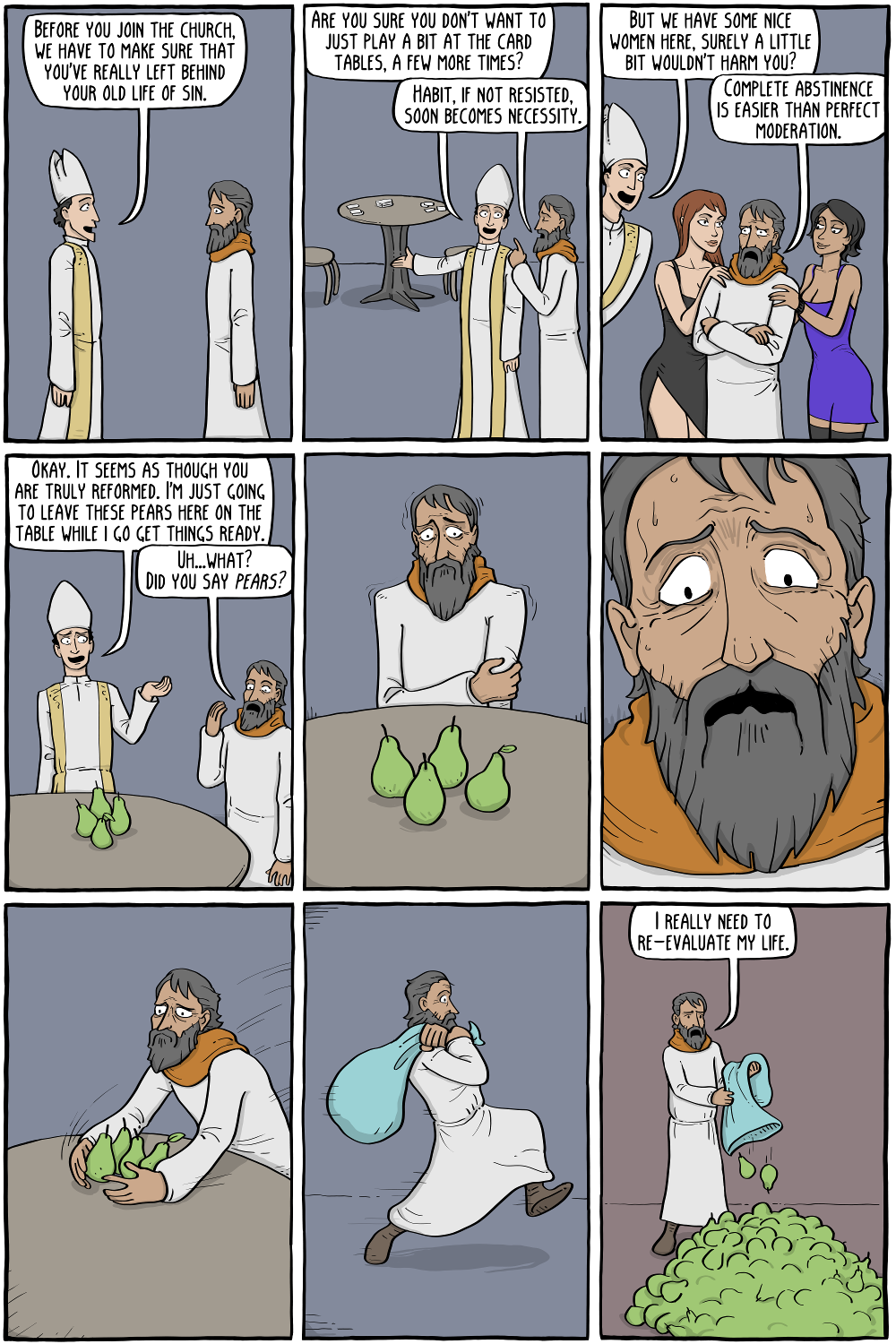
This is where I started going on a tangent about “Christian Society”, Civilization, and laws. If god doesn’t have the right to take away free will, isn’t it Hubris for humans to try to do so? Isn’t it wrong and evil to force people to do things they don’t want to or prevent them from doing what they want? Are all laws evil? Should a truly christian society not have any laws– just guidelines that follow the vibes of the Ten commandments (which weren’t commands because humans could clearly disobey them, they’re more like suggestions if one wants to be good). I think one of the comics slightly mimicked this idea with the off stage voice asking if the two religious figures would finally stop bugging us about what god supposedly thinks about gay marriage and stem cell research– it’s free will after all.
Of course, laws cannot actually stop people from committing crimes– they infringe on free will but cannot entirely block it. They just act as a severe punishment and therefore a general deterrent, which is almost worse than just outright preventing it. Would you rather only have one option or be blackmailed into choosing one when there are two? The threat and blackmail seems more traumatic to me.
Then I related all this to social media and the decline in partying among the youth. I started hunting for sources because I’ve heard it so many times. People don’t drink and party anymore for a number of reasons– expense of liquor, prevalence of other drugs of choice, health conscious– but most importantly for us is the fact that any evidence of partying that goes online, all the stupid acts you or someone else drunkenly chose to record, is there forever. It affects your future long past the painful hangover. It can prevent you from getting the job of your dreams.
Now, I had difficulty looking up scientific papers, likely because whenever I added ‘party’ to the google scholar search it immediately started talking about the youth vote and politics, but I did find few bits of evidence to say people are at least talking about it even if it hasn’t been conclusively studied. https://news.northeastern.edu/2025/08/18/why-people-are-drinking-less-alcohol/ and there has been a noticeable difference in the generations in alcohol consumption, although they don’t go into the reason why. https://onlinelibrary.wiley.com/doi/10.1111/add.70201
Delete4. What uniquely self-validating idea did Anselm say we have?
“Because we can conceive a god, (by the definition that a god is a being more powerful out there than anyone/thing else) there must be a god.” A very silly concept, because then we might be gods to ants, but we clearly aren’t gods to each other. What if the strongest thing out there is a king? Does that make him a god-king? Does that make him god?
What if our imaginations have limits we can’t comprehend? Will we never find a most powerful ‘god’? What if our imaginings are so much more powerful than what the universe can hold? What about imagining things forces them into existence? As I writer, I imagine things all the time. And perhaps they even take place on another plane of existence, (I don’t rule it out) but just because I think about it and type it doesn’t make it true. If I truly believed all my characters were out there somewhere, I’d be called delusional. Seriously, Anselm, listen to yourself for a moment.
5. Gaunilo criticized Anselm's reasoning using what example?
Gaunilo, much like I, criticized Anselm’s reasoning. He used an example of A Perfect Island. As perfect as you can imagine, and then even more perfect! (Why? Because it didn’t have people… Someone is far, far down the introvert rabbit hole). Just because you can imagine ever more perfect islands, that doesn’t force them to exist. You’re not that powerful. You’re not a god. The concept of a form doesn’t guarantee that the thing exists in any shape or meaning close to that form. It doesn’t even mean the form truly exists, all it means is you have an idea, a thought. You haven’t brought it into being simply by thinking about it, even in a plane no one can see.
BTW all this is 1.5 gdocs pages 1.15 spacing 11 size font
Still need to figure out how to do links properly...
DeleteYou can't do links in the comments section, unfortunately. You'll have to become an author on the site to embed links. You're welcome to, whenever you like (and everyone will have to, eventually, for the final blogposts).
Delete2. What does Boethius not mention about himself in The Consolation of Philosophy?
ReplyDeleteBoethius does not mention that he was an early christian in The Consolation of Philosophy. He does not mention his religious beliefs and intentionally adopts the voice of classical philosophy instead of Christian theology to provide universal comfort. I like that he did this, because now his teachings in The Consolation of Philosophy can be enjoyed by everyone without making them feel singled out by not being religious in any way.
3. Boethius' "recollection of ideas" can be traced back to what philosopher?
Boethius’ “recollection of ideas” can be traced back to Plato. In The Consolation of Philosophy, Philosophy reminds Boethius about truths that he already knew rather than teaching him things that are new to him. This is very similar to Plato’s theory that suggests that learning is the process of remembering things from a prior life.
6. What was Aquinas' 2nd Way?
Aquinas’ 2nd way was the First Cause Argument. The First Cause Argument postulates that because every effect in the world has a cause, the entire chain of existence must have an uncaused “first cause”, which is usually recognized as God. Other philosophers argued that the “first cause” didn’t have to be believed to be God. They just identify that the first uncaused cause had to be extremely powerful - it could’ve just been a surge of energy.
Section #1
DeleteAfter Augustine's Manichaean phase, he believed that people did bad because of free will, rather than god not stopping them. I definitely agree that people have free will and that's why some people do "bad" things. I don't think that god controls the actions of everyone on earth, he doesn't tell everyone what to think or what to do. Everyone is different, with different personalities and everyone makes different decisions. Everyday, goodness, is a choice that people make. In that same way, people choose "evil". Everyone has free will and chooses their actions, there's nobody else to blame.
ReplyDeleteRegarding Boethius's book, I think that right before death is an almost perfect time to write about philosophy. In moments before death, I can image that people are reflecting on their whole life. What everything meant to them, why things happened, how they lived their life, and just the general philosophy of the world. I think that's the time when people are painfully honest.
I love the concept of luck being ever-changing. It's really true, and I think it helps people stay both grateful and empathetic. You never know what the future holds and you should extend the helping hand that you want when you have a run of bad luck to those who are struggling. You may be safe and warm today, but it could be you on the streets tomorrow.
I'm also a big fan of the concept of nothing being terrible in itself. I do think that some things are just strictly terrible by themselves, but on a daily basis it really is just what you make of it.
Things are bad in consequence of the harm they inflict, and thus always in relation to something/someone other than themselves. Is that what you mean?
DeleteSection #1
ReplyDelete1. As a young man, Augustine followed the teachings of the Manichaean religion, which did not view God as an all-powerful being. Instead, the forces of good and evil are locked in a never-ending battle, each getting the upper hand in different places at different times. In humans, goodness comes from the soul, while evil comes from the body; if an individual does something wrong, it is because the evil forces in him are too strong to be defeated by the good forces. Since God is not all-powerful, He cannot be blamed for the evil that happens in the world. Later in life, Augustine began to see God as all-powerful, and evil as the result of man’s free will. Our free will allows us to be conscious humans, rather than puppets, and while we can choose to do good things, often we choose to do evil. Augustine’s explanation emphasizes the personal accountability we each have for the choices we make. With every action, we have the choice to either add to the evil that has already happened in the world, or add to the good.
2. I think it’s interesting that Boethius personified Philosophy as a woman in a time when philosophy was an activity that generally women did not participate in. I haven’t read The Consolation of Philosophy, but the purpose and symbolism of Philosophy reminds me of Beatrice in The Divine Comedy.
3. In Aquinas’s Second Way, the First Cause Theory, he argues that everything in the universe must have a cause. The table I’m sitting at is made from wood, the wood came from a tree, the tree came from a seed, and at some point long ago the first seed had to come from somewhere. But what caused the thing that caused the first tree seed? Aquinas believed the universe cannot be explained by an infinite regress, by a never-ending trail of causes. There had to have been a first cause that never had a cause, and that thing must be God.
1. How did Augustine "solve" the problem of evil in his younger days, and then after his conversion to Christianity? Why wasn't it such a problem for him originally?
ReplyDeleteIn his younger days, Augustine avoided believing that God wanted evil to happen. It wasn’t a problem for him originally because he was a Manichaean and didn’t believe God was supremely powerful; instead, he believed there was a never-ending struggle going on between the forces of good and evil. After his conversion to Christianity, he believed evil came from the fact that God gave us free will. He believed moral evil is the result of our choices and partly a result of Adam and Eve’s choices, being passed down as Original Sin.
3. Boethius' "recollection of ideas" can be traced back to what philosopher?
Boethius’ “recollection of ideas” can be traced back to Plato. Plato believed all learning is really a kind of recollection of ideas we already have, and we never actually learn anything new. This theory is interesting, and I’m not sure whether I agree or not. I have felt like I’ve learned things I’ve never heard before and things I couldn’t possibly have previously known. However, I could see someone also thinking about it this way: every new word we learn is a recollection of the way letters and sounds work together, with its definition becoming a combination of definitions of words we already knew. I think most things we learn have some connection to something we learn in the past and those connections help us remember them as a new thing, so I can see how this theory works, but I don’t think I necessarily agree. New things I learn become something new to me, but I also connect them to things I’ve already learned, so I’m not sure where I stand on this idea.
6. What was Aquinas' 2nd Way?
Aquinas’ 2nd Way from the Five Ways is the First Cause argument. He argued that everything was brought into being by some cause, and if we traced the chain of causes and effects all the way back, we would eventually find an uncaused cause and that the first cause must have been God. I feel like this theoretical kind of works with the big bang theory. Scientists have been able to (as far as I know) theoretically trace how our planet and the universe came to be what it is now, but something had to cause the big bang, and when I was taught about the big bang, we didn’t have an answer for that. In this way, I could see Aquinas’ First Cause argument working with this scenario.
Section #1
ReplyDeleteResponding to Discussion Questions
1) Do you think knowledge is really a form of remembering or recollection? Have we just forgotten what we knew?
I can't grasp the logic behind the idea that acquiring knowledge is a form of remembering something you already knew. Maybe I just forgot.
I agree with Socrates' process (questions ultimately lead to answers), but I fail to see how questions, and questions alone, without research (thought and experimentation), result in knowledge.
2) Are supernatural stories of faith, redemption, and salvation more comforting to you than the power of reason and evidence? Why or why not?
No, I have found such stories to have the opposite effect on me. If God, supernaturally, intervened to help humans in times of need, why doesn't he do so now? Therefore, I chose to believe God never intervened in the first place.
3) Do you find the concept of Original Sin compelling, difficult, unfair, or dubious? In general, do we "inherit the sins of our fathers (and mothers)"?
Yes, I find it dubious, misleading, and certainly unfair. I don't believe we necessarily "inherit the sins" of our parents, but I can see how we may inherit traits that could leave us more susceptible to making poor decisions.
And we surely inherit responsibility for ameliorating the consequences of our parents' sins, particularly when they've redounded to our social advantage.
Delete#2
ReplyDeleteLHP
2. What does Boethius not mention about himself in The Consolation of Philosophy?
What he doesn't mention in his book is that he was an early Christian. I think if he did, that would distract from his story of "Philosophy" coming in and telling him about God, that would give his writing a clear bias.
6. What was Aquinas' 2nd Way?
His second way is what he called the First Cause Argument. Simply, how did the world begin? What started it all? His argument says that there can't possibly be a never-ending chain of cause and result, something had to have started the chain. And if something did start the chain, it couldn't have been caused. And that has to be God. But then other philosophers come along and ask "Who created God? Where did God come from?" hence his uncaused cause. Today we have some more widely excepted explanations: The Big Bang Theory, Creation, Evolution, but people still ask the question "what caused that?"
Free Discussion
-What do you think of Boethius' proposed solution to the puzzle of free will, that from a divine point of view there's no difference between past, present, and future?
This is still a question that modern Christians ask, and it has a tricky answer, because there isn't a clear one. I think that's why this is a question that many philosophers ask and contemplate, it seems to go in circles. For me, I like to use an example to explain this. It works better in person and when I know them better. You have two choices of what to eat for lunch: Chick-fil-a or Dominos. (I change these options depending on the person so that one of the options is something they really like, so I know what they will choose) Then I ask them to decide in their head, but don't tell me. After they have decided what they want to "eat," I tell them what they decided to eat. When I say what they were thinking, I tell them that that's how free will and God work. I know you so well that I knew what your were going to choose before you did it, but I didn't influence your choice, you still chose that on your own. This is what God does, He knows you so well that He effectively "predicts" what you will do. I don't really know much about the "seeing all of time at once" that's explained in the book, so I can't comment on that, but God does exist out of time as we know it. He can't be constrained to the time He created.
1. How did Augustine "solve" the problem of evil in his younger days, and then after his conversion to Christianity? Why wasn't it such a problem for him originally? He said that evil is caused by free will. Evil would not exist if there were not evil people to do evil, God doesn't stop it because it would stop our free will.
ReplyDelete2. What was Aquinas' 2nd Way? He simply states that everything had to start somewhere, so why not with God? The author points out the hole that everything couldn't have just started randomly. Why can't Earth be the starting point? I would argue that the flaw in his counterargument is that he is trying to prove God using only logic without looking around the world for the evidence of God.
3.What uniquely self-validating idea did Anselm say we have?
He argued that if we can imagine a perfect being than one must exist.
1. How did Augustine "solve" the problem of evil in his younger days, and then after his conversion to Christianity? Why wasn't it such a problem for him originally?
ReplyDeleteAugustine originally "solved" the problem of evil in his younger days by adhering to the ideas of the Manichaeans. The Manichaeans believed that evil and good were constantly battling each other, and that evil ended up prevailing in certain instances. This is how evil things happen: by the forces of good slipping up from time to time. After Augustine’s conversion to Christianity, his solution to the problem of evil in a world with a good God was the concept of human free will. God has ultimate control over everything, but He chooses to allow humans to make their own choices, whether they are right or wrong. This “solution” was not such a problem for Augustine originally because he was operating on an existing belief that others around him also adhered to. After he converted, he concluded the idea of free will on his own, and this process took a lot more time and thought than simply believing something he had heard from his youth.
2. What does Boethius not mention about himself in The Consolation of Philosophy?
Boethius does not mention that he was a Christian in his book, but this fact was nonetheless evident to his readers due to his emphasis on values that aligned with Christian beliefs. I wonder if he was deliberately trying to hide this fact and didn’t do a good job of it, or if he meant for it to be implicit in his work.
4. What uniquely self-validating idea did Anselm say we have?
Anselm said that because God is definitively “The greatest being,” if a person has an idea that any sort of God exists at all, then God must therefore exist in order to be greater than that person’s idea of Him. This argument is not very strong, due to the fact that it relies solely on the logical progression of ideas and completely ignores a basis in reality. Anselm’s proof for God’s existence is quite unfounded, and I’m saying this as a believer in God.
Little History of Philosophy
ReplyDelete1. When Augustine was younger, the problem of evil didn’t bother him much because he followed Manichaeism, which taught that good and evil were two equal forces fighting each other. In that view, evil was its own substance, so its existence didn’t need explaining. After converting to Christianity, Augustine rejected this idea and argued that evil is not a substance, but a lack or corruption of goodness. Evil exists because humans misuse their free will, not because God created evil itself. Honestly, this is one of the biggest questions I've had growing up and to be honest I haven't actually done my due diligence in experiencing the question.
2. In The Consolation of Philosophy, Boethius never mentions Christianity, even though he was a Christian. He does not refer to Christ, the Bible, or Christian doctrine, and instead relies entirely on classical philosophy and reason to deal with his suffering.
3. Boethius’ idea of recollection of ideas comes from Plato. Plato believed that learning is really a process of remembering truths the soul already knew before birth, and Boethius draws directly on this idea in his book.
5. Gaunilo of Marmoutiers criticized Anselm of Canterbury by using the example of a perfect island. He argued that just because we can imagine the most perfect island does not mean it must exist in reality. This was meant to show that Anselm’s logic could be used to “prove” the existence of anything, which makes the argument flawed.
2. What does Boethius not mention about himself in The Consolation of Philosophy?
ReplyDeleteBoethius does not describe God as a Christian God. Instead, he describes God as the pure form of goodness and as a woman named Philosophy. It is odd that Boethius, who was an early Christian, did not mention his God and instead chose a more neutral representation. I think it is possible that he wanted to appeal to more people than just Christians, so perhaps he left God as an ambiguous entity on purpose.
3. Boethius' "recollection of ideas" can be traced back to what philosopher?
Boethius says that Philosophy reminds him of what he already knows. This is similar to Plato’s idea that we never learn something new, but rather that we are constantly refreshing our memories. I find this idea fascinating. It makes me ponder the possibility that beyond my atoms and DNA lie memories from other lives, and that every new thing I learn is actually just a recollection of previous knowledge. I think that this sort of thought experiment shares similarities with reincarnation and requires some deep contemplation and creativity.
4. What uniquely self-validating idea did Anselm say we have?
Anselm said that because we have an idea of God in our minds, that alone proves his existence. He believed that God was the absolute best thing that could ever exist or even be conceived. His reasoning was that if we can think of a perfect God in our heads, then an even greater God must exist in reality, since God is greater than everything. I tried writing that a few different ways, and it still does not really make sense to me. While reading, I could not help but think of the mythical Loch Ness Monster. If I were to take Anselm’s rationale and apply it to the Loch Ness Monster, then because I can think of this creature in my head, and yes, it would be super cool if it existed in reality, then boom, now it exists. This seems really far-fetched to me. Gaunilo of Marmoutiers, a monk who lived during the same time period as Anselm, met his claim with skepticism as well. He offered a counterargument that imagining a perfect island does not prove the existence of that perfect island. Guanilo argued that by using Anselm's rationale anybody could try to prove anything.
#2
ReplyDeleteLHP- 4- Anselm stated that god exists because we question if he does. Therefore, if he didn't exist we wouldn't question if there was truly a God.
5- Gulino criticized Anslem's reasoning by using an example of a perfect island. He stated that people could imagine a perfect island but that doesn't mean it's real.
Discussion questions: Can the definition of a word prove anything about the world?
I don't think a mere definition of a word can prove anything about the world because everyone has different meanings to what a word means. Also, connotations can make the definition of a word sound different. Furthermore, people take definitions of words and make it their own. So how do we know what's true.
1.) In his younger years, Augustine did not see the problem of evil as much of an issue. At the time, he followed Manichaeism, which taught that good and evil were two real and opposing forces in the universe. Because evil existed as its own force, Augustine did not need to explain why a good God would allow it. Evil simply existed alongside good.
ReplyDeleteAfter converting to Christianity, this view no longer worked. Christianity teaches that God is entirely good and the creator of everything, so Augustine argued that evil is not a thing itself, but a lack of good. Evil comes from humans misusing their free will and turning away from God. I find this later view more challenging, since it places responsibility on humans, but it also avoids the idea that the universe is fundamentally split between equal forces of good and evil.
2.) In The Consolation of Philosophy, Boethius leaves out Christianity entirely. Despite being a devoted Christian and writing while imprisoned and awaiting execution, he never mentions Christ, the Bible, or Christian salvation. Instead, he relies completely on classical philosophy, especially Plato and Stoicism, with Lady Philosophy offering him comfort through reason rather than faith.
This omission feels intentional. Boethius seems to suggest that philosophy alone can provide consolation in the face of suffering and death. I find this surprisingly relatable, as it shows philosophy not as abstract theory, but as something meant to be lived with when everything else has been taken away.
3.) Boethius’ idea of the recollection of ideas comes from Plato. Plato believed that learning is not about gaining new knowledge, but remembering truths the soul already knew before birth. Boethius uses this idea to explain how humans can grasp eternal truths despite living in a changing world. In his situation, this idea feels especially powerful, since knowledge and reason remain with him even when his freedom and life are being stripped away.
Section H01
ReplyDelete1. How did Augustine "solve" the problem of evil in his younger days, and then after his conversion to Christianity? Why wasn't it such a problem for him originally?
A: In his youth, Augustine adhered to the principles of Manichaeism, a system of religion that didn't assign omnipotence to their creator. To assuage the qualm of complicit malevolence, Manichaeans asserted the existence of "a never-ending struggle going on between equal forces of good and evil." God and Satan were antagonizing counterparts who both possessed an equal, immense amount of power. Acts of evil in this world represented moments when Satan, or evil, has the advantage. However, according to Manichaeism, God would "return and triumph over evil again."
As Augustine grew older, he rejected Manichaeism and converted to Christianity. This shift explained God's tolerance of evil through the "Free Will Defense." As a stipulation of his own creation, God provided humans with the ability to act on their own will. When people abuse this freedom, evil begins to thrive and suffering runs rampant. This, Augustine seems to suggest, is the cost of autonomy. It also mitigates the blame placed on God for the deeds of people who choose to be "evil."
2. What does Boethius not mention about himself in The Consolation of Philosophy?
A: Boethius omits his faith in "The Consolation of Philosophy." As a Christian, his work and writings appealed to zealously religious philosophers. He is regarded as an integral figure in the bridge between Greek/Roman thinkers and the Christian philosophy that dominated Western ideology for a large part of the Middle Ages. So it is peculiar that he would fail to mention his devotion to Christianity. Perhaps he did so to frame important aspects of the Christian philosophy without labelling it as such, in order to draw attention exclusively to the value of the teachings presented.
3. Boethius' "recollection of ideas" can be traced back to what philosopher?
A: Boethius' "recollection of ideas" can be traced back to Plato, who believed that learning is simply a "struggle to recall what we knew earlier." Boethius applied this axiom to his former woes concerning his "freedom and public respect." While his public perception was out of his control, he was able to adjust his attitude toward the situation, an aspect of his life that he can control.
1. Augustine’s approach to the problem of evil changed after his conversion to Christianity. In his younger days, he thought evil was simply a lack of goodness, so it wasn’t a true “thing” in itself, which meant it didn’t really need explaining. After converting, he incorporated God’s goodness and human free will into his understanding, believing that evil exists because humans misuse the freedom God gave them. This shift shows how his religious perspective allowed him to frame evil as a consequence of choice rather than a flaw in God’s creation.
ReplyDelete2. In The Consolation of Philosophy, Boethius focuses on philosophical arguments about fortune, happiness, and God, but he avoids discussing personal details about himself. He doesn’t explain why he was imprisoned or give a full account of his political life, which makes the work feel more like a universal reflection than a personal memoir. This omission allows the ideas to stand on their own, emphasizing the philosophical lessons rather than the man’s biography. It’s interesting because it shows how philosophical writing can aim for timeless wisdom rather than personal storytelling.
4. Anselm argued that humans have the idea of God as “that than which nothing greater can be conceived,” and he claimed this idea is self-validating because it exists in the mind and must exist in reality. Gaunilo criticized this reasoning with the famous example of a perfect island, arguing that imagining something as perfect doesn’t prove it exists in reality. Both of these discussions trace back to Plato’s notion of innate ideas and recollection, which suggests humans already carry knowledge of ideal Forms within themselves. This connection shows how medieval thinkers adapted classical ideas to Christian theology.
Before conversion Augustine believed that evil was a substance, something that existed outside god, and after converting to christianity he changed his believes to essentially say evil is a misuse of free will give to us by god and that when we misuse our free will it becomes an absence of good, as god created all things good we created evilness by misusing the gifts god gave us.
ReplyDeleteBoethius, despite being a christian, never explicitly mentions christ or christianity. He keeps the work philosophical and classical rather than overly christian.
Plato and his platonic theory of recollection, anamnesis.
Anselm said that we have an idea that God as “that than which nothing greater can be conceived.” this is what he used to argue the existence of god.
Guanilo fought against this idea using an example of a perfect lost island, he argued that Anselm's logic could be used to falsely prove the existence of anything imagined as perfect.
Aquinas believes that since everything has a cause, and there cannot be an infinite regress of causes, there must be a first uncaused cause, which is God.
Section #1
DeleteSection #2
ReplyDeleteLHP 1: Augustine was originally a Manichaean, and considered evil acts in humans to be the byproduct of a greater struggle between a good God and an evil Satan. Human goodness and evil occurred when one of the two forces, forever locked in a stalemate, briefly gained an upper hand.
The Christian faith, however, portrays God as all-powerful, which means that evil is permitted to happen. Augustine theorized that suffering is permitted to occur because eliminating the choice between a good action and a wicked one means that humans have no free will. The human capabilities of reason and morality exist because we are meant to make our own decisions; these abilities would not be necessary if the good and virtuous options were the only ones available to us.
Is it better to embrace (or renounce) religious faith early in life, or to "sow your wild oats" and enjoy a vast experience of the world before committing to any particular tradition or belief? Were you encouraged by adults, in childhood, to make a public profession of faith? If so, did you understand what that meant or entailed?
ReplyDeleteAs a young child, I was taught Christian values and Sunday School stories, but as a whole, religion was only what I was told and nothing that entertained deep reflection. At 5, I had made a profession of faith, but looking back, could I have vowed something I didn't fully understand? It certainly seems easier to embrace faith early in life, but I see nothing wrong with waiting to commit; my first real profession of faith happened at 22 on my own accord. While this may still be early in my life, and my brain has more time left to cook, I'm not sure how long I will actually be around. As for "sowing your wild oats," I'm uncertain whether that makes finding faith easier. As for some, that is the perfect time to find faith
Section #2
ReplyDeleteLHP
I personally agree with Augustine. Even though God has the ability to stop evil from occurring, it would not be free choice if he did so. When the original sin was committed, and we drifted away from God, we gained the knowledge of good and evil. Having such knowledge but not being able to CHOOSE not to is arguably unjust. It is not really a free choice if the choice is made for you. If we think about this in an Earthly view, imagine that the rest of your life, with all the choices that you could make includinng the choice of even taking this class, was made by your parents. Nothing would really matter because everything you do is not really your decision, and you just have to live with the life chosen for you. However, this raises the question that if God can give humans free will, why can’t humans give humans free will? Should we abolish all laws and trust that humans will make the right decision? The way I like to think about this question is that God has the same systems as humans. Even though God may not punish you for your sins during your lifetime, he will punish you in the afterlife by separating you from him. This is similar to how we humans punish others AFTER a crime is committed. The rules and laws are there, people choose not to follow them, and then face the consequences afterward.
I have very mixed feelings about the concept of “recollection of ideas”. I agree that some ideas may have come from the past, but only in this lifetime. I do not agree with the concept of “past lives.” Maybe the “recollection” one is having is from an earlier concept taught as a child. I think that Deja vou and the concept of “recollection of ideas" are linked in some weird way.
Aquinas made a very excellent point about regression: it is difficult to follow and understand. If you tried to trace the universe all the way back, there has to be a starting point—something or someone that always was, out of time and space. Human brains are simply unable to rationalize this concept. For me, it is God. For others, it’s the big bang. Whether you agree with God or not, it is plausible to think that something or someone started it all.
I answered three questions, but when I clicked post the numbers went away.
DeleteI think the paradox with this ideology is that although it is moral for God to give his creations free will (or else we would be under some pseudo-slavery), it is unkind for a creator to create knowing that harm can be done. There is no direct benefit from having a creation exist with free will on the chance that it could receive or release harm from / into the world. Essentially there is no explanation as to why evil must exist. Could we not have free will without the existence of free will? For example choosing between vanilla or chocolate ice cream is using my free will, but neither option is inherently evil, one just might provide me with more happiness than the other.
DeleteSection #3 Spencer Hebel
ReplyDelete1. Augustine “solved” the problem of evil through his first religion, which believed that there were both good and evil forces that were constantly in a war, and that evil deeds simply came from places in which evil forces were winning. When he converted to Christianity, that didn’t sit right with him, and he had come upon the conclusion that evil came from God’s blessing of free will onto humanity. The evil of the world came from Adam and Eve’s original sin, which was then passed onto all of humanity through reproduction. Originally, he never struggled with it due to how his beliefs had functioned. He had not yet come upon the conclusion that God was all powerful, meaning that it was feasible for God and Satan to constantly be in a battle.
4. The self-validating idea that Anselm had was that God had to exist because if he were to be the greatest being ever, greater than comprehension, that if we could imagine God, there must be a real one, outside of imagination. This is a bold claim due to the perfect island idea, which shows that just because something better can exist than imagination doesn’t mean it really exists. Anselm’s reasoning was that God was the one idea that truly cannot be grasped, making Him even greater still than the perfect island.
3. The recollection of ideas theory is traceable back to Plato, as he believed that everything is simply a recollection of something that we learned already. This is a unique way of thinking that I don’t think I could ever personally see being true because it is innately human to learn new things every day, even if you boil the basic functions down to things you already know, the neural pathways that are formed in utilizing your body in new ways to achieve new tasks is still learning how to do new things.
Hello Spencer, I agree that Anselm thought that God had to exist because if it's the greatest thing ever then he must have to exist. I also think that the perfect island argument was a good counterargument to this claim.
Delete(section 1)
ReplyDelete"Would the existence of evil equivalent to good, without guarantees of tthe inevitable triiumph of the latter, solve the problem of suffering?"
I believe it would solve the problem although i don't believe that is the case.
What do you think of the Manichean idea that an "evil God created the earth and emtombed our souls in the prisons of our bodies"?
I believe that is completely wrong, I believe that God created us to be made in his image and perfect in his eyes, but humanity screwed it up, I like augustine's idea of the original sin being passed on from generation to generation by sexual reproduction.
Do you agree with Augustine about "the main message of Christianity...that man needs a great deal of help"? (DR 395). If so, must "help" take the form of supernatural salvation? If not, what do you think the message is? What kind of help do we need?
Yes, but i think there is more to it, I believe that we not only need help in salvation but in our day to day quest to maintain morality; that in recent times the default back to absolute evil has become more clear day by day.
I agree with the last sentiment you shared. I believe this is why all religions exist. Different people require different methods to reach salvation. What works for one person may not work for the other. For example both an atheist and a buddhist share the same goal of eternal peace, but have different means of getting there.
DeleteSection 3:
ReplyDeleteWhat uniquely self validating idea did Anselm say we have?
Anelm claimed there is one thought in our heads that behaves differently from all others. We can imagine ordinary things vanishing, such as ourselves, or the sun. We can’t coherently imagine the greatest possible being not existing, because a being that could fail to exist is weaker than one that couldn’t. He claimed this is proof God can’t not exist.
How was religion in America, unlike Europe, non binary?
In Europe, the ruler’s religion is the territory’s religion. In Europe, each country had one official church supported by the government. You had to be a member of the Church or you were a dissenter and unable to be a part of society. The American Constitution forbade the government from having an official church. No church or religious practice was illegal either. This prevented theocracy.
What fundamental and non western sense of time has underpinned much of human history?
The dominant sense of time across human history has been cyclical, viewing time as recurring rather than as a line running from beginning to end. In a cyclical framework, time is understood through patterns and recurrent events that govern human life; day and night, moon phases, seasons, harvest, birth, and death. Everything here returns, so time is understood as returning too. Events are viewed as recurring; what has happened before will happen again.
My belief is that Boethius had the most realized take on the God - Human dynamic. This belief has been reaffirmed by the teachings of Socrates and Aristotle. I believe that Humans are limited by causation and the illusion of time, which is why we face so many moral dilemmas, a belief echoed indirectly by all three philosophers above. Boethius knew this, which is why in his final moments he was peaceful. When we base our happiness off of things that cannot exist outside of time, such as money, fame, material items, etc, we subject ourselves to sadness. These worldly things come and go because they are transient. When we dedicate our lives to achievement impermanent objects we wonder why it feels impossible to become eternally happy. The phrase money cant buy happiness is a prime example of this phenomenon. It is not uncommon for even the richest of the elites to suffer from depression because the material world only temporarily fills emotional unrest. We also are always in search of cause. Because we exist in 4-dimensions we cannot imagine anything without causation. To us, every effect must come from something. Molecules come from atoms, which come from protons and electrons, which come from quarks. There is always a smaller unit to be discovered because the cause of all reality exists outside of time. There is no "beginning of all" because that too would require a beginning. There just "is".
ReplyDeleteHello Vi, I find it cool how you say we exist in 4 dimensions and cannot imagine things outside of our dimensions. I also agree that a cause must have happened for things to start happening.
DeleteSection 3
ReplyDeleteDo you think you have a clear idea of what it would mean for there to be an all-knowing, all-powerful, all-good supernatural being?
No. I could see a being having only two. If they are all-knowing and all-powerful, then they couldn't be all good, as we’ve seen bad things happen. If they are all-knowing and all-good, then they are not all-powerful and would not be able to intervene in bad things. If they are all-powerful and all good, then they are not all-knowing and would not possess the knowledge to know what needs fixing. However, I recognize that this is incredibly limited and myopic. I believe that if there is a god, he wouldn’t intervene at all and would have simply made the universe at its beginning and then be done. No good or bad, no morality involved. Simply the ‘in-between’ of what science can’t answer. Nothing to do with religion, which is an entirely manmade thing. But this is simply my view. I respect and envy people of other faiths.
Do you think knowledge is really a form of remembering or recollection? Have we just forgotten what we knew?
I find this idea to be ridiculous. I don’t think we knew anything before we were born. Even stuff that is up to instinct isn’t a matter of knowledge at all. You start making memories and connections the second you gain experience. There is also too much knowledge to hold in our brains; if we really knew things and were just remembering them, then we would all in this moment hold everything we could ever know, right now. Which I truly can’t fathom to be the case.
How did Augustine "solve" the problem of evil in his younger days, and then after his conversion to Christianity? Why wasn't it such a problem for him originally?
He solved it by being a Manichaean, which is a religion that believes that god and satan are always fighting. But since they are equally powerful, no one ever wins, which is why there will always be both good and evil. To me, this feels like a Greek mythological lesson used to explain things to kids. I don’t find much truth in this at all personally. Perhaps on a real level, there is some truth to the idea as to why there will always be bad in the world: because good and evil are equally powerful and will always fight. But I will have to think about this more as a whole in day-to-day life and see what I think holds more power. It is a very interesting concept, one that I have never thought about too much
Section 3
ReplyDeleteLHP
1. In his younger days, Augustine followed Manichaeism, which explained evil as an independent force opposed to good. After converting to Christianity, he argued that evil is not a substance but a privation or lack of goodness, resulting from the misuse of free will. Evil was not originally a major problem because Manichaeism already provided an explanation for its existence.
4. Gaunilo used the example of a perfect island, arguing that Anselm’s reasoning could wrongly “prove” that such an island exists.
5. Aquinas’s Second Way argues from efficient causes: because nothing causes itself and an infinite chain of causes is impossible, there must be a first cause, which Aquinas identified as God.
Hello, I agree that Augustine followed Manichaeism and that's what explain his good vs evil ideas.
DeleteSection H01:
ReplyDelete1. When Augustine was younger, he believed that evil was its own force fighting against good, so it wasn't as much of a problem for him. After converting to Christianity, he believed that evil came from people misusing their free will and choosing to do wrong.
3. Boethius' idea of recollecting knowledge comes from Plato. Plato believed that learning was really about remembering things that the soul already knew.
4. Anselm believed that we have the idea of God as the greatest possible being. He thought that if we can understand this idea, then God must exist in reality and not just as an idea in our brain.
Section 2
ReplyDelete3: Recollection of ideas can be traced back to Plato's theory that we never truly learn, we just recall what we already knew. I can't fully understand or believe this; to me, new experiences shape my understanding and build on what I interpreted in the past. It is not that I already knew something; it is that I had not fully seen or understood it.
Questions: Section 2#
ReplyDelete2. Boethius does not mention that he was an early Christian in The Consolation of Philosophy. It is a bit puzzling why he does not mention his belief because it would be directly akin to his philosophy. Either way, his Christianity was apparent in his writings according to later readers.
3. Boethius got his recollection of ideas from Plato.
6. Aquinas' second way was the First Cause Argument. The First Cause Argument was that everything that there is has a cause of some kind that made it or brought it into being.
Section 1
ReplyDelete1.When he was a child, Augustine believed that evil was an independent force that was fighting against good. However as he grew up and converted to Christianity he believed that evil was just people misusing their free will.
Are supernatural stories of faith, redemption, and salvation more comforting to you than the power of reason and evidence?
I think that I do find supernatural stories of faith and salvation more comforting than the power of reasoning and evidence because it puts situations in the hands of a higher power. I think that believing that a situation is in the hands of someone more divine than me allows me to worry less about the future, and therefore brings me a sense of comfort.
Would the existence of evil equivalent to good, without guarantees of the triumph of the latter, solve the problem of suffering?
I do not think that an equal balance of good and evil would solve the problem of suffering. I think that a balance of good and evil in this case would mean that a person can still suffer, but that for every moment of suffering that they face they will then have an equal moment of joy. So while I don't think equal parts evil and good would end suffering I do think that it would make suffering more bearable because a person would know that eventually they would have happiness again.
Section 1
ReplyDelete1. How did Augustine "solve" the problem of evil in his younger days, and then after his conversion to Christianity? Why wasn't it such a problem for him originally?
He prayed for god to relieve him of his desires but later in life because he still enjoyed them at the moment. Originally it was not problematic because he was not always christian.
2. What does Boethius not mention about himself in The Consolation of Philosophy?
He doesn't specify his religious orientation.
3. Boethius' "recollection of ideas" can be traced back to what philosopher?
Plato and his theory of forms
4. What uniquely self-validating idea did Anselm say we have?
Because god is the greatest being imaginable, he must exist; otherwise, there would be a greater being.
5. Gaunilo criticized Anselm's reasoning using what example?
He used the perfect island example that follows the same logic as Anselm's claim, explaining how imagination cannot validate legitimate existence.
6. What was Aquinas' 2nd Way?
His idea that God could be the only explaination as the cause to why everything exists.
H03
ReplyDelete1. In his younger years, Augustine viewed "evil" not as something that could be stopped with the power of god, but rather a force that naturally happened with "good". Since it's a natural force, there's not much you can do about it and therefore shouldn't worry. After converting to christianity, he flipped that view to say that "evil" was just the misuse of the freedom god gave. As such, it became an issue where people actively chose to do evil, and therefore was a problem.
2. He didn't mention that he was christian.
3. The "recollection of Ideas" comes from Plato.
4. That god must be real, because if he isn't then that means there's something greater than god.
1. How did Augustine "solve" the problem of evil in his younger days, and then after his conversion to Christianity? Why wasn't it such a problem for him originally?
ReplyDeleteIn his younger days, Augustine was a Manichaean, and Manichaeans did not believe that god was an all powerful being, but rather that good and evil were in a neverending battle for control. Once he converted to christianity, he reasoned that god has given humans the gift of free will. And since they can choose to be good and follow god, they can also choose evil. Therefore, evil as far as humans are involved is solely our fault.
2. What does Boethius not mention about himself in The Consolation of Philosophy?
Boethius does not refer to christianity, even though he was a Christian. He instead refers to a woman he calls philosophy explaining God to him. I found what Boethius claimed particularly interesting, because the concept of an eternal afterlife and God in the way we view time often perplexes me. But the idea that time is completely different to God than the way we see it in this reality is very fascinating and hard to wrap my head around.
3. Boethius' "recollection of ideas" can be traced back to what philosopher?
Boethius’s ideas can be traced back to Plato, who thought that you don’t really ever learn new things, you just recollect and reflect. This reminds me of the fact that Plato thought there was the physical reality, and then the reality that exists in your mind and philosophy. Since everything we think and observe comes from our consciousness and the senses we observe, this makes a lot of sense to me but also makes me ponder the metaphysical level of this reality.
4. What uniquely self-validating idea did Anselm say we have?
Anselm believed that since we can conjure up an idea of god in our heads, he must exist and be even better than we can even imagine. Why would we question the existence of something if it was common knowledge that it wasn’t real?
5. Gaunilo criticized Anselm's reasoning using what example?
Gaunilo, a monk, countered Anselm’s reasoning by arguing that if there was a perfect island, we could not say it existed just because it existed in our heads. I agree with him. While Anselm is compelling especially if you wholeheartedly believe Plato’s theory that you never learn anything and that it’s all already in your head, I think it is also clearly a logical fallacy if you are observing it from an unbiased perspective.
I am very compelled by Boethius’s book, especially combined with his adoption of Platonic philosophy. I find myself quite interested in the argument of time. I once heard someone say that instead of viewing time as linear in whatever reality god resides in, we should try and see it circular. This is still so hard to wrap my mind around, but also somehow makes a lot of sense to me personally.
1. How did Augustine "solve" the problem of evil in his younger days, and then after his conversion to Christianity? Why wasn't it such a problem for him originally?
ReplyDeleteWhen Augustine was younger, he followed Manichaeism, which taught that good and evil were two different forces fighting against each other. This gave him an explanation for why evil existed because evil was considered its own force and was not created by God. After Augustine converted to Christianity, he changed his view and believed that evil was not a thing or substance on its own, but rather a lack of good. He believed that God created everything good, but humans have free will and can choose to turn away from that good. Evil therefore comes from the misuse of free will. Originally, the problem of evil was not as difficult for Augustine because Manichaeism gave him an explanation that evil existed as a separate force from good.
2. What does Boethius not mention about himself in The Consolation of Philosophy?
Boethius does not mention that he is a Christian in The Consolation of Philosophy. Even though Boethius was a Christian, the book mainly discusses philosophy and his ideas about happiness, suffering, fortune, and God without directly identifying himself as a Christian.
3. Boethius' "recollection of ideas" can be traced back to what philosopher?
Boethius' idea of the recollection of ideas can be traced back to Plato. Plato believed that learning is a process of remembering knowledge that the soul already had. Boethius uses a similar idea when discussing how people can recover knowledge that is already within them.
Section 2
ReplyDelete1. How did Augustine "solve" the problem of evil in his younger days, and then after his conversion to Christianity? Why wasn't it such a problem for him originally?
In his younger days Augustine followed the religion of Manichaeism. In this religion, they didn't believe that evil was necessarily a problem because they didn't believe that God was all powerful over both good and evil, but that they were two didn't forces fighting against eachother. After his conversion to Christianity, he believed that the power of free will gave you the choice to be good or evil, as it is shown in God's eyes.
2. What does Boethius not mention about himself in. "The consolation of philosophy"?
He didn't mention Christian religion. The book was supposed to mainly discuss philosophy, but his belief in God remained hidden throughout the text.
3. What was Aquinas’ 2nd way?
Aquinas’ 2nd Way was known as The First Cause Argument which serves as the starting point of existence. It states that everything in existence has a cause because it exists and it was brought into being.
Robert Orr, Section 2.
ReplyDeleteIn response to the comic about understanding God's nature, it is true that humanity cannot comprehend the full nature of God. This does not, however, mean that God is incapable of making his will known in terms man can understand, nor that man is incapable of recognizing when clear cases of when God has done so. Though I don't know anything about the controversies surrounding stem cell research, I do know that God has made clear that ideal, fulfilling sexuality is shared between a faithfully married man and woman, and that anything other than that is unhealthy.
On the question of whether the existence of suffering implies either that God is inferior or equal to Satan, or that neither exist:
God exists; that much is undeniable. While He is not inferior to Satan, his commitment to free will gives - one might say - an advantage to Satan's scheme to draw humanity away from prosperity in relationship with God.
God created us that we might share in His presence and the joy of creating, but to be truly able to love God, it must be a choice. We are the children of God, and as a Good Father, God wishes for us to grow mature enough to choose good without him strong-arming us into it. This of course does leave open the door for evil to be chosen, and so suffering and heartbreak result.
Section 2
ReplyDeleteLHP Chapters 6-8
1. How did Augustine "solve" the problem of evil in his younger days, and then after his conversion to Christianity? Why wasn't it such a problem for him originally?
When he was younger, Augustine was a Manichaean, believing that there was a never-ending power struggle between God and Satan, so he wasn’t concerned with the idea of evil. After his conversion to Christianity, Augustine believed instead that there was evil, which wasn’t the work of a devil, but the product of free will. God did not predestine actions on Earth, he merely views them, all of them all at once. God gave us free will to make our own choices.
3. Boethius' "recollection of ideas" can be traced back to what philosopher?
Boethius’ belief that knowledge is remembered can be traced back to Plato, who believed that learning is just a recollection of ideas we already have.
6. What was Aquinas' 2nd Way?
Aquinas did not believe that there was an infinite regress, or a cause for every effect, because there must be a first cause, an uncaused cause, which must be God.
Section 3
ReplyDelete1. Augustine solved the problem of 'evil' by following the belief that God and Satan were in a never-ending battle for good and evil, so God wasn't responsible for the bad things that were to occur throughout the world.
2. Boethius does not mention does not mention christianity and his faith within that.
3. Boethius' "recollection of ideas" can be traced back to Plato. They believed that everything is a collection of the old. Ideas we already have and things we are already knowledgeable of
Section #2
ReplyDelete1.) Augustine believed in his younger days that there was a never ending battle between good and evil, or God and Satan. Evil would sometimes lead the battle, causing the bad things in the world to happen, but good would still prevail, allowing for the good things in the world. Later, Augustine rejected this believe because he couldn't understand why God couldn't just win the battle if he was really an all powerful being. He then started believing the idea that God gave humans free will, and humans sometimes use that free will to do bad things, which is where the evil comes from. God can't stop humans from exercising their free will or else all humans would just become like his puppets. These questions originally weren't a problem for him for a couple reasons, one being that he was a Manichaean instead of a Christian, and two being that he was afraid of believing in the wrong thing and going to hell.
2.) In The Consolation of Philosophy, Boethius does not mention that he is a Christian. I think he did this so his book could appeal to people of different religions rather than only to Christians. It left the interpretation of Philosophy's God to be anything, including the pure Form of goodness that Plato believed in.
3.) Aquinas' 2nd Way was the First Cause Argument, which said that everything had to have a cause, and those causes had to have a cause. For example, the universe had to exist because of a cause, which we now know to be the Big Bang, but, Aquinas claims, something would have had to cause that too. You can go back forever to see the causes, but what caused the very first cause? Aquinas believes that the very first cause of everything had to be God, and that God wasn't caused from anything, rather God is the uncaused cause. I personally have wondered about this before, but I always come back to the question of what created God? The answer is supposedly that nothing did and that God has just always existed, but that deeply puzzles me. I just can't wrap my head around the idea of God just existing by himself for eternity until one day he just creates the universe. What did he do before he created everything? Did he one day open his eyes and start existing, or has he existed infinitely with no starting point?
Section 2
ReplyDelete1. When Augustine was younger he considered himself as a part of the Manichaeans, believing that God and evil were equally powerful. These two powers were constantly at battle with eachother so the evil that was found around the world was due to the moments where good couldn't "beat" the evil forces. This helped explain how evil could exist in a world created by God. Later in life he transitioned to Christianity and he understood the concept of free will. He began to believe that free will allowed humans freedom of decisions, and through our choices there is always room for "evil". I think that it is interesting how different religions incorporate into philosophical ideas and from there more answers are able to be "answered" in one way or another.
2. Boethius doesn't mention that he is Christian. He brings up a question that I have never heard before and stumped me. If God is "all knowing", is free will and the ability for us to make choices all an allusion? I think that the proposed answer to this in that God sees everything in a timeless point of view being past, present, future, creates a good solution to align with Catholic teachings ensuring that we do always have free will.
Section 2
ReplyDelete1. How did Augustine "solve" the problem of evil in his younger days, and then after his conversion to Christianity? Why wasn't it such a problem for him originally?
He first looked to Manichean ideals about how good and evil were constantly in battle with one another, but came to reject it when he converted to Christianity. Then human's free will was his solution to why there was evil in the world.
2. What does Boethius not mention about himself in The Consolation of Philosophy?
He doesn't mention being a Christian.
3. Boethius' "recollection of ideas" can be traced back to what philosopher?
Stoic philosophers, but mainly Epictetus.
Tyler Scherr - H02
ReplyDeleteLHP
5. He used the example of the perfect island, an island that you can imagine but surely does not exist and you can't verify its existence on the sole idea that you can imagine it. However the response was that God is the best of everything and therefore couldn't not exist in some aspect.
6. The First Cause Argument: How do you explain everything around you In the absence of a god, because everything was made by something else?
Section #2 (1pm)
ReplyDeleteLHP
1. Augustine had asked God to make him stop having sexual desires. But he also asked to wait because he still enjoyed worldly pleasures. In his younger years, he was a Manichaean which believed God was not all powerful. He later rejected these ideas. In his younger years evil was not a problem because he believed God was not supremely powerful against evil.
2. Boethius did not mention that he was an early Christian.
3. The "recollection of ideas" comes from Plato.
Tyler Scherr - H02
ReplyDeleteDiscussion Question 4.
I have always struggled with the idea of an all knowing and powerful being consistent with the Christian concept of "God". I don't follow a typical religion so my grasp of the concept would also be different from those of other people. In general the idea doesn't seem impossible to me, however I would have trouble explaining the implications of such a being. The biggest part I don't think I could understand from a Philosophical standpoint would be The First Cause Argument. If there is an all knowing and all powerful being, then how did it come to be? I know this concept is explained in a few religions but the two can't seem to coexist in my mind, because if you believe in The First Cause Argument, then something had to have caused the God to exist, but it creates a paradox from texts like the Bible that reference them being the first existence. (Been a while since I looked at a bible but pretty sure this is accurate.)
well I'm a Christian so my very Christian response to that is that God always has and always will be. however. I know this isn't an acceptable answer so ill try to do a little bit better. the timeline we live on is linear, not circular. no individual is repeating their lief over and over and i know some people will try to argue that but there isn't any real reason behind that concept. the way i see it is that because time is linear something had to have been at the start of time and that something is something outside of time that we cant comprehend. especially when tied with the first cause argument because at least based on my religion God wasn't caused he was the thing outside of time that we cant understand that was the first cause and to then ask what caused God then refutes what a god is. God is non contingent being that doesn't require anyone or anything to be here while everything else is contingent and required him to be here. also you don't have to agree with the idea that it was the Christian God I'm just using that because of my faith but the main idea is that there is some being that started our linear timeline that we cant comprehend and I just happen to believe that it is the Christian God
DeleteBoethius does not mention anything about Christianity despite the fact that he is one which seems very strange when considering the fact that most people who are Christians will try to preach and prove their faith, but it does seem somewhat reasonable considering the fact that many will simply argue with you if you claim to be Christian. because of this if he first brought up good points and ideas that people respected and agreed with without knowing he was Christian as he did not proclaim to be one and then if he happens to be Christian afterwards then...
ReplyDeleteSection #3 (2:40 P.M.)
ReplyDeleteLHP
1. In his younger days, Augustine embraced the idea of Manichaeism. The religion believed that God was not an all-powerful being, being taught instead that the universe was caught within a battle between good and evil. However, after his conversion to Christianity, he began arguing that an all-good, all-powerful God granted humans free will, and that evil was a consequence of humans using their free-will to make immoral choices.
2. Boethius had never mentioned that he was a Christian, nor did he reference any Christian principles, despite the fact that he was one.
3. Boethius' "recollection of ideas" can be traced directly back to Plato, as Plato famously argued that all learning is a recollection of innate knowledge that our souls had forgotten upon entering the world.
1. Augustine first started off believing the Manichaean approach. This included the idea that evil came from the body and goodness came from the soul, explaining sin. They didn't believe hat God had power over everything. Later in his life, he began to question why God couldn't overpower the evil in the body that made you commit sin.
ReplyDelete2. Boethius didn't mention that he was an early Christian. However, he talked about God, so it made readers have to come to their own conclusions about which God he was referring to.
3. Anselm believed that God had to be real because He was the greatest thing imaginable, and since you can't imagine anything better, then He must be real. Gaunilo challenged this by giving an example of the perfect island. Just because you can imagine the perfect island, it doesn't necessarily make that island real.
1. How did Augustine explain the problem of evil before and after converting to Christianity? Why wasn't it originally a problem for him?
ReplyDeleteWhen Augustine was younger, he followed Manichaeism, which viewed good and evil as two opposing forces. Because of this, evil wasn't really a problem for God in the same way, since there was another force working against him. After Augustine converted to Christianity, he no longer believed that evil was its own separate force. Instead, he believed that evil came from people having free will and choosing to do things that go against God. I can understand why he changed his mind about this. If people are able to make their own choices, then some of those choices are going to be bad. However, I don't think free will explains every kind of evil, especially things like illness or natural disasters that aren't caused by someone's choices. So I think Augustine's explanation makes sense in some situations, but I don't think it completely solves the problem.
5. What example did Gaunilo use to criticize Anselm?
Gaunilo criticized Anselm's argument by using the example of a perfect island. Anselm believed that if we can imagine the greatest possible being, then that being must exist because existing is greater than only existing in our minds. Gaunilo pointed out that we could use the same reasoning to imagine the greatest possible island, but that doesn't mean the island actually exists. I think this is a pretty convincing criticism because being able to imagine something doesn't automatically make it real. I can imagine an island with perfect weather, beautiful beaches, and everything else I would want, but that doesn't mean I could actually find it somewhere. I understand what Anselm was trying to argue, but I don't think the idea of something being perfect is enough to prove that it exists.
6. What was Aquinas' Second Way?
Aquinas' Second Way was his First Cause argument. He believed that everything has a cause, but nothing can cause itself, so there must be a first cause that started everything else. He believed that this first cause was God. I can understand why this argument might seem convincing, but I still have some problems with it. If everything needs a cause, then I think it's reasonable to ask what caused God. I know Aquinas would say that God is the first cause and doesn't need one, but that seems like an exception to the argument. It also seems possible that there is something else we don't understand that could explain how everything began. I think there may be a first cause, but I'm not sure that means we can automatically say it was God.